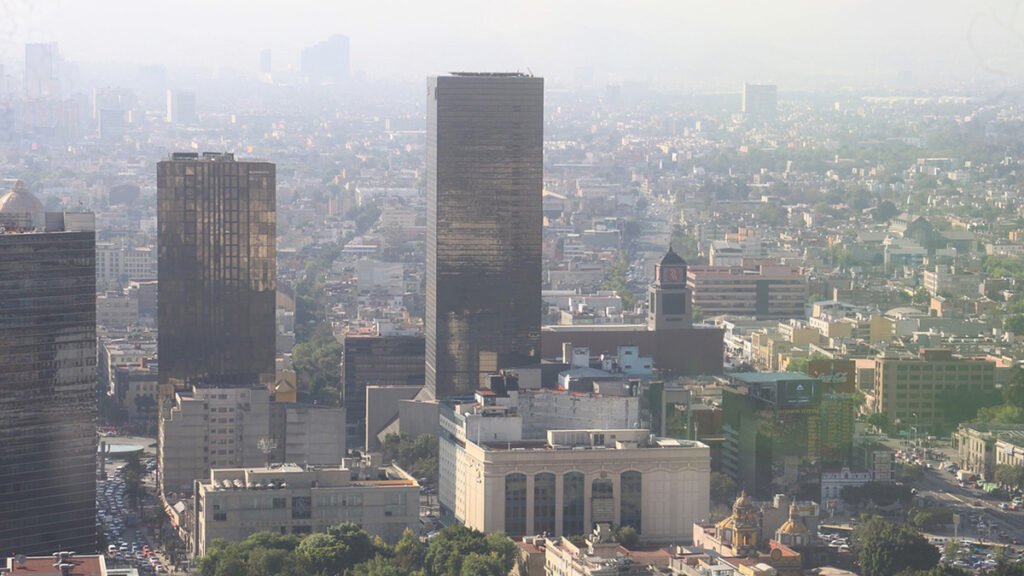
Mexico City has an atmospheric puzzle: Air quality policies have significantly reduced concentrations of many primary pollutants such as carbon monoxide, sulfur dioxide, and nitrogen oxides, but decreases in the amount of ozone, a secondary pollutant, have leveled off in recent years. This apparent contradiction is part of what the scientific literature describes as the “ozone paradox.” Could air temperatures be the key to this conundrum?
The ozone paradox has implications for health and safety. Unlike stratospheric ozone, elevated ozone concentrations near ground level are associated with respiratory tract inflammation, increased susceptibility to lung infections, and aggravation of existing respiratory diseases. Further, ozone can impede the growth of certain plants and can make them more vulnerable to disease and damage from insects and severe weather.
Ozone in the troposphere remains a challenge for Mexico City’s public health and policymakers. Unlike other pollutants emitted directly from car exhaust or industry, ozone forms when precursor pollutants such as nitrogen oxides (NOx) and volatile organic compounds (VOCs) interact with sunlight through photochemical reactions. Under favorable atmospheric conditions, more heat and more sunlight can increase the efficiency of ozone formation. As temperatures rise, so does the efficiency of atmospheric reactions related to ozone production. This dynamic was identified decades ago [Sillman and Samson, 1995; Jacob and Winner, 2009; Nolte et al., 2021] and reaffirmed by our most recent analysis of atmospheric data collected in the Mexico City area between 2000 and 2021 [Castro et al., 2025].
Our data revealed that high-ozone episodes occur most frequently at the end of the dry season, particularly during April and May, and again in winter. The April–May peak coincides with intense solar radiation and rising ambient temperatures, creating ideal conditions for ozone formation. The winter peak, on the other hand, is related to atmospheric stagnation and a compressed boundary layer that traps pollutants near the surface [Castro et al., 2025].
A Complex History of Air Pollution
The ozone paradox is especially relevant in Mexico City because the region has a long and complex history of air pollution management.
The ozone paradox is especially relevant in Mexico City because the region has a long and complex history of air pollution management. The metropolitan area, located at high elevation and surrounded by mountains, has meteorological and topographic conditions that often limit pollutant dispersion.
During the late 20th century, the city became widely known for severe air pollution episodes associated with rapid urban growth, industrial activity, traffic emissions, and frequent atmospheric stagnation. Since then, air quality policies have substantially improved the situation, but ozone remains one of the most persistent challenges.
For more than 20 years, Mexico City has addressed these issues with ambitious environmental policies. The city’s comprehensive “ProAire” programs, for example, included expansion of the Metrobús system, reforestation efforts, and environmental education. Additionally, the city introduced requirements for low-sulfur fuels, vehicle inspection programs, and measures to reduce industrial and transportation emissions.
These efforts should not be underestimated. They have successfully reduced several ozone precursors and primary pollutants and represent one of the most important urban air quality management experiences in Latin America. Mexico City’s long-term air quality monitoring network has also made it possible to evaluate the effectiveness of these policies and to identify new atmospheric challenges as they emerge.
So why do ozone levels remain high, even when levels of its precursor pollutants decrease?
Scientists have concluded that the missing piece of the puzzle may be temperature. The average maximum surface temperature in Mexico City’s metropolitan area increased from 32.5°C to 33.2°C between 2000 and 2021. This increase of almost 1°C, although modest, acts as a catalyst, accelerating the chemical efficiency of ozone formation [Sillman and Samson, 1995; Jacob and Winner, 2009].
Ozone is becoming a defining pollutant of a warming and chemically complex urban atmosphere.
The COVID-19 lockdown offered an unusual opportunity to study this phenomenon. During this period of reduced mobility, emissions of several primary pollutants decreased, but ozone did not decline in the same proportion. These data indicate that reducing NOx alone reduces the chemical removal of ozone by nitric oxide, but VOCs, sunlight, and high temperatures continue to favor ozone production [Peralta et al., 2021].
Mexico City is not an isolated case; other large urban regions around the world have also faced difficulties reducing ozone, even after achieving important reductions in primary emissions. A study of air quality during the COVID-19 lockdown in northern China saw similar results: Surface-level quantities of NOx decreased by about 60%, while surface-level ozone increased by a factor of 1.5 [Shi and Brasseur, 2020]. This broader context suggests that ozone is becoming a defining pollutant of a warming and chemically complex urban atmosphere.
Quantifying the Relationship Between Heat and Ozone
A relatively small temperature increase can have a disproportionately large effect on ozone formation.
Using data from the RAMA (Red Automática de Monitoreo Atmosférico) and REDMET (Red de Meteorología y Radiación Solar) networks, we identified a clear exponential relationship between ozone concentrations and temperatures in Mexico City between 2000 and 2021 (Figure 1), with a model fit to the data explaining more than 70% of the variation in peak ozone levels. Essentially, each additional degree of warming produces a progressively larger peak in ozone concentration [Castro et al., 2025].
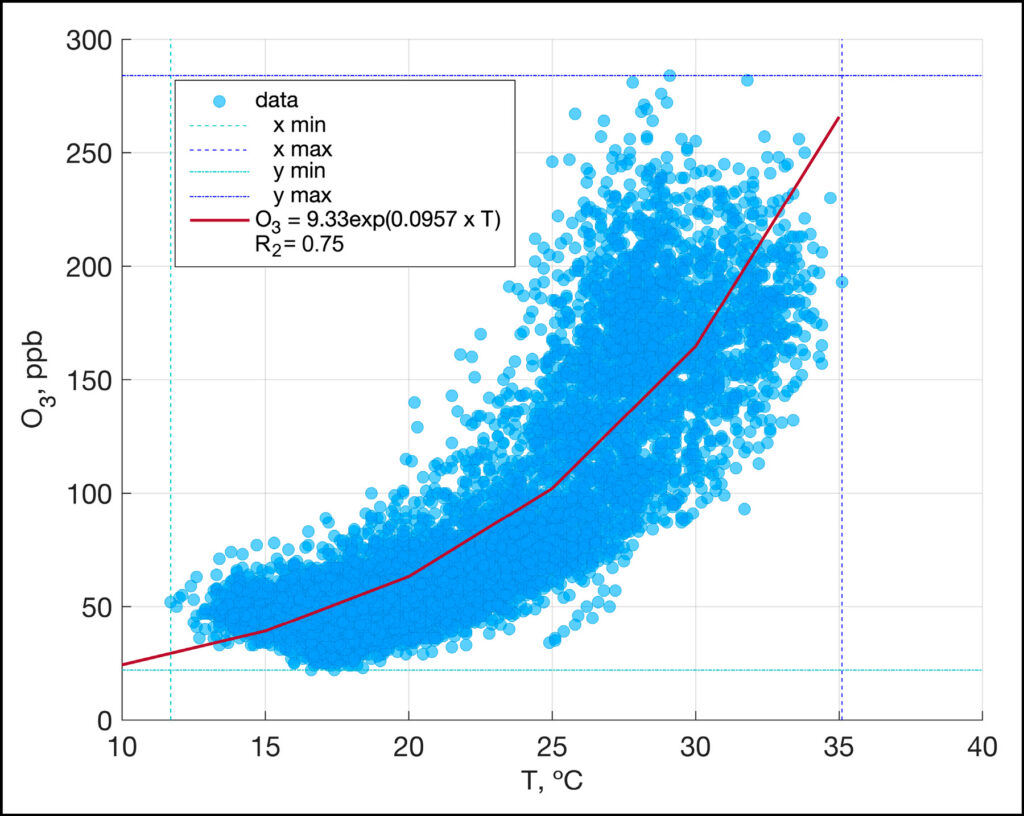
Importantly, our results show that ozone does not respond to temperature in a simple linear way and help to explain why ozone episodes may continue even when long-term emission control policies are in place. A relatively small temperature increase can have a disproportionately large effect on ozone formation when other conditions are favorable. These conditions include intense solar radiation, the presence of stagnant air masses, and sufficient availability of precursor gases.
This dynamic is most visible during the “ozone season” from March to May, when high solar radiation and stagnant air masses prevent pollutants from dispersing in the atmosphere. These conditions are no longer just seasonal anomalies; they are expected to become more frequent or more intense as climate change progresses [Estrada et al., 2023]. In this context, ozone management is not only an air quality issue but also a climate adaptation challenge.
The city is running a race where the finish line, clean air, is receding farther and farther because of global warming.
The relationship between heat and ozone is also connected to urbanization. Large cities modify their local climate through the urban heat island effect, which can increase surface temperatures relative to surrounding rural areas. In Mexico City, this effect interacts with regional climate warming, local emissions, and basin meteorology. Together, these factors can create a more reactive atmosphere than the one that existed 2 decades ago.
The city is running a race where the finish line, clean air, is receding farther and farther because of global warming.
The Way Forward: Integrated Policy
Our findings highlight a critical challenge for urban planning. If temperatures continue to rise, technological advances in vehicles and industry could be partially offset by the increased chemical efficiency of the atmosphere [Nolte et al., 2021]. The next generation of policies must recognize that ozone control requires a more integrated strategy.
First, ozone mitigation should consider the balance between NOx and VOC emissions. Because ozone formation depends on nonlinear chemistry, reducing only one group of precursors may not always produce the expected response. More detailed control of VOC emissions from fuels, solvents, industry, traffic, and consumer products may be necessary, especially during the ozone season.
Second, air quality policy should be linked to meteorological forecasting. High-ozone episodes often occur under predictable combinations of high temperature, intense solar radiation, atmospheric stagnation, and limited vertical mixing. Short-term actions during these periods could help reduce peak exposures, particularly for vulnerable populations such as children, older adults, outdoor workers, and people with respiratory disease.
Air quality strategies cannot exist in isolation. They must be integrated with climate change adaptation and mitigation goals.
Third, reducing the urban heat island effect should be considered part of ozone management. Measures such as increasing urban vegetation, protecting green areas, using reflective materials, improving building efficiency, and reducing heat emissions from transport and infrastructure can contribute to climate adaptation while also helping to reduce conditions favorable for ozone formation.
Fourth, long-term monitoring must continue. Mexico City’s atmospheric monitoring networks are essential because they allow scientists to distinguish between emission-driven trends and climate-driven changes. Without continuous measurements of pollutants and meteorological variables, it would be much more difficult to understand why ozone remains persistent despite reductions in other pollutants.
To protect public health, air quality strategies cannot exist in isolation. They must be integrated with climate change adaptation and mitigation goals. In megacities like Mexico City, reducing emissions is no longer enough; we must also address the urban heat island effect and prepare for a fundamentally more reactive and hotter atmosphere.
Mexico City’s experience with the ozone paradox offers a useful lesson for other megacities. The challenge ahead is not only to emit less but also to understand how a warmer atmosphere changes the effectiveness of traditional pollution control strategies. Ozone is therefore more than an air pollutant; it is a signal of how climate change can reshape urban environmental risks.
References
Castro, T., et al. (2025), Evolution of tropospheric ozone and surface temperature in Mexico City from 2000 to 2021, Atmosphere, 16(12), 1379, https://doi.org/10.3390/atmos16121379.
Estrada, F., et al. (2023), State and perspectives of climate change in Mexico: A starting point, cambioclimatico.unam.mx/.
Jacob, D. J., and D. A. Winner (2009), Effect of climate change on air quality, Atmos. Environ., 43(1), 51–63, https://doi.org/10.1016/j.atmosenv.2008.09.051.
Nolte, C. G., et al. (2021), Regional temperature-ozone relationships across the U.S. under multiple climate and emissions scenarios, J. Air Waste Manage. Assoc., 71(10), 1,251–1,264, https://doi.org/10.1080/10962247.2021.1970048.
Peralta, O., et al. (2021), Ozone over Mexico City during the COVID-19 pandemic, Sci. Total Environ., 761, 143183, https://doi.org/10.1016/j.scitotenv.2020.143183.
Shi, X., and G. P. Brasseur (2020), The response in air quality to the reduction of Chinese economic activities during the COVID-19 outbreak, Geophys. Res. Lett., 47, e2020GL088070, https://doi.org/10.1029/2020GL088070.
Sillman, S., and P. J. Samson (1995), Impact of temperature on oxidant photochemistry, J. Geophys. Res., 100(D6), 11,497–11,508, https://doi.org/10.1029/94JD02146.
Author Information
Telma Castro (telma@atmosfera.unam.mx), Oscar Peralta, and Salvador Reynoso-Cruces, Instituto de Ciencias de la Atmósfera y Cambio Climático, Universidad Nacional Autónoma de México, Mexico City; Harry Alvarez-Ospina, Facultad de Ciencias, Universidad Nacional Autónoma de México, Mexico City; and Alejandro Salcido, Instituto Nacional de Electricidad y Energías Limpias, Cuernavaca, Mexico
Citation: Castro, T., O. Peralta, S. Reynoso-Cruces, H. Alvarez-Ospina, and A. Salcido (2026), The ozone paradox: A growing cost of a warmer atmosphere, Eos, 107, https://doi.org/10.1029/2026EO260284. Published on 9 September 2026.
Text © 2026. The authors. CC BY-NC-ND 3.0
Except where otherwise noted, images are subject to copyright. Any reuse without express permission from the copyright owner is prohibited.