
Coursera doesn’t advertise this, but a small number of courses can be completed for free (not just previewed) through an option called Partner-supported free access. The catch: it’s deliberately hard to find, and some courses include the graded items while others don’t.
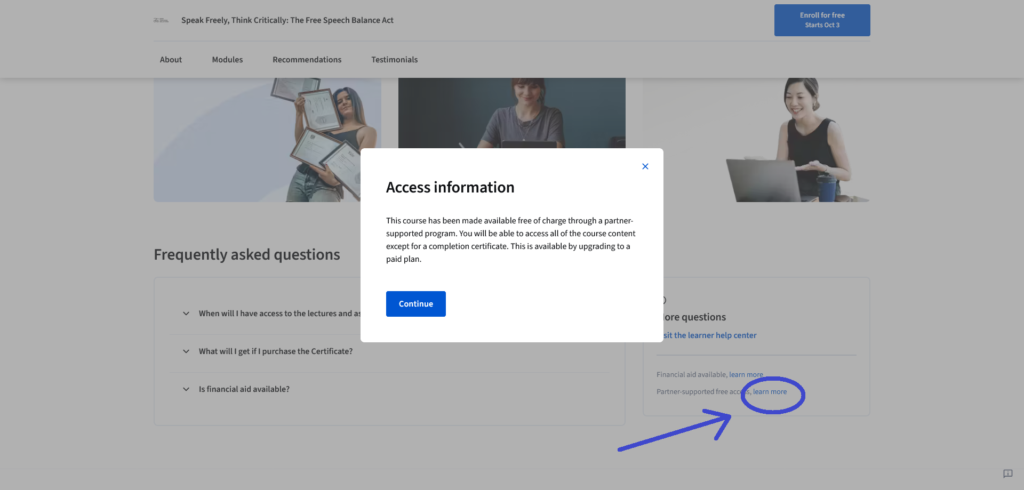
Here’s how to find it. Don’t click the Enroll for free or the Try free for 7 days button. That leads to a paid enrollment or a limited preview. Instead, scroll down the course page to the Frequently Asked Questions section. On the right-hand side, look for Partner-supported free access and click Learn more. From there, you can access the course for free.
There’s a wrinkle, though. Not all of these courses include the graded items for free, meaning you can work through the material but not the assessments without paying. And on every one of them, the certificate itself still costs money, or, if you’re eligible, you can apply for financial aid, which covers a percentage of the cost.
How We Got Here
This wasn’t always so complicated. When Coursera launched in 2012, courses were completely free: videos, readings, graded items, and even certificates, which were then called Statements of Accomplishment.
That changed when Coursera introduced a paid Verified Certificate. The free Statement of Accomplishment stuck around for a while before being phased out around late 2014. From that point on, if you wanted proof you’d completed a course, you had to pay, but the course itself was still free to access.

Around the same time, Coursera introduced auditing: you could watch the videos and read the material for free, but for many courses graded items and the certificate were behind a paywall. As the years went on, the free audit link became harder and harder to find, which is why Class Central put together a guide on how to sign up for Coursera courses for free.
Then, in mid-2025, Coursera rolled out Free Preview mode. Under this system, learners can access a course’s first module (including its graded items) for free, then have to pay to complete the course and earn a certificate.
While digging into Free Preview, we found that some courses were still fully free beyond that first module, but didn’t offer a certificate at all, even to learners willing to pay. As of August 2026, we counted more than 470 completely free courses like this on Coursera.
It was digging further into the Coursera catalog that turned up the Partner-supported free access courses described above. This is a distinct, smaller category where you can access all course modules for free and can pay for a certificate if you want one.
The 45 Courses, as of September 2026
- Learning How to Learn: Powerful mental tools to help you master tough subjects from Deep Teaching Solutions ★★★★★(27696)
- Uncommon Sense Teaching from Deep Teaching Solutions ★★★★★(487)
- Uncommon Sense Teaching: Part 2, Building Community and Habits of Learning from Deep Teaching Solutions ★★★★★(129)
- Uncommon Sense Teaching: Teaching Online from Deep Teaching Solutions ★★★★★(62)
- Speak Freely, Think Critically: The Free Speech Balance Act from Deep Teaching Solutions ★★★★★(33)
- The Science of Well-Being from Yale University ★★★★★(32)
- Algorithms for DNA Sequencing from Johns Hopkins University ★★★★★(17)
- Python for Genomic Data Science from Johns Hopkins University ★★★☆☆(15)
- Introduction to Genomic Technologies from Johns Hopkins University ★★★☆☆(12)
- Command Line Tools for Genomic Data Science from Johns Hopkins University ★★☆☆☆(9)
- Making Math Click: Understand Math Without Fear from Deep Teaching Solutions ★★★★★(7)
- Rethinking Logic: Surprising Science of Critical Thinking from Deep Teaching Solutions ★★★★★(5)
- Bioconductor for Genomic Data Science from Johns Hopkins University ★★★☆☆(4)
- Measuring and Maximizing Impact of COVID-19 Contact Tracing from Johns Hopkins University ★★★★☆(4)
- Addiction Treatment: Clinical Skills for Healthcare Providers from Yale University ★★★★☆(3)
- Statistics for Genomic Data Science from Johns Hopkins University ★★☆☆☆(3)
- Strategies for Senior Housing Communities during COVID-19 from Johns Hopkins University ★★★★★(3)
- Principles of fMRI 1 from Johns Hopkins University ★★★★★(2)
- Critical Thinking & Logic: Real-World Skills from Deep Teaching Solutions ★★★★★(2)
- COVID Vaccine Ambassador Training: How to Talk to Parents from Johns Hopkins University ★★★★★(2)
- Fundamental Neuroscience for Neuroimaging from Johns Hopkins University ★★★★★(1)
- Critical Thinking for Better Decisions in the ChatGPT Era from Deep Teaching Solutions ★★★★★(1)
- Infectious Disease Transmission Models for Decision-Makers from Johns Hopkins University ★★★★★(1)
- Strategies for Assisted Living Communities during COVID-19 from Johns Hopkins University ★★★★★(1)
- Think Critically: Deductive Reasoning and Mental Models from Deep Teaching Solutions ★★★★★(1)
- The Science of Well-Being for Parents from Yale University ★★★★★(1)
- A tanulás tanulása: Hatékony mentális eszközök, melyek segítenek megbirkózni a nehéz tantárgyakkal (Learning How to Learn) from Deep Teaching Solutions ★★★★★(1)
- The Science of Well-Being for Teens from Yale University
- Principles of fMRI 2 from Johns Hopkins University
- Data Use for Disease Control & Global Health Decision-Making from Johns Hopkins University
- Introduction to Neurohacking In R from Johns Hopkins University
- A Public Health Approach to Hearing Loss and Aging from Johns Hopkins University
- Investigating Epidemics like COVID-19: An Analyst’s Guide from Johns Hopkins University
- Building Alliances in Global Health: From Global to Local from Johns Hopkins University
- Bioinformatics Methods for Transcriptomics from Johns Hopkins University
- Gender Foundations in Health Data: A Data for Health Course from Johns Hopkins University
- Infectious Disease Modeling in Practice from Johns Hopkins University
- Civil Registration & Vital Statistics in Population Health from Johns Hopkins University
- Programación en Python from Universidad de los Andes
- Fundamentos de probabilidad y aplicaciones from Universidad de los Andes
- Fundamentos de estadística aplicada from Universidad de los Andes
- État civil et statistiques pour la santé des populations from Johns Hopkins University
- Digitizing Population Health in Low-Resource Settings from Johns Hopkins University
- Embajador de la Vacuna COVID: Cómo Hablar con los Padres from Johns Hopkins University
- Registro civil y estadísticas para la salud de la población from Johns Hopkins University
The post Coursera’s Hidden Free-Access Courses (and What’s Actually Free About Them) appeared first on The Report by Class Central.