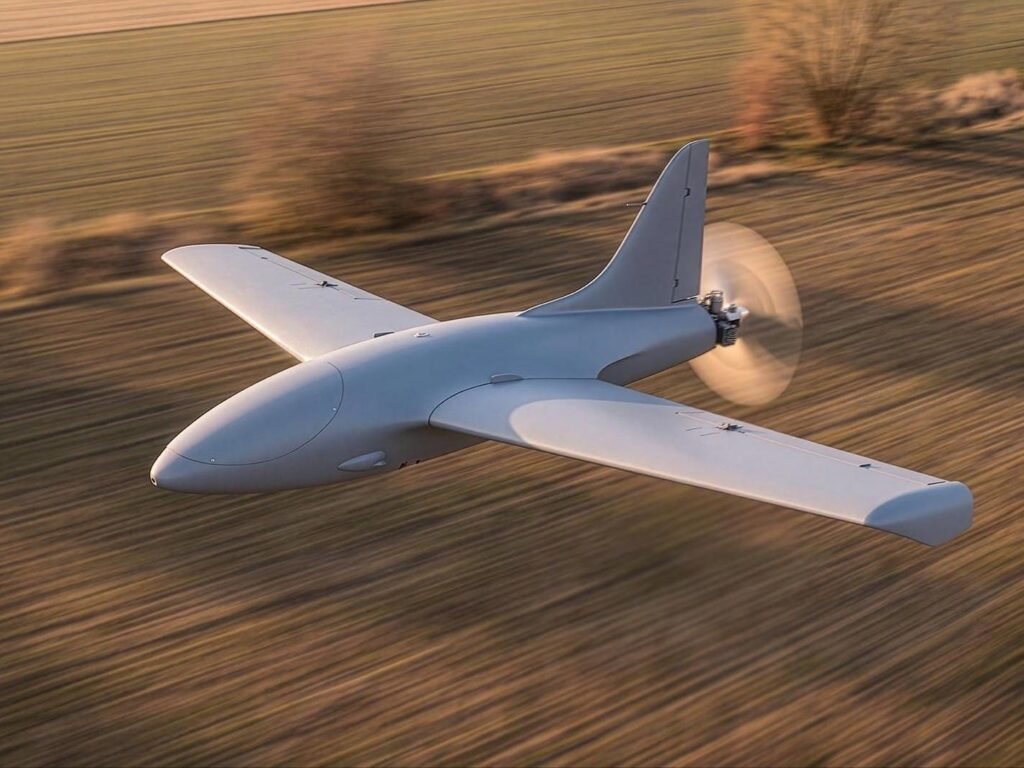
Courtesy of LPP Holding
- Ukraine has proven that deep-strike weapons must work under electronic warfare conditions to be effective.
- One European arms maker said this ability is crucial for weapons on the modern battlefield.
- NATO has shown interest in similar capabilities that can swarm enemy airfields and deny operations there.
Ukrainian deep-strike operations have shown that drones must be able to fly through heavy electronic warfare conditions to reach their targets, a European arms maker told Business Insider.
In the war in Ukraine, electronic warfare is a dominating battlefield effect, and there is a growing realization among Western militaries and defense firms that long-range strike weapons will have to work even when disconnected from their pilots to be relevant in a modern conflict.
NATO recently hosted a challenge for Ukrainian and Western firms, asking them to explain how the strike weapons they developed could swarm an airfield and prevent an enemy from operating there.
Czech defense firm LPP Holding said it won the challenge because its long-range drones, which Ukraine has used to strike targets inside Russia, work in a GPS-denied environment.
For roughly 18 months, Ukraine has been using LPP’s drone, the MTS-40, to strike inside Russia. At $90,000 apiece, the aircraft can travel more than 180 miles across the border, using artificial intelligence-enabled optical navigation to fly autonomously.
Martina Tauberová, the head of government and strategic relations at LPP, said the battlefield in Ukraine has shown that militaries can’t rely solely on strike weapons that depend on maintaining communication links with their pilots because when they fly through areas where that access is denied, those assets often fall short.
AP Photo/Efrem Lukatsky
NATO, she said, made the ability to push through enemy jamming a requirement for a recent “Innovation Challenge” that sought cost-effective, electronic-warfare-resistant systems suitable for strikes against enemy airfields. The ultimate goal would be to use these solutions to persistently deny their ability to conduct operations.
The contest, which marks the first Innovation Challenge focused on strike capabilities since NATO began hosting them nearly a decade ago, comes amid broader efforts by Western defense firms to develop low-cost, long-range weapons.
French Navy Cdr. Bastien Salasca, the Innovation Challenges project manager at the NATO command tasked with overseeing alliance modernization, said it “is not about preparing NATO to go to war. It is about making sure that, if an adversary is considering military action, they have to account for NATO’s ability to impose persistent and credible costs on the systems that enable their operations.”
“Recent conflicts have shown that military power depends on complex networks of infrastructure, logistics, and support, not just individual platforms,” Salasca told Business Insider. “This Innovation Challenge is about finding affordable, scalable, and resilient ways to affect those systems, thus strengthening deterrence by giving allies more credible options before and during a crisis.”
NATO announced the three finalists in early September. LPP’s drone took first place; Polish aerospace startup Supercluster’s high-altitude balloon, which positions autonomous gliding systems for long-range strikes, took second; and an unnamed Ukrainian company took third with an AI-based autonomy system for uncrewed aircraft.
Tauberová said the war in Ukraine has demonstrated that it’s crucial to have cheap weapons in large quantities that can be systematically launched against targets. In the case of the airfield scenario, drone swarms can pursue aircraft, runways, buildings, and fueling stations.
2025 Planet Labs PBC/via REUTERS
“You need to have a deep-strike capability that you can use on a mass scale,” Tauberová said. Instead of using a single expensive missile to strike the target, like a multimillion-dollar Tomahawk, cheap swarms could prove more effective at overwhelming an enemy’s air defenses.
Although its products have already proven themselves in combat in Ukraine, LPP has kept much of its work there out of the public eye. It entered the Innovation Challenge because it is seeking NATO validation and greater visibility, Tauberová said.
The next step for LPP is to test its drone in Eastern Europe alongside the other finalists. Tauberová said she hopes to see the company sign deals with NATO militaries and scale up manufacturing.
LPP is also developing a cruise missile powered by a turbojet engine, and like the company’s drones, the “MTS Narwhal” is intended to operate in GPS-denied environments. The company is testing a prototype and hopes that the missile will make its combat debut later this year.
Across Europe and the US, defense firms and startups are developing low-cost cruise missiles that can be mass-produced as NATO militaries explore alternatives to more exquisite weapons.