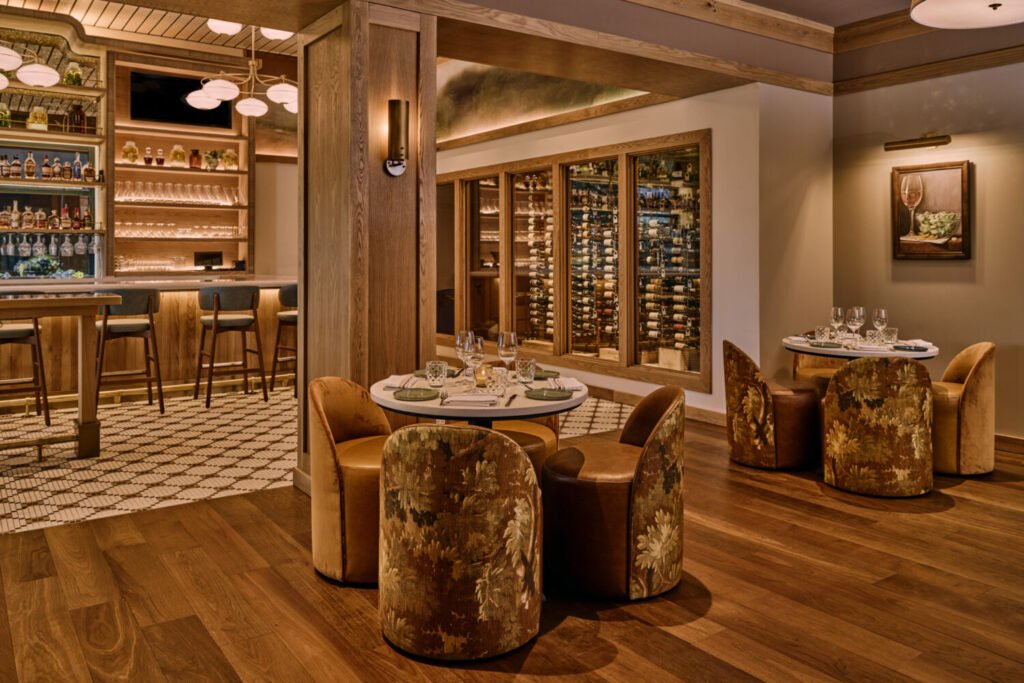

A once-ordinary restaurant begins a new chapter in Charlotte, North Carolina, one of the Southeast’s fastest-growing cities. Designed by FictionWorks, Napa Bistro and Wine Bar Stonecrest draws inspiration from the 1976 Paris Wine Tasting, blending the aesthetics of a French bistro with the subtle charm of a Napa Valley farmhouse.

Photography by Pablo Enriquez
“The goal was to create a restaurant that feels approachable enough for a casual weeknight dinner while offering the sense of occasion people look for when celebrating a great meal and a bottle of wine,” say FictionWorks co-founders Andrea De Camps and Olivia King.

Photography by Pablo Enriquez
With architecture by In Situ Studio, the 6,500-square-foot space is organized into a series of connected rooms, each defined by its own character. A curved, vaulted ceiling with a system by Baswa Acoustics softens the sounds of a busy dining environment while also contributing to the interior’s spatial rhythm. Thoughtfully scaled dining rooms feature intimate seating areas with worn leather upholstery, inviting guests to settle into their surroundings.

Photography by Pablo Enriquez
Perhaps one of the restaurant’s biggest roadblocks was working within an existing structure. Transforming a former taco restaurant into a warm, wine-focused destination, FictionWorks strategically invested in high-impact elements. Completed in under nine months, the renovation required intentional coordination, smart budgeting, and a clear design hierarchy. The result is a transformation of a flat, open layout into a layered sequence of rooms that echo the coziness of a Napa Valley farmhouse.

Photography by Pablo Enriquez
“We put the money into the details that would really make an impact—the stained-glass installation, custom lighting, and millwork,” the team at FictionWorks says, “and we stayed more practical with the secondary elements—the tabletops, mosaic flooring, thrifted artwork, and accessories.”

Photography by Pablo Enriquez
Drawing on three key influences, the color palette reflects the verdant vineyards of Napa Valley, the warmth of 1970s interiors, and the refined character of a Parisian bistro. Deep greens and warm wood tones are accented by shades of amber and bronze, evoking the richness of aged wine without feeling dated. Classic black-and-white tiles from Daltile’s Keystone collection ground the design, providing a unique mosaic floor pattern that contrasts sharply with the more natural materials.
For De Camps and King, every “design decision, from the architecture and materials to the artwork and guest experience, supports a deeper appreciation of food, wine, and the history that inspired the brand.”

Photography by Pablo Enriquez
Crafted from hand-blown rondels, the custom stained-glass installation references 1970s glasswork and takes the form of a wine bottle punt. Custom lighting, linen pendant fixtures, and sculptural chandeliers are arranged to complement natural light while creating intimate, moody vignettes. A series of distinctive photographs and digital artwork by California artist Julia Crane are intertwined with pieces by Charlotte-based creatives, connecting the space back to its local community. The result? A materiality that tells a story that goes far beyond the menu.

Photography by Pablo Enriquez
Modeled after a global wine competition that transformed the perception of Californian wines, Napa Bistro and Wine Bar builds its identity around the spirit of that event. For the team at FictionWorks, the restaurant is a celebration of challenging expectations. “That same spirit shaped every aspect of the design,” they explain. “The restaurant draws from this spirit of transformation, not to recreate history, but to honor and reimagine it.”