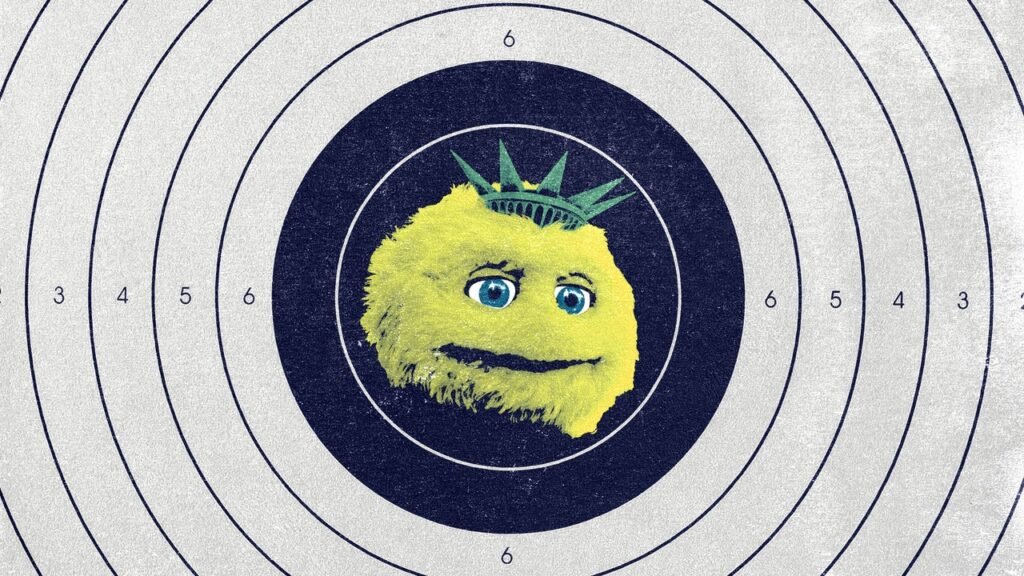
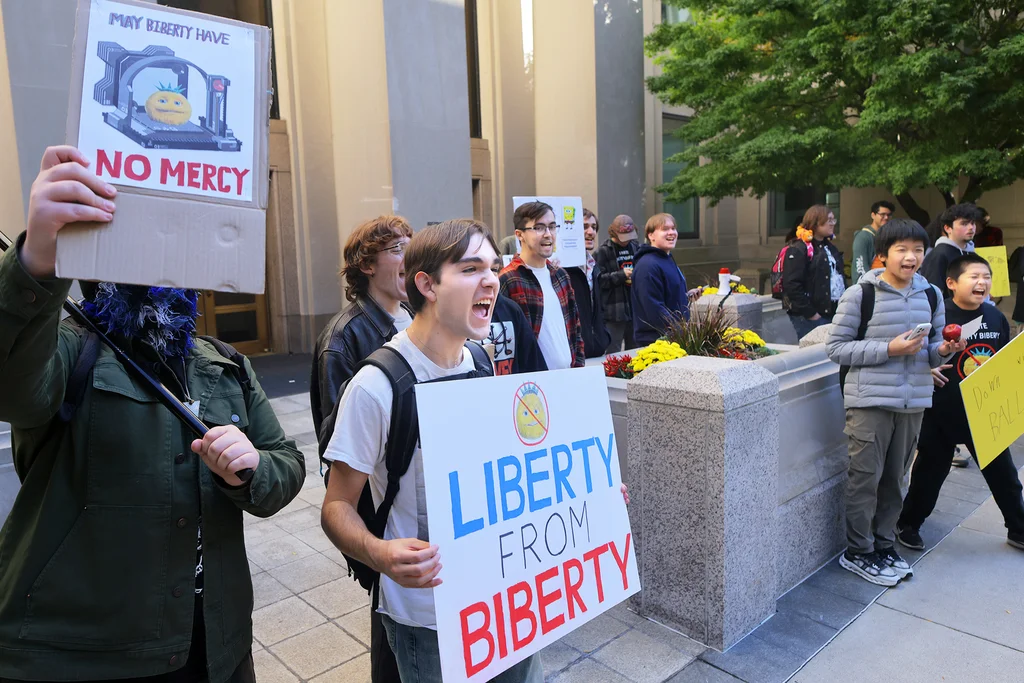
The day was October 25, and the streets of Boston were full of protestors hoisting signs, chanting, and wielding megaphones. Their explicit goal: calling for the head of Liberty Mutual Insurance’s new mascot, Liberty Biberty.
The protest, which took place outside Liberty Mutual’s Boston headquarters, featured signs reading, “May Biberty have no mercy,” “Liberty from Biberty,” and “If you give me Biberty, give me death.”
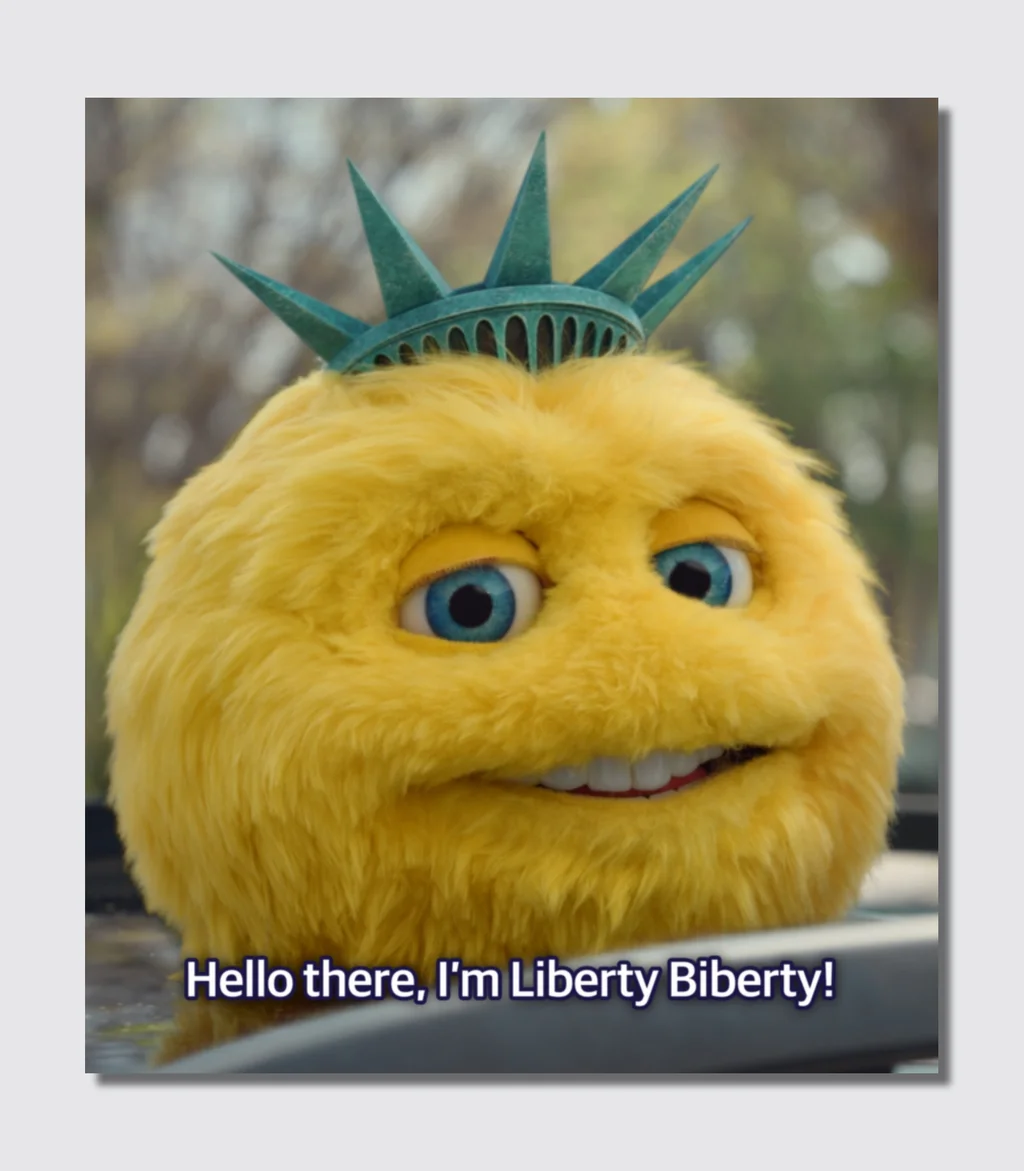
While these sentiments might seem extreme on their own, they’re tame compared to the Biberty-centric vitriol that’s been brewing online for weeks. Liberty Mutual unveiled Biberty in late July with a series of six commercials. He’s a fluffy yellow orb with piercing blue eyes, uncannily human teeth, and no nose, who’s a little bit too into insurance. Since he debuted, he’s turned into the internet’s common enemy—seemingly for being generally unfunny and a bit creepy.
And yet, all of this negative attention is turning hundreds of millions of eyeballs toward Liberty Mutual. According to Jenna Lebel, CMO of U.S. retail markets at Liberty Mutual, Biberty has been an on-paper success thus far.
“We’ve been encouraged by the early results, including independent testing that shows Biberty performing above average on attention and brand attribution,” Lebel says. “At the same time, we’re always listening to consumers and paying attention to how they engage with our brand.”
In the undeniably bland insurance industry, mascots are a common tool for building brand affinity and standing out from competitors. Now, Liberty Mutual is facing a brand conundrum: What do you do when your mascot becomes mega-famous for all the wrong reasons?
Why insurance companies need mascots
Mascots are everywhere right now. From sports teams to candy companies and Big Tech, everyone seems to want an anthropomorphic brand symbol. In the insurance world, though, this strategy is old news.
Picture the Geico gecko, Flo from Progressive, Jake from State Farm, the Aflac duck; nearly every major insurance company relies on a mascot for its advertising. For these companies, mascots serve as memorable touchpoints in an industry that’s otherwise serious and difficult to visualize.
“Insurance is a unique category because it’s not a product people interact with every day, so staying top of mind really matters,” Lebel says. “That’s one reason you see insurance brands invest so much in distinctive brand assets, whether that’s characters, jingles, taglines, or other recognizable cues. The goal is to create something people remember and, just as importantly, immediately connect back to your brand.”
The challenge, Lebel says, is that having a character isn’t enough. It has to be “distinctive and ownable.” Liberty Mutual’s formula for achieving that effect has historically been combining something familiar with something unexpected. For example, its existing mascots, LiMu Emu and Doug, are a satirical take on the buddy-cop trope.
The same formula served as the inspiration for Biberty. “Liberty Biberty” first emerged as part of a 2019 ad in which an actor struggles to pronounce the company name; it has since evolved into a running gag in the company’s advertising (one more recent iteration of the joke has 264 million views on YouTube). For many fans, the verbal gag morphed into a persistent earworm. When Liberty Mutual saw how the phrase “stuck with consumers long after the original ad aired,” Lebel says, it realized that an opportunity had landed in its lap.
“With Biberty, we built on something people already knew from our advertising and gave it a completely unexpected physical expression,” Lebel says.
How Liberty Biberty was spawned
On a table surrounded by the leftovers of failed prototypes, the supplies were readied. Swaths of yellow fur sat beside sets of disembodied blue eyeballs and pearly white teeth. A mess of wires spilled from the mechanical outlines of a head. Like Frankenstein’s monster, Biberty opened his eyes and spoke.
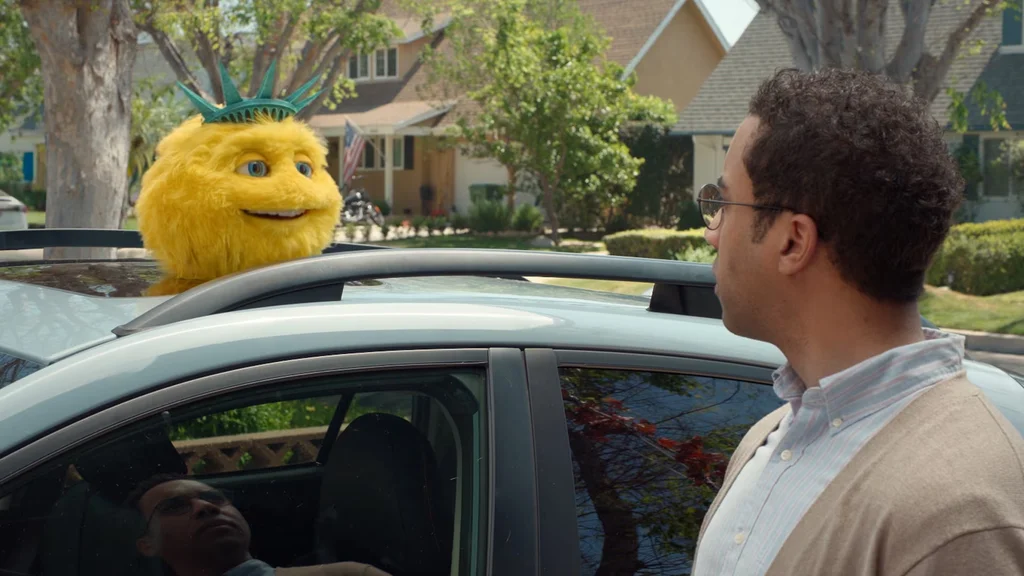
Liberty Biberty is a physical puppet that was hand-made by artists in Jim Henson’s Creature Shop. According to a Liberty Mutual press release, Biberty was originally imagined as “a fuzzy, yellow manifestation of the feeling of great insurance.” The Creature Shop team took that inspiration and transformed it into a talking, moving, expression-filled character.
In an Instagram post describing the process, the Creature Shop team explained that it started with a simple foam sphere mock-up to establish the character’s proportions and silhouette. From there, the artists and engineers sourced “mountains of bright yellow fur” and incorporated custom blue eyes fabricated by Fourth Seal Studios. To support the production’s performance needs, the team built multiple versions of Biberty, including some designed for stunt action and others made specifically for close-up shots.
In the six final ads that feature Biberty, the character is played and voiced by the puppeteer Grant Baciocco. Everything from the slight movement of his eyes to the crinkle in his bright yellow brows is part of the performance.
It’s difficult to pin down one specific feature that’s turned Biberty into the internet’s punching bag. His slow-blinking eyes have an intense-yet-vacant quality. The shifting of his yellow fur into imitated human microexpressions veers into the uncanny valley. His “jokes” stretch the definition of the term. He’s not exactly offensive. He’s not even that irritating. Nevertheless, the internet has agreed that the sum of his parts makes for an infinitely “dropkickable” result.
The internet calls for blood
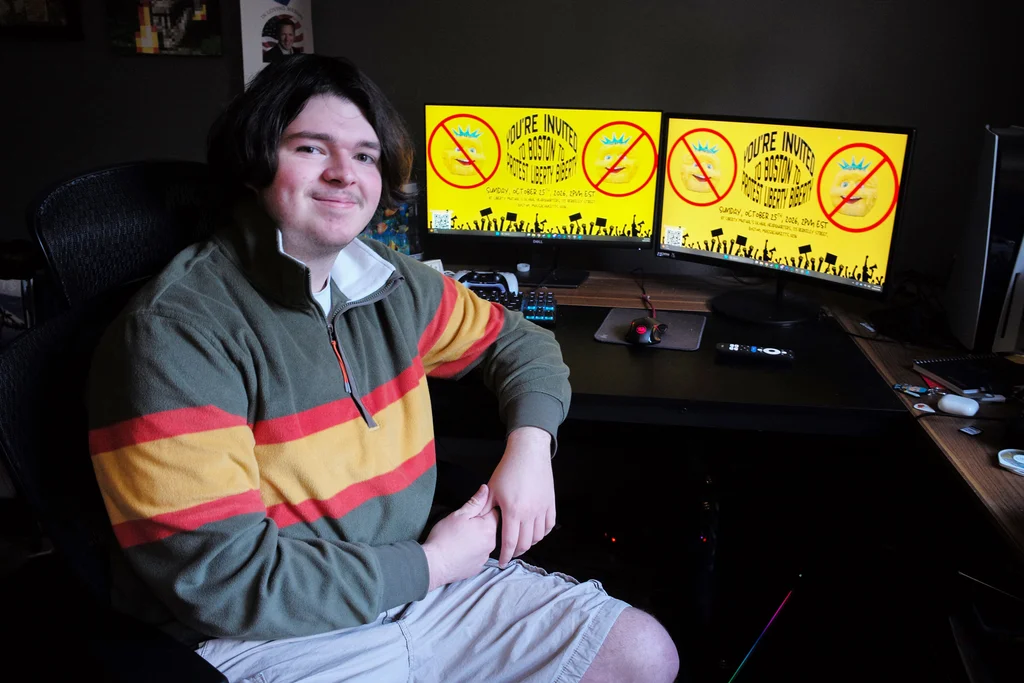
“We’re done. It’s over,” 19-year-old Connor Harvey told WBZ NewsRadio outside Liberty Mutual’s headquarters, amid the Liberty Biberty protest he organized. “We’re getting rid of him, and we have to make our voices heard.”
The protest, Harvey told the publication, started as a joke video posted to his YouTube channel on October 9. After the video gained more than 600,000 views, though, he decided to go through with organizing a real event.
And Harvey’s video, which calls Biberty a “nasty little pest” and shows the mascot getting obliterated by missiles, is far from the only user-generated content that’s sprung up around him. In fact, Biberty hate has spawned its own internet niche that’s turned into engagement bait for creators, with many Biberty-centric videos notching hundreds of thousands of views and tens of thousands of likes.
There are videos of people demonstrating how they’d crush Biberty like a watermelon. Clips of DJs remixing his commercials with machine gun fire. Calls for Liberty Mutual to kill off Biberty in a Super Bowl commercial “in the most hilarious, dramatic fashion.” There’s no other way to put it: The internet really, really wants to kill Liberty Biberty.
“If I ever came across that little yellow S.O.B. Liberty Biberty, I would punt him into the sun,” one creator summed it up.
It’s unclear whether Liberty Mutual had any inkling of the public fury that Biberty would inspire, or if, like Dr. Frankenstein, its team is internally horrified at what he’s wrought. The internet reaction could be entirely organic. On the other hand, it could also be a manufactured engagement play on Liberty Mutual’s part, a strategy that’s become popular in our current suspicion economy.
If Biberty is purposeful rage bait marketing—marketing designed to ruffle feathers and elicit a strong negative reaction—then he’s certainly been successful. In fact, numbers-wise, he’s an unarguable advantage for Liberty Mutual: as of this writing, the six commercials he stars in have amassed 754 million views on YouTube alone.
Like all rage bait marketing, intentional or not, Biberty creates an unfortunate paradox for Liberty Mutual. As brand attention spikes, so does the negative fervor of the fan reaction. Biberty might be the king of insurance mascots now, but fans want his head on a silver platter.
Finally, Liberty Mutual has the unforgettable mascot that all insurance marketers dream of. But at what cost?