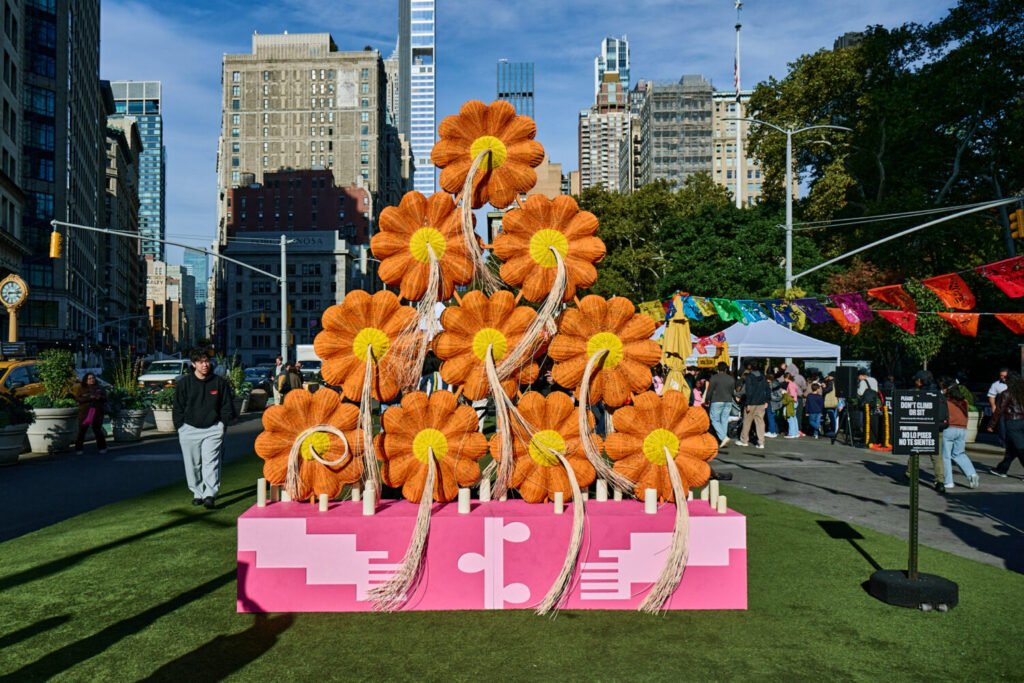
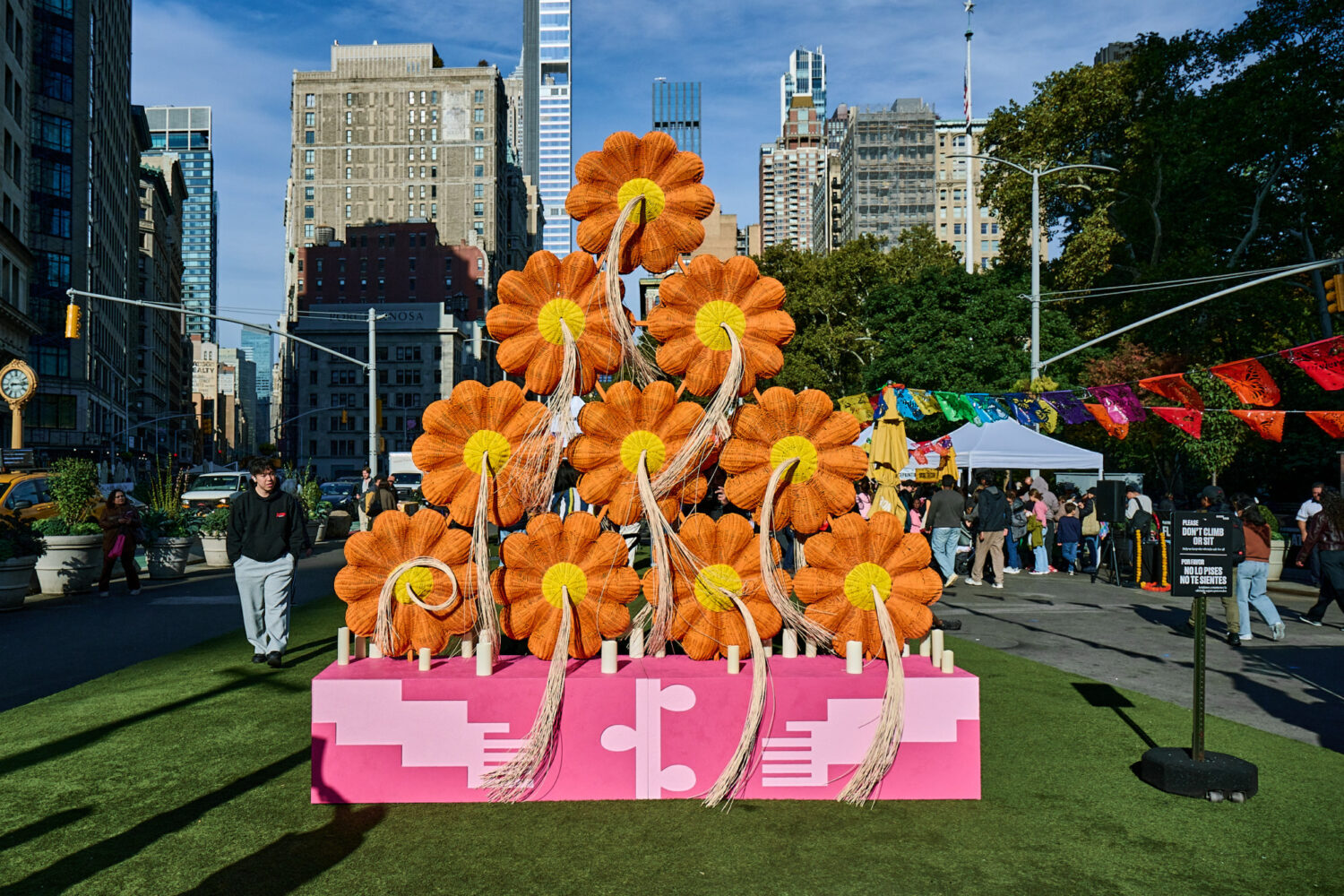
For Día de Muertos, marigolds are more than decorative flowers. Their vivid orange petals and distinctive scent are believed to guide the spirits of loved ones home, making them an essential part of the Mexican tradition of remembrance. In New York City’s Flatiron District, artist and designer Daniel Valero has transformed the familiar flower into something architectural: a monumental, seven-tier altar constructed from handwoven floral forms.
Titled Twenty Petal Flower, the installation was commissioned by the Flatiron NoMad Partnership and created through a collaboration between Valero’s Mexico-based design studio, Mestiz, and Brooklyn-based fabrication organization Powerhouse Arts. On view in Flatiron North Plaza through Nov. 3, the public artwork reimagines the traditional ofrenda, or altar, as a gathering place where visitors can leave mementos honoring loved ones who have passed.

Photography by Wil Pierce
Rather than focusing exclusively on remembrance, Valero wanted the installation to recognize the people whose work makes the tradition possible.
“An altar usually honors someone we love who has passed away,” explains Valero. “This time, I wanted to honor the many hands behind the cempasúchil, from the people who grow it to those who transform it into an ofrenda.”
The installation takes its name from cempōhualxōchitl, a Nahuatl word meaning “20-petal flower,” from which the Spanish name cempasúchil is derived. Its design traces the flower’s journey from the fields of Michoacán, Mexico, to the artisans who transform it into the elaborate floral arrangements associated with Día de Muertos.

Photography by Wil Pierce
For Valero, the challenge was translating something delicate and ephemeral into a large-scale structure without losing its cultural significance or handmade character. “I’ve always been fascinated by the idea of flowers becoming architecture,” he says. “With Twenty Petal Flower, we used weaving and scale to transform something delicate and temporary into a monumental structure, creating an architecture of celebration where people can gather, remember, and connect.”
The oversized flowers were handcrafted primarily from wicker using traditional weaving techniques. Their rounded, organic forms are arranged across the altar’s seven tiers, creating a dense composition of orange petals illuminated by warm, candle-like lighting.

Photography by Wil Pierce
The Mestiz team developed and produced the woven elements at its fiber workshop in Tequisquiapan, Mexico—but bringing those intricate forms to a busy Manhattan plaza presented additional structural challenges. Powerhouse Arts worked with Mestiz to develop a supporting framework durable enough to withstand the demands of an outdoor public installation.
The collaboration involved frequent exchanges between Mexico and Brooklyn, with the fabrication team sharing photographs of CNC-cut samples, texture tests, and paint color matches to ensure that the structural elements remained faithful to Valero’s design. One of the most important decisions was how to support the flowers without making the underlying framework visually dominant.

Daniel Valero in his Mexico studio, Mestiz. Photography courtesy of Mestiz.
“We wanted the internal structure to support the woven flowers without overpowering them,” says Brittni Collins, director of public art at Powerhouse Arts, “so we built a steel frame with a slim profile and color-matched it to the cempasúchil orange so it could hide behind the weavings. The flowers were secured with stainless steel zip ties that hold up to wind and weather.”
The installation was also designed with its future in mind, Collins explains. Rather than building a temporary structure intended for a single celebration, Powerhouse Arts developed a modular system that can be disassembled, stored, and reinstalled for future celebrations.

Photography by Wil Pierce
Despite its size, the finished installation is intended to feel welcoming rather than monumental in a conventional sense. Visitors are encouraged to approach the altar, spend time with it, and contribute their own remembrances.
“I love the idea of someone walking through Flatiron NoMad and suddenly discovering this joyful, vibrant, handmade monument,” Valero says. “Bringing an ofrenda into a public space allows it to become part of the city’s everyday life, a place where people can stop, remember someone they love, and leave an offering.”

Women elements were produced at Mestiz’s fiber workshop in Tequisquiapan, Mexico. Photography courtesy of Mestiz.
Creating that kind of experience was central to the Flatiron NoMad Partnership’s vision for the project. “The scale and openness of Flatiron North Plaza gave us an opportunity to create something immersive and unexpected in the middle of the neighborhood’s everyday rhythm,” says James Mettham, president of the Flatiron NoMad Partnership. “What is so exciting about this project is that it does more than occupy the plaza. It changes how people move through it, invites them to stop and look more closely, and introduces them to the stories and traditions behind the work.”
For Valero, bringing the ofrenda to New York also creates an opportunity for cultural exchange, allowing people familiar with Día de Muertos to honor an important tradition while introducing others to its meaning. “I hope it brings a little piece of home to the Mexican community while inviting everyone in New York to share in the beauty of Día de Muertos,” he says.

Twenty Petal Flower is on view in Flatiron North Plaza in New York City through Nov. 3, 2026.
Editorial Transparency: This article was developed with the assistance of AI tools, which may have been used for research, outlining, editing, or copy refinement. Reporting, fact-checking, and editorial decisions were made by the Design Milk editorial team.