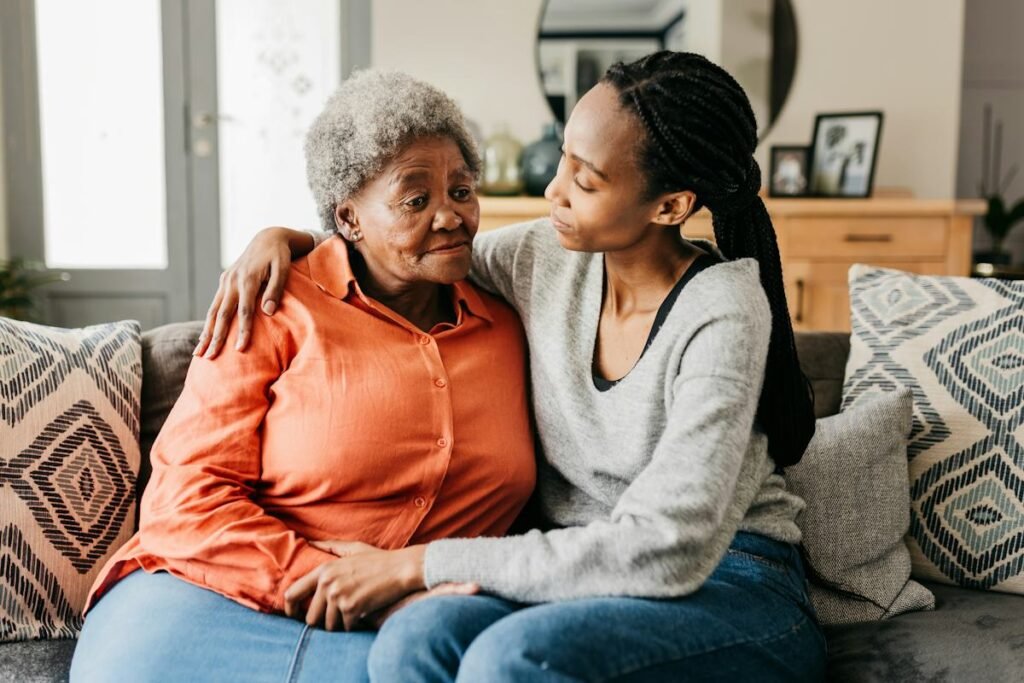
Tuesday, 8:10 p.m. I’m helping my 87-year-old mother brush her teeth and change for bed. My 10-year-old calls from the room next door that he and his dad are done reading his latest Big Nate book. He asks (again) when I’m coming to his room to say goodnight. I try not to rush my mother, but I’m exhausted after a long day, and keenly aware of missing those precious minutes right before bedtime when you get the real deal from your child about everything that happened that day.
After months of juggling my work as a therapist with caring for my aging mother (who has been diagnosed with dementia), and being a present, engaged mom and wife, I had to admit that I was dropping some balls. Having all of this on my plate was clearly not working.
I knew I was not alone — I’ve been having this conversation with many friends and clients, also in their 40s or early 50s. In fact, 47% of caregivers under the age of 50 are part of the sandwich generation, those of us who are raising children and caring for aging parents at the same time. If we aren’t talking about perimenopause with all its patches and pills, we’re talking about the health concerns of our parents and, potentially, our grandparents as well.
The burnout I was feeling falls particularly heavily on the shoulders of women. Even if you have siblings, most of the caregiving responsibility consistently falls on one person, and that person is typically a woman. Women shoulder the majority of caregiving responsibilities, often to the detriment of their careers. To make matters worse, some caregivers may have a complicated relationship with the parent who is now dependent on them.
Caring for your parent can be immensely rewarding and depressing. Sometimes I feel deeply honored to care for the person who dedicated her life to caring for me. Other times, my mom can’t remember why her beloved husband hasn’t come home yet — my father passed away several years ago. She really doesn’t enjoy having to be bathed by her child, for that matter.
As a mental health professional who has sat with clients going through this very thing, I expected to have more of the answers, to be able to cope and balance more than someone else due to my experience. But the truth is, nothing can truly prepare you for your induction into the sandwich generation.
No matter how we try to overcome the difficulty of caregiving as individuals, we must acknowledge that there’s minimal financial or systemic help for consistent care for the elderly living at home. Some Medicare programs can provide all your healthcare in one place, which is obviously better than driving all over town talking to doctors who aren’t talking to each other. But they often only offer last-minute daily help and, because of the high need in our country, you typically see a new caregiver each day. While better than nothing, it’s clearly not a great situation for a parent who is already confused in their day-to-day life. Some programs actually pay you, the caregiver, for your work, but that doesn’t give you back the missed moments with your own children or restore those career opportunities.
Eventually my husband and I realized that we needed help. Fortunately, we could afford to pay a nurse out of pocket, but the costs have been steep: tens of thousands of dollars annually to have carers for my mother seven days a week, and that’s with me still doing bedtime duty on the weekends. It’s simply not realistic or sustainable for most people.
And one of the challenges that we don’t often talk about is the guilt. Even if you are able to defy the odds and pay someone to come in to help, you still feel guilty about it and get caught up in the “shoulds.” I should be able to care for my parents and my children at the same time; people have been doing this forever with a lot less help. I should be grateful to be able to spend whatever time I have left with my parent. The important part missing from that is the fact that many of us don’t have villages in the way we used to — that nearby family network that would support each other during all the stages of life.
Our lack of a village came into focus for me recently when we adopted a baby into our family. She has brought us more joy than we could have imagined, and I see how much a community would change this experience for us. In my Mommy and Me classes, so many of the young mothers have discussed having their parents come and stay with them during the early weeks of having a newborn. What a stark contrast for me as a mother, in a different phase in my life, where I am taking care of my parent, rather than her taking care of me and my children.
This is a problem that is not going anywhere. Around the country and the world, people are making tough decisions every day — draining bank accounts, missing out on kids’ milestones, declining promotions and date nights with their partner — to take care of a loved one. The physical, financial, and emotional toll can cause extensive damage to the caregiver’s well-being in so many ways.
We also know what to do about this problem. Studies show that while caregiver burnout is a worldwide issue, it is less so in the countries where (surprise, surprise) there is a strong public healthcare system, flexible work environments for caregivers, and affordable private health insurance. These kinds of safeguards can be a key part of rebuilding a new kind of village and community support. The answer is there. The question is if we will take heed before we all burn out.
Dr. Patrice Le Goy is a licensed marriage and family therapist and international psychologist. She is also the research chair of Maternal Mental Health Now and the board chair of Open Paths Counseling Center, as well as the host of Like-Minded with Dr. Patrice, an award-winning mental health podcast.
Patrice lives in Los Angeles with her husband, two children, and their massive dog who is definitely part wolf. You can follow her on social media @drpatricelegoy.