
Are Trump Accounts Worth It? What $1,000 at Birth Really Means for Your Child
Are you worried whether Trump accounts are a scam?
Can a Trump account lead to substantial money for my child?
Discover how a $1,000 investment at birth can yield over $300,000 in retirement, with no additional contributions.
Regardless of your thoughts about Trump, the fact that the government is giving away free money to babies is a good thing. And, after claiming the money, you can track it’s growth on the Trump Account app.
Table of contents
This article may contain affiliate links which means that – at zero cost to you – I might earn a commission if you sign up or buy through the affiliate link.
What is a Trump Account?
Children born between January 1st, 2025, and December 31st, 2028, may qualify for $1,000 from the government paid into their Trump Account. The account is in the child’s name with an authorized adult, such as a parent, grandparent or guardian as custodian of the account, until the child reaches age 18.
The Trump Savings Account for children is similar to a Traditional IRA.
If you meet the qualifications and claim the account, that’s free money for the child!
Others are also allowed to contribute up to $5,000 per year to the account.
If you need help with your investments, we’ve partnered with WiserAdvisor to provide you with access to three vetted Financial Advisors – in your area. Click the image below to sign up. (no obligation when signing up)

Who is eligible for the $1,000?
To be eligible, children born between January 1, 2025, and December 31, 2028, must also hold U.S. citizenship and possess a valid Social Security number.
How do you claim the $1,000 for a child?
To claim the $1,000 you’ll need this information:
- Your name and identifying information.
- Your child’s legal name.
- Your child’s Social Security number.
- Your child’s date of birth.
You can claim your child’s Trump account by submitting the IRS Form 4547 and selecting the option for the $1,000 pilot program contribution.
Who else can contribute to the child’s Trump Account?
In addition to the initial government payment of $1,000, others can also contribute to the minor’s account. Although, the account has an annual $5,000 contribution limit.
Contributors include:
- Qualified general contributions from states, Indian tribal governments and 501(c)(3) charities.
- Employers may be eligible to contribute.
- Qualified rollover contributions from an original Trump account may be eligible.
- Contributions from other sources including the child, the child’s parents, philanthropists and others.
We’ll explore whether additional contributions from others, make sense or if contributing to other types of accounts would be better for the child.
How is the money invested?
According to a Treasury.gov press release, initially, all Trump Account money will be invested in the State Street SPDR Portfolio S&P 500 ETF (SPYM). This is a low-fee ETF (exchange-traded-fund) that tracks the performance of the S&P 500 market index. This index owns a market capitalization weighted proportion of 500 of the most important US companies.
The US Treasury also selected the following additional low-cost index ETFs for the Trump Accounts investment lineup:
- iShares Core S&P 500 ETF (IVV)
- Vanguard Total Stock Market ETF (VTI)
- State Street SPDR Portfolio S&P 1500 Composite Stock Market ETF (SPTM)
- iShares Core S&P total U.S. Stock Market ETF (ITOT)
Three of the additional funds offer broader coverage of the U.S. stock market than the S&P 500. More funds will be added later.
A S&P 500 ETF or total US market fund give the child the opportunity to participate in the growth of major companies in the U.S. Many of these U.S.-based firms, also have large global presences, further diversifying the child’s investments. These funds have proven long-term growth records, despite occasional stock market price declines.
If you need help with your investments, we’ve partnered with WiserAdvisor to provide you with access to three vetted Financial Advisors – in your area. Click the image below to sign up. (no obligation when signing up)
What Happens at Age 18?
At age 18, the account holder/child is eligible to withdraw the funds. Although, he or she can leave the money in the account to grow and compound for the future.
The $1,000 grows tax-deferred within for 18 years or longer. When the money is withdrawn, you’ll pay tax on the entire withdrawal at ordinary income tax rates. The initial $1,000 plus all of the earnings and capital appreciation is taxed.
How Much Money Could the Account be Worth at Age 18?
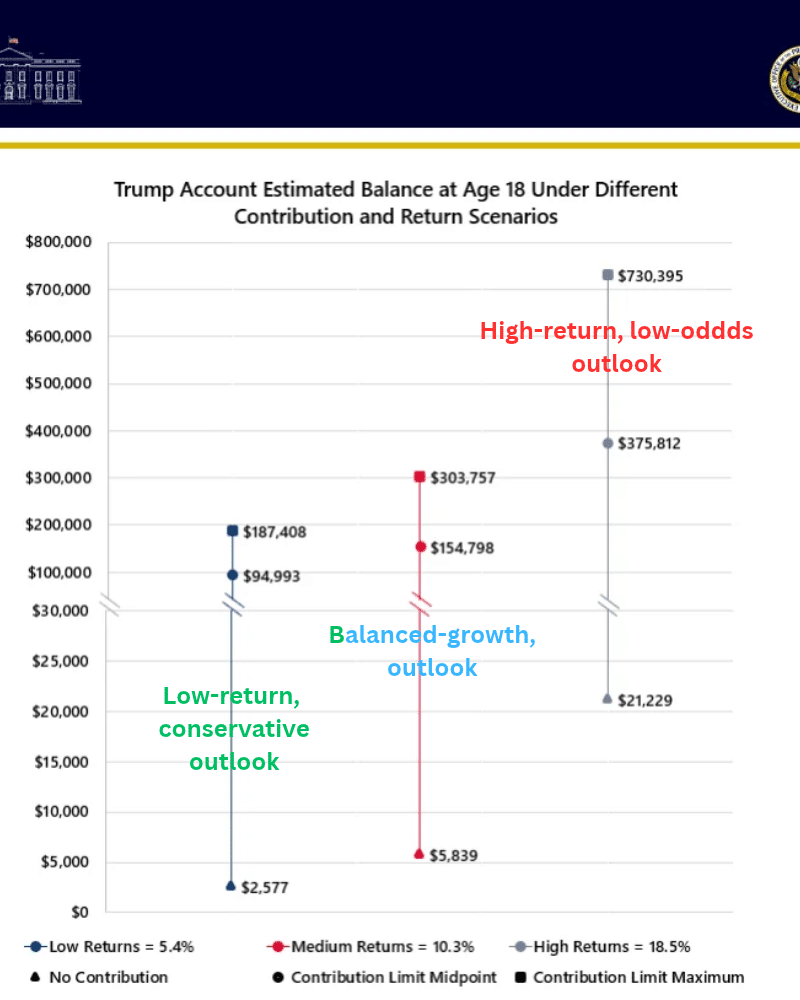
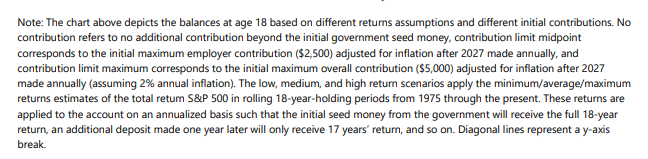
The chart above depicts just how much the account could be worth at age 18, with various investment returns and additional contribution scenarios. From 1928 through 2025, the U.S. stock market delivered average annual returns of approximately 10% annually. Assuming an average annual return of 10.3% and no additional contributions, the initial $1,000 investment grows to $5,839 by age 18.
While helpful, $5,839 will only cover a fraction of college costsor a few months of rent.
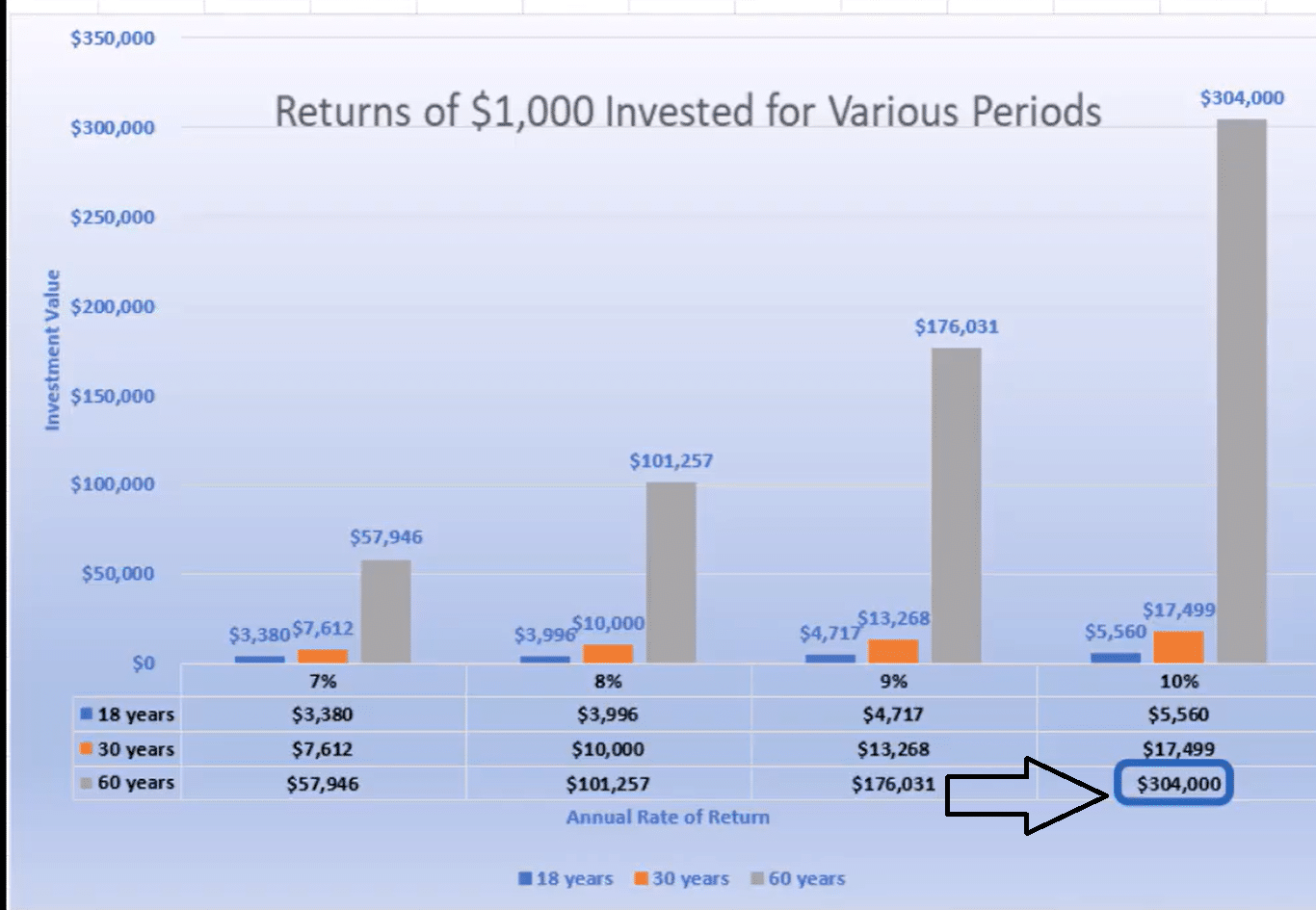
As shown in the chart above, one path to maximize your initial $1,000 contribution is to leave it invested. For those who can resist withdrawing the funds at age 18, letting the money compound until age 60 can yield impressive results. With a 10% annualized return, that initial $1,000 grows to roughly $304,000 by age 60.
The Trump Savings Account money is a good start, but you’ll still need to save and invest more money on your own, for a secure financial future.
Beyond the Trump Account: Additional Family Contributions
First, if any charity, workplace or organization wants to contribute free money to the Trump account, take the FREE money.
To maximize long-term financial impact, parents and relatives can utilize a combination of tax-advantaged vehicles tailored to the child’s specific goals. In some cases these accounts offer better tax treatment and higher contribution limits than the Trump Account.
- 529 Plans: Ideal for educational expenses, offering tax-free withdrawals and rollover flexibility to a
- Roth IRA.
- Custodial Accounts (UGMA/UTMA): Great for broad financial goals without contribution limits, though assets transfer outright at age 18.
- Custodial Roth IRAs: Perfect for children with earned income, offering decades of tax-free
- compounding for retirement.
If you need help with your investments, we’ve partnered with WiserAdvisor to provide you with access to three vetted Financial Advisors – in your area. Click the image below to sign up. (no obligation when signing up)
Trump Accounts Pros and Cons
As with all financial products, there are Trump Accounts pros and cons. That withstanding, if your child is eligible for the $1,000 free money and any other free contributions from companies and charities, take the money!
Trump Account Advantages
- $1,000 contribution is FREE money, accept it! Think of it like your employer contribution to your 401(k) account, tax-deferred compounded growth.
- Money invested in the US stock market over long periods of time has grown exponentially. For the past 100 years or so, the money in the US stock market has grown nearly 10% per year annually. (Investment returns are not guaranteed.)
Trump Account Disadvantages
- The money can’t be withdrawn until the child reaches age 18.
- Upon withdrawal, the the initial $1,000 plus any added growth in the value of the account, is taxed as ordinary income, not at lower capital gains rates.
- If others contribute—like mom or dad, grandma, whomever—only the money that they contribute is an after-tax contribution, which means, you will not owe tax on Mom or Grandma’s initial contribution, just on the capital growth. That can yield a record-keeping nightmare.
- For the less computer-savvy, it might be difficult to open and track the account funds.
Trump Account Wrap Up
Trump accounts are not a scam. Your child is receiving real money, that will be entirely his or hers at age 18, including all additional growth beyond the $1,000. The Trump money for kids is invested, tax-deferred, in U.S. companies, through low-fee index funds for the first 18 years of their life. Although free money is great, it comes with some baggage.
Navigating the eligibility requirements, contribution limits and eventual tax implications requires careful planning. For families weighing the Trump Accounts pros and cons, exploring alternative options like 529 college savings plans or custodial accounts might provide greater flexibility for additional child financial contributions.
Ultimately, claiming your child’s initial pilot program contribution is a smart first step toward building a strong financial foundation for their future.
If you need help with your investments, we’ve partnered with WiserAdvisor to provide you with access to three vetted Financial Advisors – in your area. Click the image below to sign up. (no obligation when signing up)
Related
- 5 Financial Lessons To Teach Your Child
- 5 Tips to Manage Debt and Save as a Family – Without Sacrifice
- How To Become A Millionaire by 40 – 9 Strategies That Work
- The Financial Planning Process – Steps to Wealth
- What are Index Funds and Asset Classes Investing?
Sources:
- https://www.irs.gov/trumpaccounts
- https://www.irs.gov/instructions/i4547
- https://trumpaccounts.gov
- Trump account investments (July, 2026): https://home.treasury.gov/news/press-releases/sb0551
Disclosure: Please note that this article may contain affiliate links which means that – at zero cost to you – I might earn a commission if you sign up or buy through the affiliate link. That said, I never recommend anything I don’t believe is valuable.
Investment results are not guaranteed.
The post Trump Accounts – Pros And Cons appeared first on Barbara Friedberg.