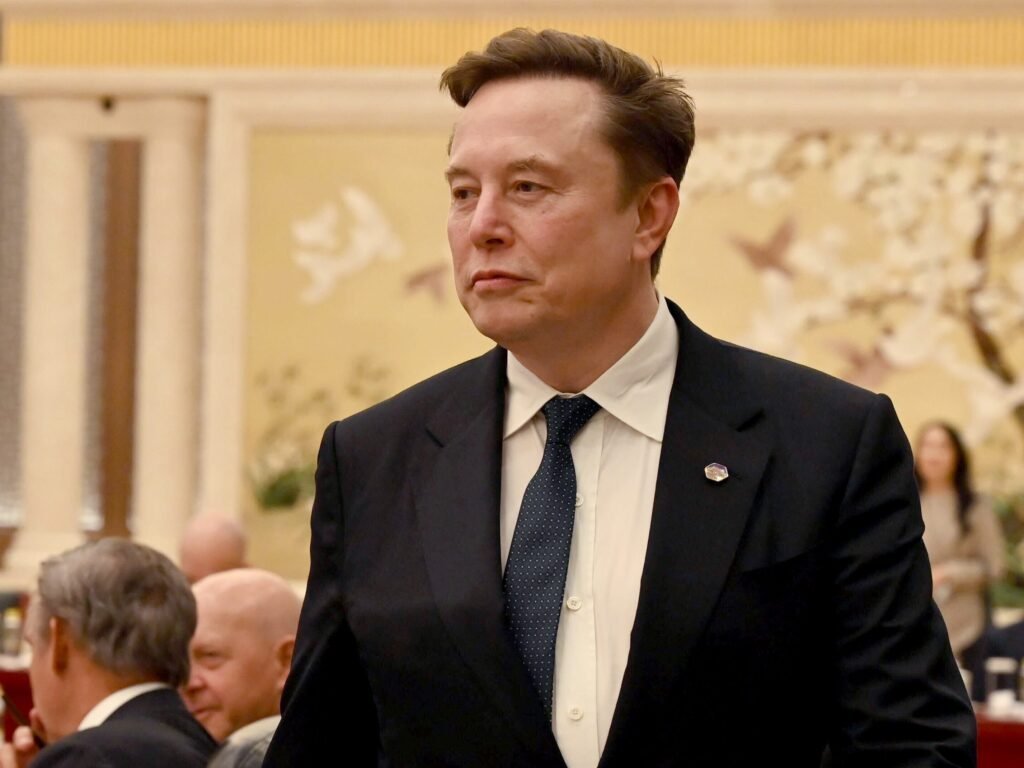
Johannes Neudecker/picture alliance via Getty Images
- The FAA ordered a nationwide ground stop on Friday following a major network outage.
- Elon Musk said Monday that he previously offered Starlink terminals to help the FAA’s aging network.
- But it’s unclear whether that would have prevented Friday’s outage, with investigations ongoing.
Elon Musk says Starlink terminals could be the answer to fixing the struggling US air traffic control system after last week’s outage.
Nearly 20,000 flights were canceled after the Federal Aviation Administration ordered a nationwide ground stop last Friday. No airplanes were allowed to take off for over four hours — the largest shutdown since September 11, 2001.
While the root cause is still under investigation, the FAA said its legacy equipment became unstable after its network was flooded with connection attempts — disrupting major air traffic control centers. Investigators are examining sites in Texas and Arkansas, where contractor L3Harris had been installing a new router.
Transportation Secretary Sean Duffy said last Friday that the country has “old switches, old routers” and asked for $50 billion to build a new system.
Musk previously called out the aging technology in February 2025 after a minor system outage.
On Tuesday night, he reshared that X post, adding “I wrote this 18 months ago.”
The SpaceX CEO also said on Monday: “Free Starlinks for FAA were offered to Sec. Duffy, but he said they were not needed. As it turns out, they were.”
However, it is unclear how Starlink terminals could have prevented the data flood that caused this weekend’s disruption.
The FAA did not immediately respond to a request for comment on Musk’s remarks.
In March 2025, the FAA said it was testing Starlink at sites in Alaska, Oklahoma City, and Atlantic City — through the same network managed by L3 Harris, which broke down last weekend.
The Alaska deployment was at “non-safety-critical sites,” intended to provide more reliable weather information for pilots and FAA stations in remote areas.
“To update our air traffic control system, it will require multiple companies and multiple technologies,” the FAA said at the time. “That is why we are testing multiple communication technologies, including satellites, fiber, and wireless to ensure the safety of the national airspace system.”
Starlink terminals can provide useful connections, particularly at remote sites. But that is different from replacing the entire network that links air-traffic-control facilities and carries aircraft radio and radar feeds.
Plus, relying on Starlink for vital infrastructure hasn’t worked perfectly for everyone.
Ukraine uses Starshield, SpaceX’s military-focused satellite service, for critical battlefield communications, including with interceptor drones.
President Volodymyr Zelenskyy said this month that Ukraine had detected renewed restrictions on the service in Russian-occupied parts of the country. He said interceptor drones were losing connection with their operators when traveling faster than 100 mph, preventing them from catching some Russian jet-powered drones.
“And this means more Russian strikes get through, and more of our people are killed,” Zelenskyy said.
Musk has said Starshield is “owned and controlled” by the US government, and that limits on its use are ultimately decided by President Donald Trump.
Trump denied ordering any slowdown. “It wasn’t me,” he told reporters last month. “And I don’t think it was Elon.”