A new paper analyses the cluster of landslides triggered by an exceptional rainfall event. In total, 43 people were killed in this terrible set of failures.

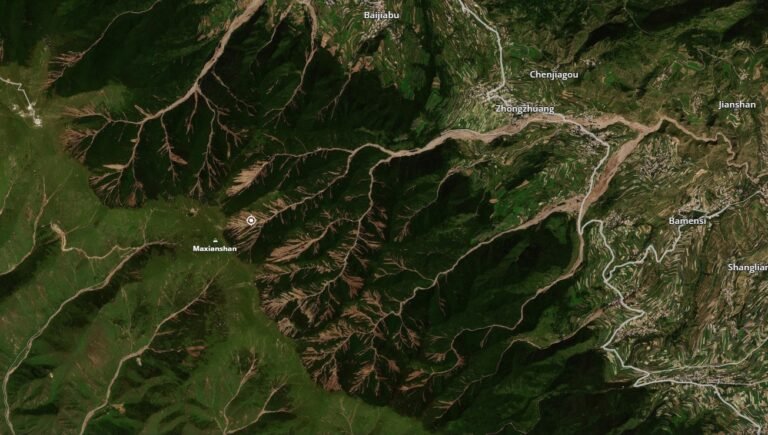
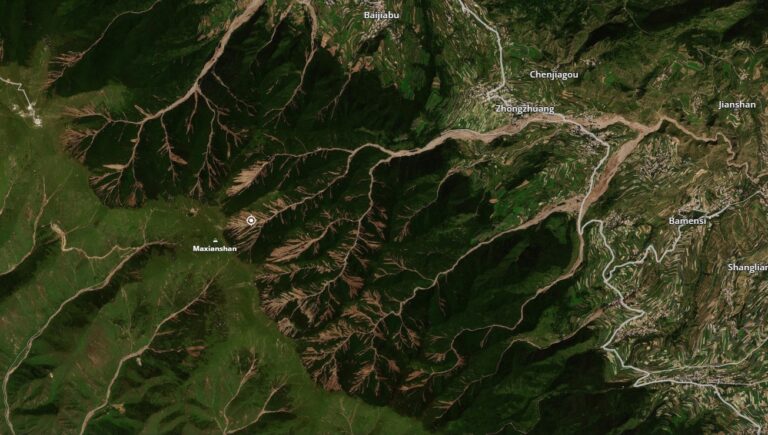
On 7-8 August 2025, an intense rainfall event triggered a remarkable cluster of landslides in Yuzhong County in Gansu Province, China. I blogged about this at the time, and included this Planet Labs image of the aftermath, showing both the cluster of landslides and the channelised debris flows through the lower part of the drainage system:-
I very much welcome the publication of a paper (Guo et al. 2026) in the journal Natural Hazards that provides a comprehensive analysis of this event. This link should give you access to the article behind the paywall.
The team have mapped the landslides – they have identified 280 individual failures that amalgamated to form channelised debris flows. In total, 43 people were killed, although officially 28 of those are missing. As the image above shows, a particularly interesting aspect of this cluster of landslides is that it occurred on a mountain that was densely vegetated.
Guo et al. (2026) have come to an interesting conclusion about these landslides, which is that failure was preconditioned by repeated freeze-thaw cycles. This caused a weakening at the soil-bedrock interface, with failure then being triggered by intense precipitation. The rainfall itself was exceptional – the nearest rain gauge recorded 220.2 mm in the storm, which is 56% of the total annual precipitation. The rainfall arrived in two distinct spells, of which the second (between 11 pm on 7 August and 1 am on 8 August) was the more intense, triggering the landslides.
Guo et al. (2026) consider how these landslides created the dramatic channelised debris flows that killed so many people. They have concluded that the debris flows were the result of blockage of channels by the landslide debris, with collapses of the blockages then generating rapid flow events, combined with constrictions in the channels that impeded the flows, leading to amplification of the discharge.
Interestingly, they conclude that the woody debris in the flows may have contributed to these blockage and surge events. Thus, Guo et al. (2026) suggest that, contrary to the commonly held dogma that woodland is good for slope instability, in this case the presence of trees may have amplified the channelised debris flows.
Reference and acknowledgements
Guo, F., Xie, Y., Zhao, Y. et al. 2026. Causes of mass shallow landslides in densely vegetated areas and their amplifying effect on debris flows: insights from the 2025 Yuzhong event. Natural Hazards 122, 677. https://doi.org/10.1007/s11069-026-08455-5
Text © 2026. The authors. CC BY-NC-ND 3.0
Except where otherwise noted, images are subject to copyright. Any reuse without express permission from the copyright owner is prohibited.