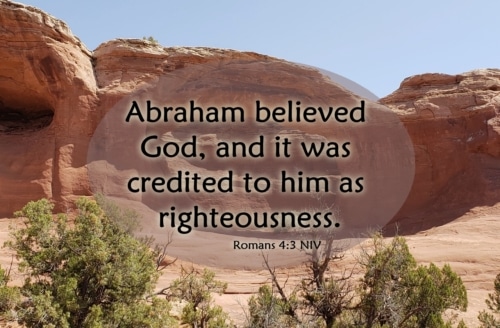
For what does the Scripture say? “Abraham believed God, and it was counted to him as righteousness.”
Central to the gospel that Paul proclaimed is that salvation is a matter of God’s grace, received through faith, and apart from works (Eph. 2:8-9). There is nothing we can do to earn it. To illustrate this point, Paul turned to Abraham.
God called Abraham to leave his home and family behind and move to a strange land. And Abraham did. God promised Abraham that he would have descendants. And not just a few. God told him that his offspring would be as countless as the stars (Gen. 15:5). And Abraham believed God. Even though he was an old man. And even though he did not yet have any children.
And, because Abraham believed what God had told him, God considered him to be righteous (Gen. 15:6). Abraham had already moved to the place God had sent him. And he continued to do what God had told him to do. But his being in a right standing with God was not because of his obedience. It was because he believed what God told him. He was “fully convinced that God was able to do what he had promised” (Rom. 4:21).
Paul concluded by saying that this is true not just for Abraham. All who believe in Him who raised Jesus from the dead will also be considered righteous (Rom. 4:23-24).
So, what does it mean to believe in God? Belief is often equated with intellectual assent: I accept as true that there are trillions of stars in the universe. But that belief has no practical impact on my life.
But as used in the Scripture, belief implies trust or reliance on the object of belief. Abraham was not perfect. But his belief in God’s promises to him led him to act in very concrete ways. Even so, my belief in Christ Jesus (Rom. 3:22), if genuine, will lead to action on my part. And it is that belief, not the actions that follow, that leads God to declare me as righteous.
Related Posts
The post Abraham Believed God – Romans 4:3 appeared first on A Clay Jar.