
A small gallery on the border between Ridgewood and Bushwick transports viewers from a quiet, part-industrial, part-commercial block to mountaintops and topsy-turvy skies via the möbius strip of textile. It must be nice to fall in love at artist-run Tempest gallery features delicate and detailed manipulations of thread and fabric by Raisa Kabir, Katherine Earle, and Leila Seyedzadeh, gently enveloping viewers in conversations about climate change and shifts in cultural identity alike.
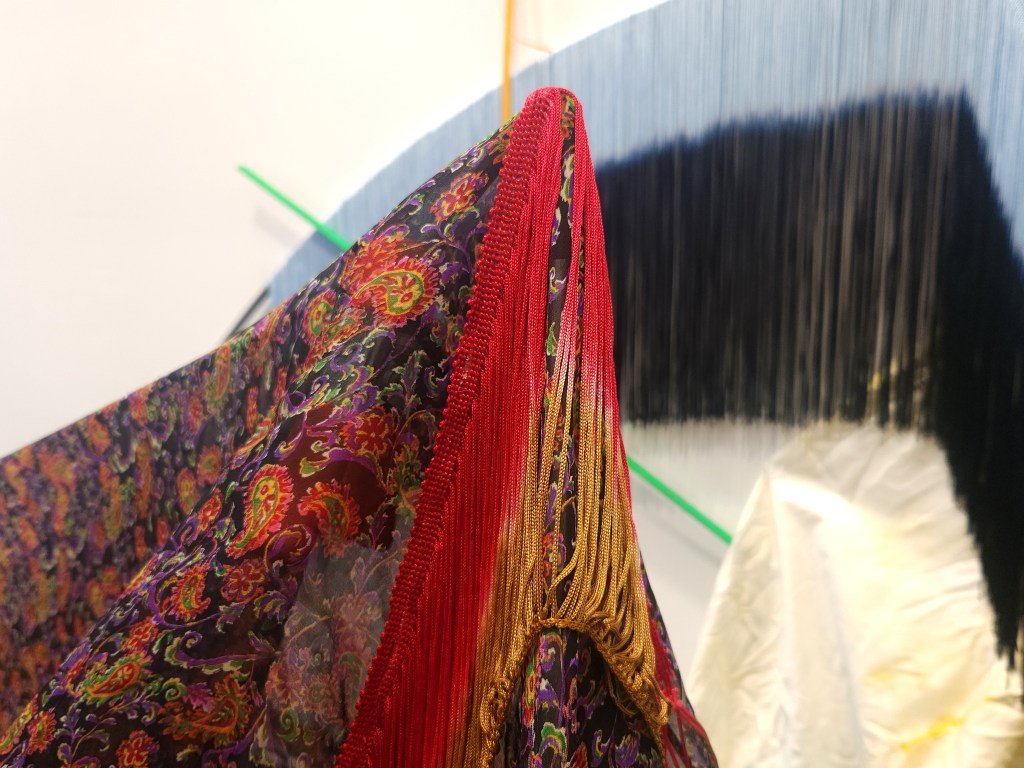
Each of these works simultaneously embeds itself within and pushes back against the rigidity implied by the gallery’s white walls and concrete floor, forming new yet familiar scapes from each angle. The flexible poles of Iranian artist Seyedzadeh’s installation “Mapping the air through its peaks” (2025) suspend the draped summits and fringed slopes of a surreal, practically weightless mountain range.

The translucent paisley-printed fabric harkens back to her childhood memories of playing underneath her mother’s chador namazes (prayer veils), while the equally playful and elegant hand-dyed fringe channels the tasseled edges of Persian carpets. Referencing the multidimensional perspectives of Persian Negārgarī paintings, Seyedzadeh’s installation takes us to the Alborz mountain range that served as the backdrop of her upbringing in Tehran. On the adjacent wall beside the gallery’s entryway, Seyedzadeh’s “Threads of Longing” (2025) also plays with multidimensionality through its floating, warped strip of sky-blue fabric suspended below a plane, flipping one’s sense of up and down and jumbling the reality of life in 360 degrees.

At the back of the gallery, Earle’s wall hangings stir delicately when someone breezes by. Displayed in a row of three, Earle’s cotton and silk works operate as deliberate but anxious contemplations on the role of manmade disposability in the natural world. On the left, the artist’s “Languages die like rivers” (2025), a dyed batik stretch of blood-red cotton with minute embroideries, speaks to what has been lost or altered beyond the point of return on an anthropological and ecological scale. “Fault Lines” (2025), the central silk piece, is both dyed and printed with rust, an indication of Earle’s continued interest in the material’s connotations of obsolescence and abandonment in the wake of progress. Colorful and metallic threads snake in their confinement within the printed shapes, reintroducing the limits of the human hand into the labor of silkworms and machines. To the right, Earle’s rust-printed silk square translates as scabbed-over scrapes and cuts.

Kabir, a Mancunian artist of Bangladeshi heritage based in London, guides her audience through a history of imperial trauma interlaced with anti-colonial resistance. This includes the British imperial violence inextricable from Bangladesh’s formation and the ensuing civilian flight into the United Kingdom; the disruption and devaluation of the South Asian textile industry through industrialization and trade; and hierarchical structures within the British textile industry. Kabir’s woven pattern tapestries are imbued with four-way mirrored Bangla characters in black, white, and red. They are clear and legible in certain areas before a floating weft stretches and distorts them; they ultimately rupture completely into cascading, bleeding tangles of loose threads.

The delicate tapestries suggest abstracted archives documenting colonial and post-colonial bloodshed, the loss of culture and history through diaspora, and the painful fragmentations of families, societies, traditions, and economies. But perhaps more importantly, they also reclaim and reinterpret Bangladesh’s cultural heritage with a sense of profound agency and urgency.


It must be nice to fall in love continues at Tempest Gallery (1642 Weirfield Street, Ridgewood, Queens) through November 1.