
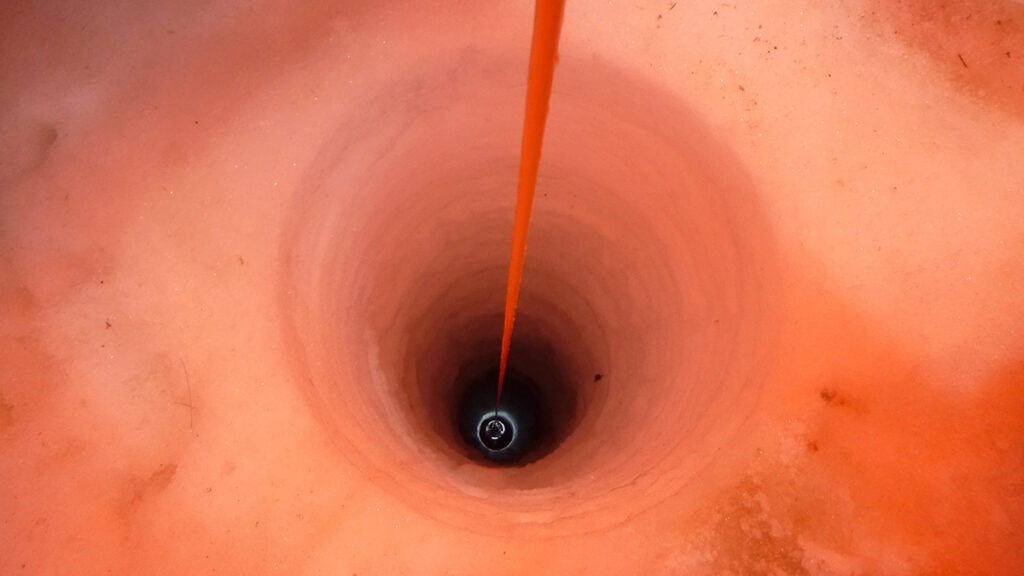
Source: Journal of Geophysical Research: Oceans
Antarctica’s massive ice shelves melt largely from the bottom, as warmer seawater eats away at the floating ice. What’s going on beneath these shelves isn’t well-known, however. Because Antarctic conditions are challenging, few boreholes exist from which to gather data on temperature, currents, salinity, and other properties beneath hundreds of meters of ice.
With the first multiyear hydrographic dataset from one of the few boreholes through the Ross Ice Shelf, Xiahou et al. examined the interannual dynamics of Antarctic ice shelf cavity circulation. The new dataset shows how conditions in this largely unexplored zone may influence the evolution of the ice sheet, the authors say.
The data span from 2018 to 2022 and come from hydrographic instruments placed at different depths through the hot water drilling site 2 (HWD2) borehole in the Ross Ice Shelf, which was drilled in 2017. The authors monitored changes to currents, temperature, and conductivity (a proxy for salinity), though some instruments failed before the study period was up. The authors noted distinct circulation patterns at different depths, including seasonal intrusions of supercooled water in the upper to middle water column and altered flow near the ice shelf likely caused by ice surface roughness. They also noted an increase in melting and refreezing rates in the shelf cavity in 2019, which they suggest was caused by increased polynya activity in the Ross Ice Shelf in 2018.
The discovery of regular supercooled water intrusions could be important for future simulations of meltwater dynamics, the researchers say. Overall, they add, data from the Ross Ice Shelf provide an important point of comparison for other Antarctic ice shelves, which have similarly sparse hydrographic data records. In the future, they recommend placing instruments near Byrd Glacier, which terminates at the Ross Ice Shelf, to further study how supercooled meltwater influences cavity circulation and ice shelf stability. (Journal of Geophysical Research: Oceans, https://doi.org/10.1029/2025JC023511, 2026)
—Nathaniel Scharping (@nathanielscharp), Science Writer

Citation: Scharping, N. (2026), A long-term look beneath an Antarctic ice shelf, Eos, 107, https://doi.org/10.1029/2026EO260078. Published on 6 March 2026.
Text © 2026. AGU. CC BY-NC-ND 3.0
Except where otherwise noted, images are subject to copyright. Any reuse without express permission from the copyright owner is prohibited.


