In the first century BCE, Rome’s elite would often retreat to the resorts of beachside Baia, 16 kilometers outside of present-day Naples, to engage in hedonism and lavish displays of wealth. But over the centuries, the ground where families and emperors had erected villas and statues listed, sank, and flooded as volcanic activity and subterranean magma flows slowly changed the topography. Now, once-coastal sites like Baia lie submerged beneath the Mediterranean.
Now, in a study published in Communications Earth and Environment, a team of geologists and marine ecologists has shown that ocean acidification is threatening the integrity of underwater cultural sites like Baia.
Using a combination of field studies, laboratory experiments, and computational modeling, the researchers assessed how carbonate materials commonly used in antiquity, such as marble and limestone, dissolve in different acidic conditions.
Caged Carbonate
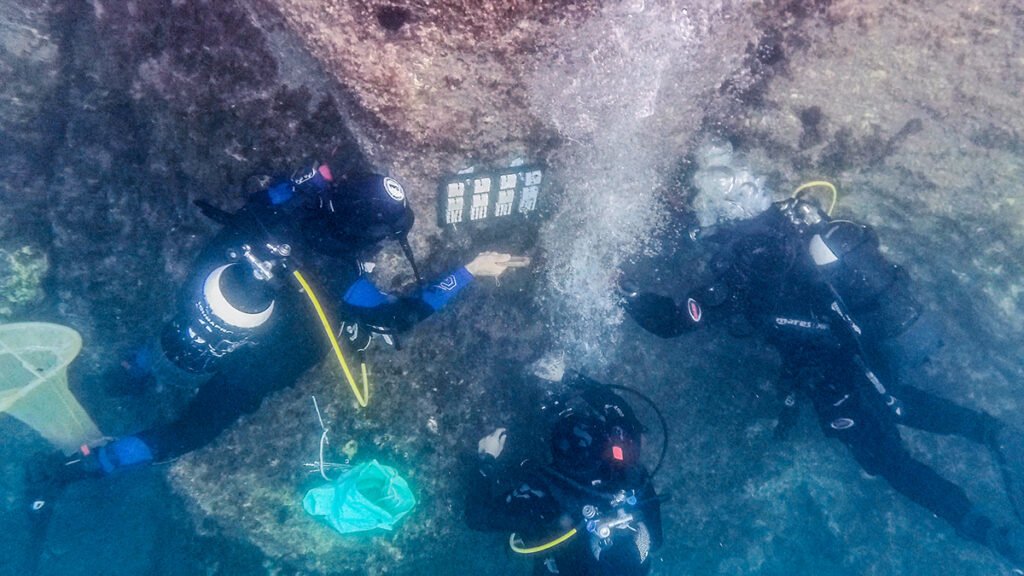
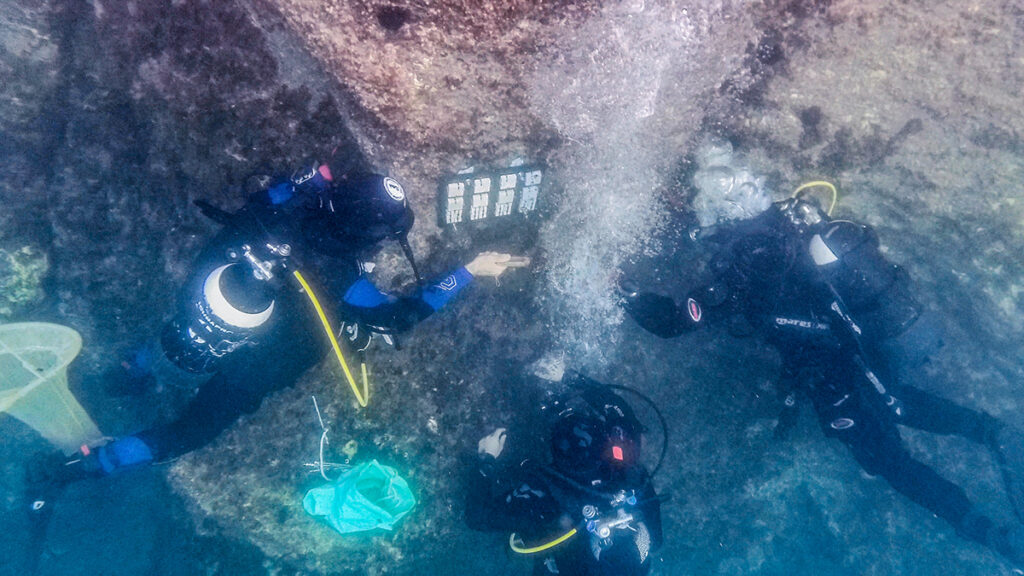
For the field tests, Luigi Germinario, the Università Degli Studi di Padova heritage scientist who led the paper, dove with members of his team in the shallows of a bay off the volcanic island of Ischia, itself just 16 kilometers from Baia. Ischia offers an environment that makes it easy to test the effects of ocean acidification. Submarine vents around the island bubble away like freshly poured soda water, releasing a steady stream of carbon dioxide bubbles but—unlike most volcanic vents—little in the way of heat or other contaminants. Thus, the vents create an acidity gradient that decreases with distance from the bubble columns. Germinario’s team installed three panels at varying distances from the vents, each with samples of marble, travertine, and both porous and compact limestone.
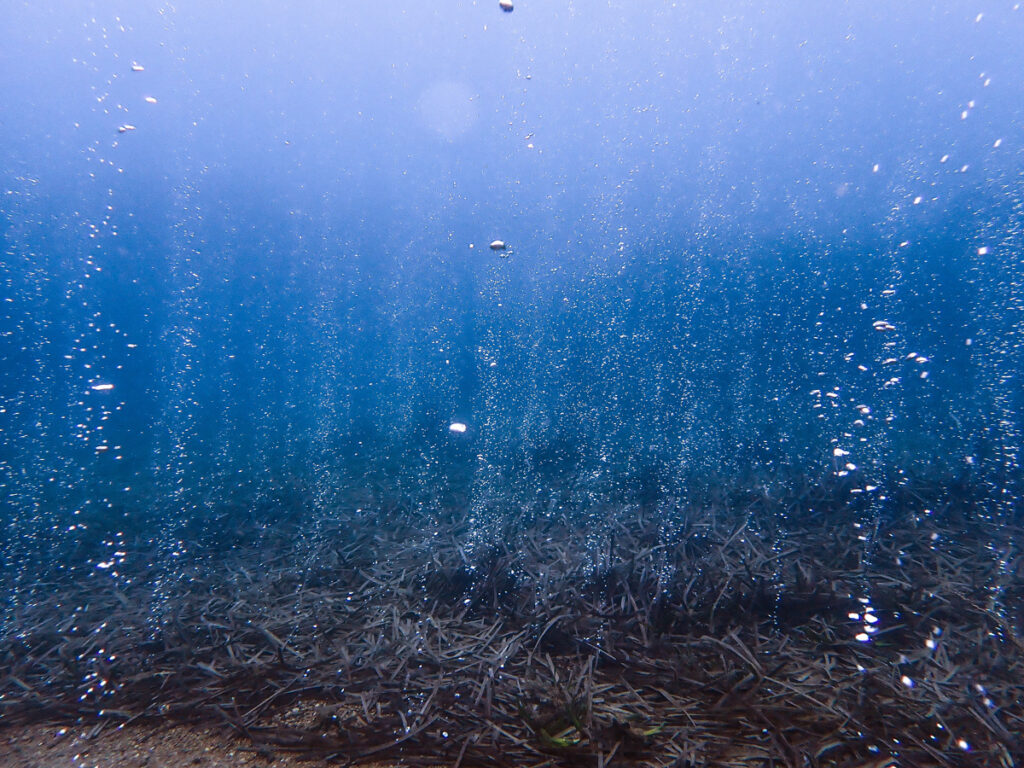
“Three or 4 years ago, I wasn’t even a diver,” said Germinario, who took scuba courses specifically to conduct these field studies. He also partnered with a pair of technical divers who could operate the aquatic power tools required to install and cage the samples (to ward off curious snorkelers).
Meanwhile, in the lab at the Università Degli Studi di Padova, Germinario’s team submerged carbonate slabs in waters with precisely controlled levels of acidity, temperature, and pressure but without any of the waves, currents, algae growth, sand splash, or tourist traffic that might affect the field experiment.
The field experiments are “a standard methodology drawing from the marine geological and marine ecological sciences,” said Colin Breen, an archaeologist at Ulster University who is leading a series of white papers for the United Nations Educational, Scientific and Cultural Organization (UNESCO) focused on marine cultural heritage but who was uninvolved in Germinario’s research.
Germinario’s team carried out both the field and lab tests over the course of a year so they could isolate the effect of acidity from the confounding influences of turbid ocean environs.
Different Rates for Different Rocks
“There’s a trend showing an exponential increase in the vulnerability of the materials as the [acidity increases].”
On the basis of the lab experiments, Germinario’s team found that under preindustrial conditions as well as those of the present, erosion and dissolution of the samples were almost negligible; the surfaces shed a micrometer or less over the course of a year. But at higher acidities, porous limestone began to lose more than 1 millimeter in a year, and even marble, the most resolute rock type they tested, started to lose roughly a quarter of a millimeter over the same period.
“I was surprised by the difference in erosion rates,” Germinario said. “There’s a trend showing an exponential increase in the vulnerability of the materials as the [acidity increases].”
That vulnerability is further mediated by the waves, currents, and storms a material is exposed to. Geometry plays a role as well, their fieldwork results showed: The face of an artifact exposed to wave fronts and current flows dissolves faster than the shielded back portion.
“It’s brilliant seeing this type of scientific approach being taken, but it’s a start.”
Both Breen and Elena Perez-Alvaro, a marine heritage researcher at the University of Auckland unaffiliated with Germinario’s group, highlighted the importance of conducting similar experiments at other sites around the world to examine how vulnerabilities vary by region.
“It’s brilliant seeing this type of scientific approach being taken, but it’s a start,” Breen said. “The replication of these types of studies across different types of environments will be really interesting to see.”
John Hughes, a heritage scientist at the University of the West of Scotland also uninvolved in Germinario’s work, added that while carbonates are an incredibly common material found at many archaeological sites, cultures ultimately build with what their local geology provides. So Hughes is eager to see what these experiments would show for other classes of stone, such as the granites and sandstone commonly found in archaeological and historical sites across Scotland.
Accelerating Erosion
Overall, the results paint a concerning picture for the integrity of many underwater cultural sites.
When the authors of the recent paper combined their experimental results with models of ocean acidity derived from data published by the Intergovernmental Panel on Climate Change, they found that by century’s end, under some of the more pessimistic scenarios, the rates of decay at underwater sites could increase anywhere from fourfold to sixfold compared with the present. This rate would be enough to erode away the fine features of marble sculptures submerged at Baia.
Millions of seafloor cultural sites exist around the world, including those associated with UNESCO World Heritage Sites. This study shows how climate change threatens not only marine ecologies but unique opportunities to study human history via underwater settlements, shipwrecks, and singular artifacts. In the paper, the authors acknowledge an urgent need for preservation and adaptation policies.
Identifying workable solutions to safeguard underwater artifacts from climate-driven deterioration is increasingly important, as island nations and coastal cities are at risk of fast becoming the kind of marine relics Germinario’s paper is concerned with, Perez-Alvaro said.
To Breen, the most valuable contribution from the paper is the ability to model and project future changes when most heritage research focuses on the state of existing deterioration. Such results could help authorities design strategies to protect sites from the eroding forces of the climate crisis.
—Syris Valentine (@shapersyris.bsky.social), Science Writer
Citation: Valentine, S. (2026), Acidifying seas are wearing away at underwater archaeology, Eos, 107, https://doi.org/10.1029/2026EO260079. Published on 9 March 2026.
Text © 2026. The authors. CC BY-NC-ND 3.0
Except where otherwise noted, images are subject to copyright. Any reuse without express permission from the copyright owner is prohibited.