Last week, a new piece of public art appeared outside of the Italian National Olympic Committee (CONI) headquarters, located in Rome’s Piazza Lauro de Bosis. The graffiti centers an image of an Olympic ski jumper sailing through the air, while, from below, an ICE agent in a tactical vest points a gun directly at the jumper’s heart. Above the scene, the Olympic Rings are featured, with a twist: the red ring has been reimagined as the bleeding crosshairs of a deadly weapon.
The art was created by Laika, a self-described activist and graffiti artist based in Rome. In an interview with the publication ANSA English, she explained that the art was an act of protest in the wake of an announcement from U.S. officials that Immigrations and Custom Enforcement (ICE) officers would be part of the American security detail at the Olympics. The announcement came just weeks after ICE agents shot and killed Minneapolis residents Renee Good and Alex Pretti amidst ongoing protests in that city.
Reports that ICE agents would appear at the Olympics surfaced in late January, and were met with confusion, outrage, and wide-spread protests from Italian citizens. The U.S. Department of Homeland Security clarified in a statement to the AP on January 26 that the agents in question would not be part of ICE’s immigration enforcement operations, but rather from its Homeland Security Investigations branch, which frequently travels overseas to events like the Olympics to assist with security. Still, Italian citizens and Olympic attendees are continuing to speak out against ICE in solidarity with both the people of Minnesota and Americans at large.
Laika is one of many Italian citizens who have taken to using artwork as a form of protest against ICE’s presence at the Olympics. Here are three examples of the most powerful work so far.
“No ICE in Milano”
On January 31, hundreds of protestors gathered in Milan’s Piazza XXV Aprile (a central square) to voice their dissent against ICE. In the crowd, dozens of people held aloft the same sign: an image of the Olympic Rings, reimagined as colorful handcuffs, captioned with the phrase, “No ICE in Milano.”
The signs appear to have been designed and distributed by the group I Sentenilli di Milano, an organization dedicated to supporting the queer community and advocating against fascism.
“The disturbing images coming from the United States add to the horror of other places in the world where human rights have been trampled on,” the organizers wrote in a caption on Instagram, adding, “That’s why the Sentinelli with many other democratic realities are waiting for you in the square on Saturday. Come with a whistle.”
At the protest, another organizer named Alessandro Capella, head of the Italian Democratic Party’s Milan chapter, told NPR, “It’s not just for the Olympic games, it’s about justice in the world. We don’t want ICE here.”
“ICE OUT!”
Just a week after the January 31 protest, hundreds of people once again took to the streets of Milan in an anti-ICE protest on February 6. Among them was Laika, who captioned an Instagram post of her graffiti with a call for followers to attend the gathering.
“ICE OUT!” the caption begins. “With the ‘Trump’s Gestapo’ at the Milan-Cortina Games, fundamental values of the Olympic Charter are being killed, such as solidarity and the fight against discrimination, values that affirm the principle that ‘sport is at the service of the harmonious development of man, to promote the advent of a peaceful society committed to defending human dignity.’”
Laika is using her art as a direct call-out to CONI and International Olympic Committee (IOC) for failing to bar ICE agents from attending the Olympics.
“It angers me that the IOC and CONI have not taken a clear position consistent with their values, but have looked the other way, downplaying the issue as the exclusive responsibility of states and governments,” she told ANSA English. “Today, the entire world of sport, and beyond, is raising its voice: there is no room for racism, violence, or those who threaten democracy.”
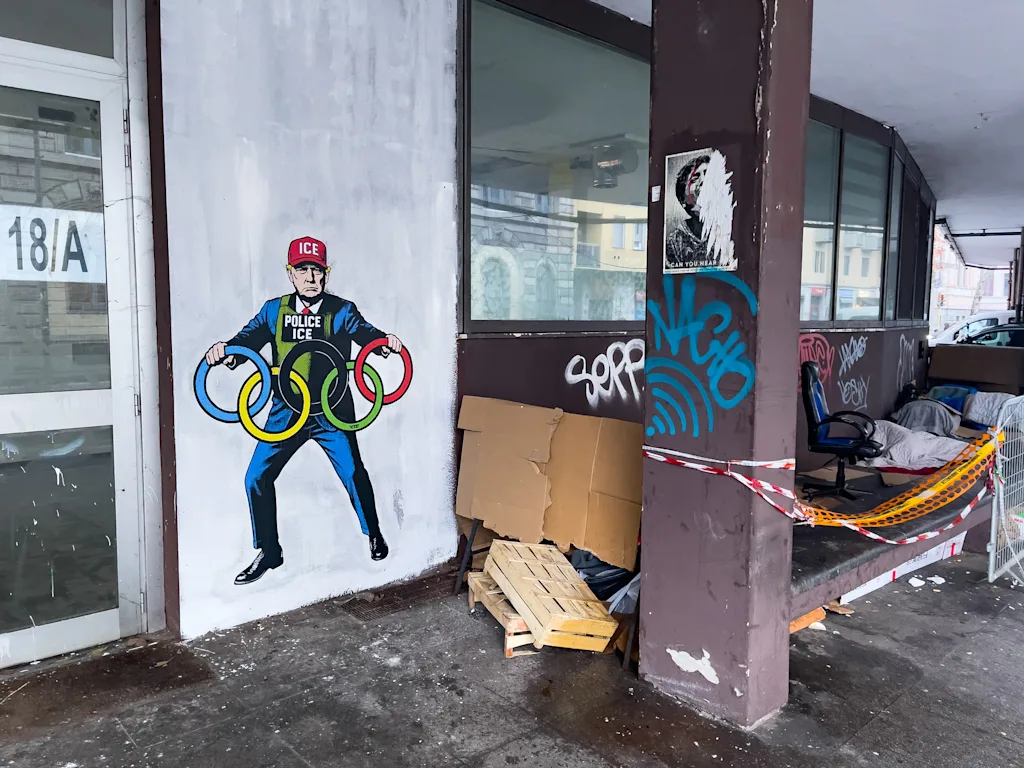
Donald Trump as an ICE agent
Amidst the recent protests in Milan, another artist has added his own mural to the heart of the city, just minutes away from the Olympic cauldron at the Arco della Pace. The graffiti, created by Italian pop artist aleXsandro Palombo, depicts President Trump in his quintessential blue suit, wearing a red hat with the phrase “ICE” and a tactical vest reading “POLICE ICE.” In his hands, he’s brandishing the Olympic Rings like a weapon.
The concept for the mural, Palombo says, came from the gap between the Olympics’ imagined world “without barriers” and “the contemporary reality made of borders, controls, and exclusions.”
“The Olympic rings represent the last great shared utopia, the idea that humanity can recognize itself as a single community,” Palombo says. “The ICE uniform instead evokes the mechanisms that decide who may move, who may remain, who may be seen. Bringing these symbols together reveals the contradiction between the ideal and the real.”
The physical placement of the mural brings these themes into sharper focus. Palombo chose the Bastioni di Porta Volta as the site of his work, a historic shelter formerly used by public transport staff, which has recently become an improvised refuge for many unhoused migrants. On one side of the building, he explains, is an athletic celebration of “universal brotherhood,” while on the other are the “invisible lives of those without documents, without voice, without recognized rights.”
He hopes that the work will bring these inherent contradictions to the surface of discussions around the Olympics, while also paying tribute to the American athletes who have chosen to speak out against ICE.
“Within this visual tension there is also an implicit tribute to those, like many American athletes, who have chosen to use their visibility to speak out against what is broken,” Palombo says. “Their gesture is not only political, it is an act of responsibility toward freedom of expression. It is proof that the America we admire still exists, one willing to show itself, to take risks, to defend what is right. The message of the work is that every image of power carries responsibility, and that every symbol, even the brightest one, casts a shadow.”