The EU’s way or the highway.
After months of politically motivated trade tensions between the European Union and China, the former is considering a dramatic retreat of its policies targeting electric vehicle manufacturers in the People’s Republic after just a year and a half.
According to new reports published on January 12 by The New York Times and the South China Morning Post, the European Commission, the executive arm of the European Union, and China’s Ministry of Commerce announced new guidance that would replace steep tariffs on imported EVs from China.
These new policies would allow automakers with factories in China, as well as Chinese automakers, to voluntarily limit the number of units they ship from China to Europe. In addition, the Commission’s new documentation also outlines that Chinese exporters would set minimum prices for said cars; a figure that the EU will calculate based on the ability to “eliminate the injurious effects of the subsidies and provide equivalent effect to duties.” The commission also implored Chinese EV brands to state their plans for future investments in the EU.
Automakers who play ball with the European Commission on its price control and import restriction scheme could be exempt from the anti-subsidy tariffs of up to 35% that it first proposed in 2024 on imported Chinese EVs. In a statement to the Times, European Commission spokesman Olof Gill noted that the European Commission had been flexible with its counterparts in the People’s Republic on this matter, with this measure being an example of such.
“We have said from the start, as the European Commission, as the investigative authority in this case, that we’re willing to look at alternatives to the anti-subsidy duties we put in place,” Gill said.
In a separate statement seen by the SCMP, China’s Ministry of Commerce said the new proposal “fully reflects the spirit of dialogue and the outcomes of consultations between China and the EU,” adding that “It shows that both China and the EU have the ability and willingness to properly resolve differences through dialogue and consultation under the framework of WTO rules and maintain the stability of automotive industrial and supply chains in China, the EU and the whole world.”
Xie Guiming/VCG via Getty Images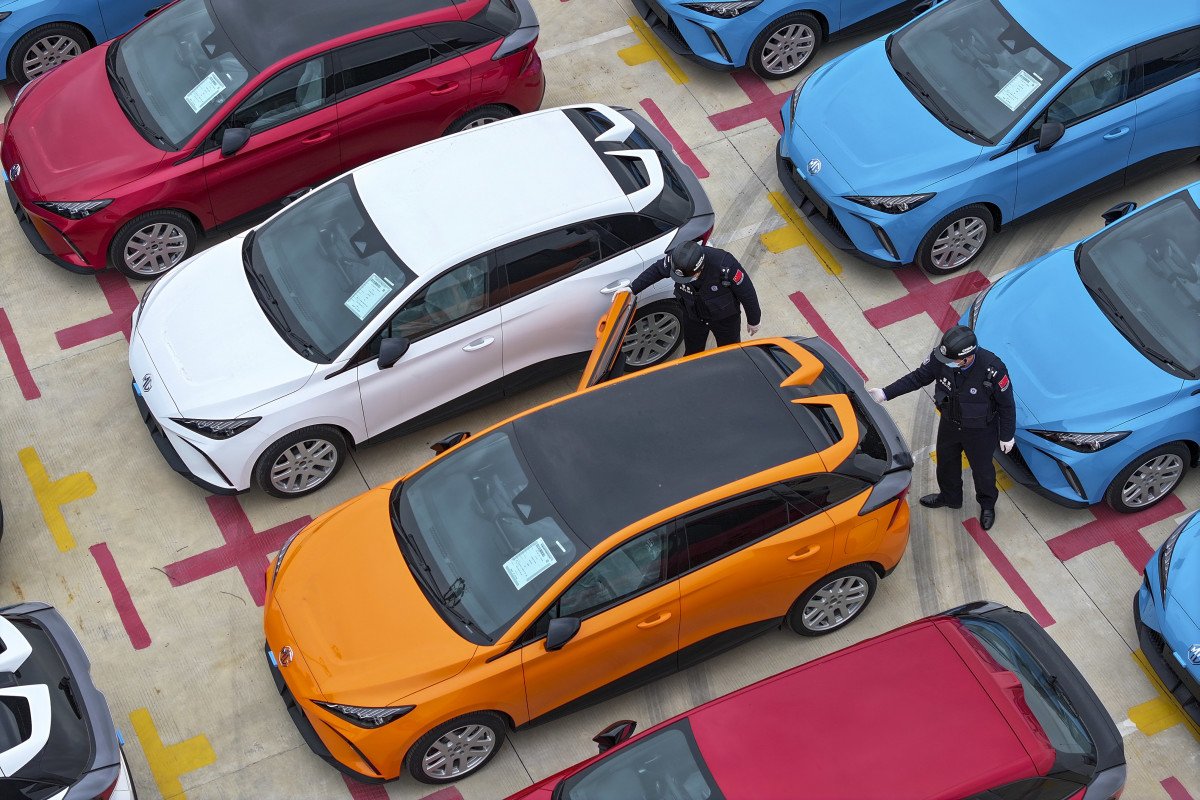
Amending the EU’s sliding-scale tariff rules
The rules come as the two economic superpowers have been at odds with each other due to conflicting policies. In October 2024, the European Union published details of an investigation into government subsidies to carmakers in China, which it claimed gave them a competitive advantage over their European rivals in the electric vehicle market.
Much like the proposed new ruling, the tariffs were based on the amount of subsidies each automaker in China received, ranging from 7.8% for Tesla Shanghai (the division of Tesla that produces CN-exclusive Model Y variants) to 35.3% for SAIC Motor, the state-owned automaker that owns the British heritage brand MG. In response to these tariffs, officials in Beijing launched counter-probes into certain products it believed the EU was flooding, namely European brandy and cognac (i.e., Rémy Martin and Hennessy), pork, and dairy products.
Although these measures were intended to protect the European auto market from juggernauts such as BYD, the measures also affected Western automakers that made cars in China for Europe, including BMW, who made the EU-bound iX3 there and Volvo, who moved production of EU-bound EX30s from China to Belgium to decrease its exposure. At the time, then-Stellantis CEO Carlos Tavares said that the tariffs were counterproductive.
“There should be no mistake these short-term actions will have negative mid- and long-term implications,” Mr. Tavares said at the time. “The best way — the only way — to protect ourselves, our industries, our workers is to compete with the newcomers and raise ourselves to their game.”
Honda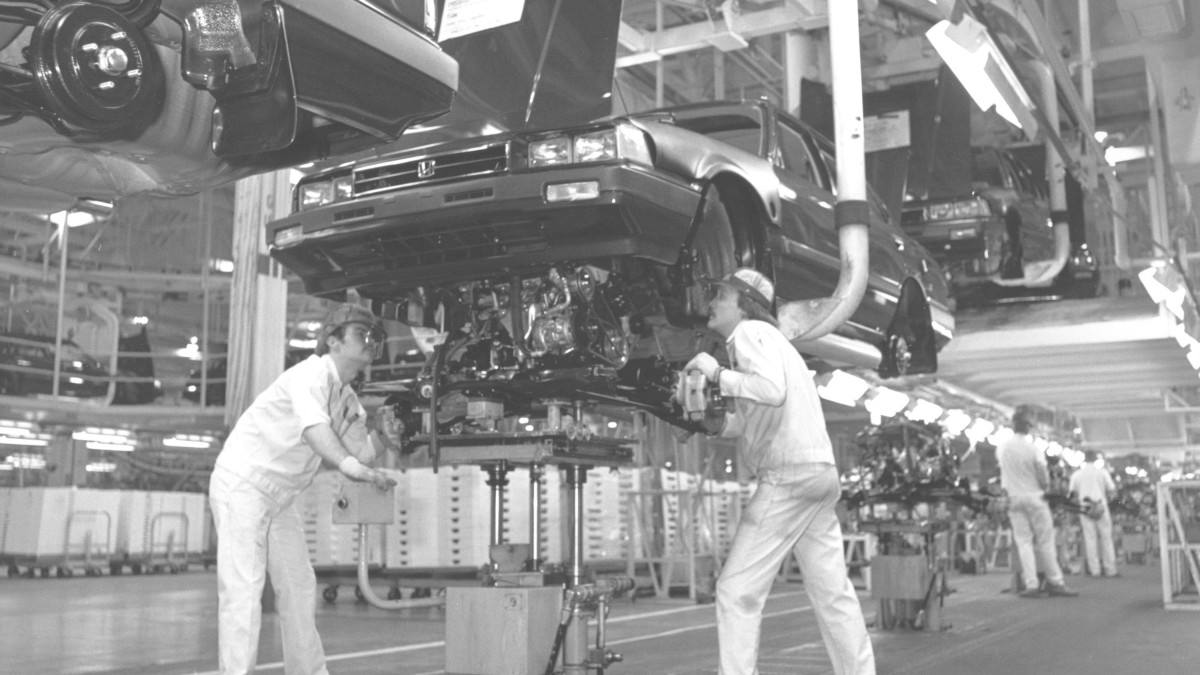
The proposed rules echo similar sentiment between the U.S. and Japan during the 1980s.
The proposed rules from the EU and the Chinese government aren’t entirely new, as a similar measure had been tried during trade tensions between the U.S. and Japan during the early 1980s, as the visual dominance of Japanese companies in key industries like electronics, steel, shipbuilding, textiles, and especially cars led American politicians, workers, and the general public in middle America to lament the land of the rising sun.
During this time, the rise of smaller, imported Japanese cars caught Detroit automakers not paying attention, as sales figures showed that between 1978 and 1980, U.S. automakers lost more of their share in the market when sales of small cars in the United States increased by a third.
In February 1980, UAW President Douglas Fraser traveled to Japan to persuade Japanese automakers to impose voluntary export restraints and to consider setting up operations in the U.S. However, the Japanese companies were reluctant to enter the unfamiliar American business environment. By July, the UAW and Ford urged the U.S. International Trade Commission (ITC) to investigate whether the influx of Japanese cars was harming the domestic auto industry. Despite their claims, in November the ITC ruled that the economic troubles were primarily due to the recession and the U.S. industry’s inability to meet the demand for fuel-efficient vehicles.
The narrative of doom regarding Japanese imports took hold, influenced by the political climate during the 1980 presidential election. At a campaign stop in Michigan, Ronald Reagan assured auto workers, “There is a place where government can be legitimately involved, and this is where I think government has a role it has shirked so far, and that is to convince the Japanese one way or another, and in their own best interest, the deluge of cars into the United States must be slowed while our industry gets back on its feet.”
Despite the strong urge from a bipartisan group of lawmakers to implement trade restrictions, nothing significant occurred initially. During Reagan’s early administration, pressure was applied to Japan’s Ministry of International Trade and Industry, resulting in the Voluntary Export Restraint (VER) agreement that took effect on May 1, 1981. Under this agreement, Japan set its own quotas on car exports to the U.S., starting with 1.68 million vehicles per year from 1981 to 1983, which later increased to 2.3 million by 1985.
Related: How Honda and Other Japanese Redefined the American Car
Final Thoughts
It is important to recognize this small detail in the EU’s proposal, where it asks Chinese automakers about “planned future investments in the EU,” as it could have consequences for both the EU and China, based on what has happened in the United States as a result of the similar policy it enacted to combat Japanese imports.
This period in the 80s led Japanese automakers to explore U.S. local manufacturing to avoid export restraints. Honda came first to Marysville in 1982, followed by Nissan‘s opening of its Smyrna, Tennessee assembly plant in 1983. Toyota opened its Georgetown, Kentucky assembly plant in 1988, and Subaru followed with the opening of its Lafayette, Indiana plant in 1989.
The impact is undeniable. According to the Japan Automobile Manufacturers Association, over 110,000 people are directly employed by Japanese automakers. Since 1982, Japanese automakers have produced over 100 million vehicles in the US, and one in three cars made in the country bears a Japanese brand badge. If they play ball, Chinese automakers have an opportunity to redefine the face of the European car and, hopefully, revitalize Europe’s industrial core if they meet eye to eye on all fronts.
Related: Watch A Chinese EV Beat Ferrari When Conditions Are Not Perfect