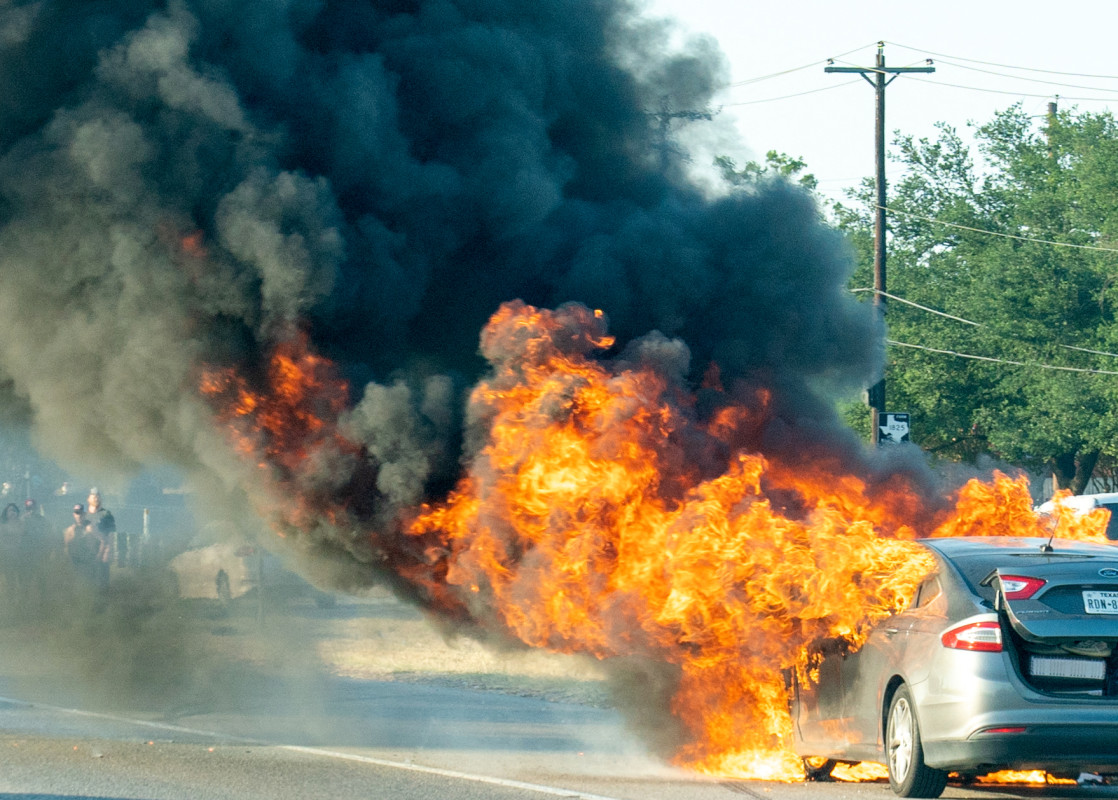
Firefighters know exactly what they’re up against with an internal combustion vehicle fire. Kill the flames and cool the metal so what remains of the vehicle can be towed away. With an EV, though, the fire can come back hours after the fire is seemingly suppressed. When a lithium-ion battery pack enters thermal runaway, a self-sustaining chemical reaction, cells continue to overheat from the inside and vent (accompanied by a popping sound) long after the fire appears to be out. This reaction creates toxic gases that feed the heat and can reignite at any time with no warning. That one difference is the main factor that makes fighting electric vehicle fires so difficult to suppress and safe to leave.
Water Helps, But You Need a Lot of It
While water is still the most commonly used method for suppressing these fires, the volume of water used is quite considerable. One Tesla battery fire documented by the International Association of Fire and Rescue Services needed roughly 24,000 gallons over 40 minutes to bring under control. Some estimates suggest EV fires can demand up to 40 times more water than a conventional ICE vehicle blaze to put out.
A large part of that is thanks to the very thing that gives EVs their low center of gravity and characteristic handling: battery placement. The battery pack sits low in the vehicle, locked inside a protective casing that’s built to be tough and water-resistant. It’s the reason why EVs can be driven in the rain, through flood water, and so on without the fear of an electrical short circuit, but it’s a genuine safety risk during a fire. National Fire Protection Association (NFPA) tests in 2025 found that just tipping a burning EV onto its side gave firefighters a much clearer shot at the battery compartment, cutting suppression time to around 24 minutes using multiple hose lines.
Fire Blankets Aren’t the Answer Either
Some responders have attempted to use fire blankets to deprive the battery of oxygen and starve the fire. While that is a logical approach, unfortunately, it does not work effectively to prevent EV fires. The blanket traps the toxic gases building up inside, and the moment someone lifts or adjusts it, those gases meet fresh air. That can trigger an explosion. Australia’s EV FireSafe has pushed back against their use for this reason, pointing out the danger they create for the very people handling them. It’s worth noting, though, that EV fires are genuinely rare occurrences. Safety data puts the number at around 25 fires per 100,000 EVs, in stark comparison to the roughly 1,500 fires per 100,000 ICE vehicles. So, while EVs are 60 times less likely to catch fire, they demand a lot more when they do happen and are more hazardous until contained.