Editors’ Highlights are summaries of recent papers by AGU’s journal editors.
Source: Journal of Geophysical Research: Atmospheres
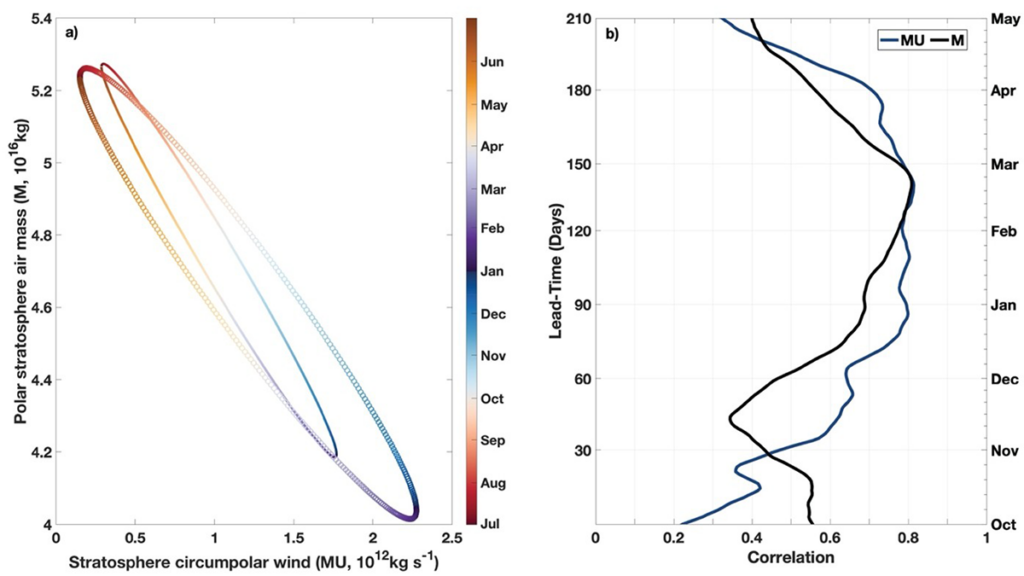
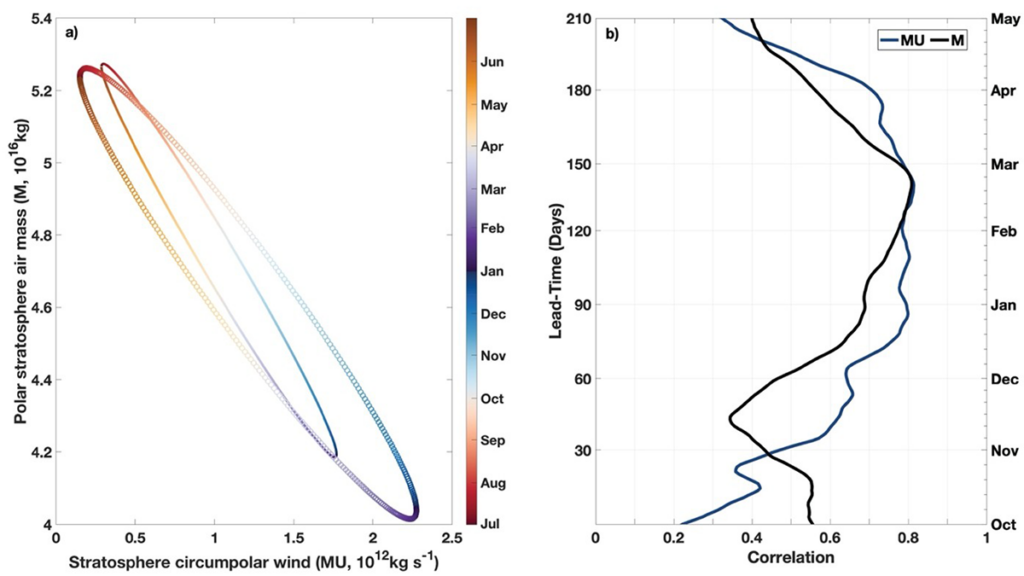
In a new study, Secor et al. [2026] introduce a new forecasting paradigm that constructs an elliptical orbit in stratospheric polar vortex (SPV) phase space with a single annual frequency, whose parameters vary from year to year, for representing the annual evolution of the stratospheric polar vortex.
By forecasting these annually varying parameters, the framework enables skillful prediction of subseasonal-to-seasonal (S2S) SPV anomalies, including the magnitude and timing of wintertime extrema, at lead times of one to six months. These results demonstrate that a large portion of the SPV’s S2S variability is closely associated with year-to-year variations in its annually evolving phase-space trajectory, revealing a new source of predictability for S2S forecasts.
Beyond the polar vortex, this new paradigm can be applied to other climate systems with strong annual cycles, including Arctic sea-ice variability, East Asian monsoon rainfall, and regional temperature and precipitation extremes. Linking year-to-year variations of the annual evolution to S2S anomalies could open new pathways for improving long-range climate forecasts.
Citation: Secor, M., Sun, J., Yu, Y., Wu, Z., & Cai, M. (2026). Elliptical orbit representation for the annual evolution of the Northern Hemisphere stratospheric polar vortex. Part II: Long-lead forecasts of wintertime S2S anomalies. Journal of Geophysical Research: Atmospheres, 131, e2025JD044222. https://doi.org/10.1029/2025JD044222
—Xin-Zhong Liang, Editor, JGR: Atmospheres
Text © 2026. The authors. CC BY-NC-ND 3.0
Except where otherwise noted, images are subject to copyright. Any reuse without express permission from the copyright owner is prohibited.