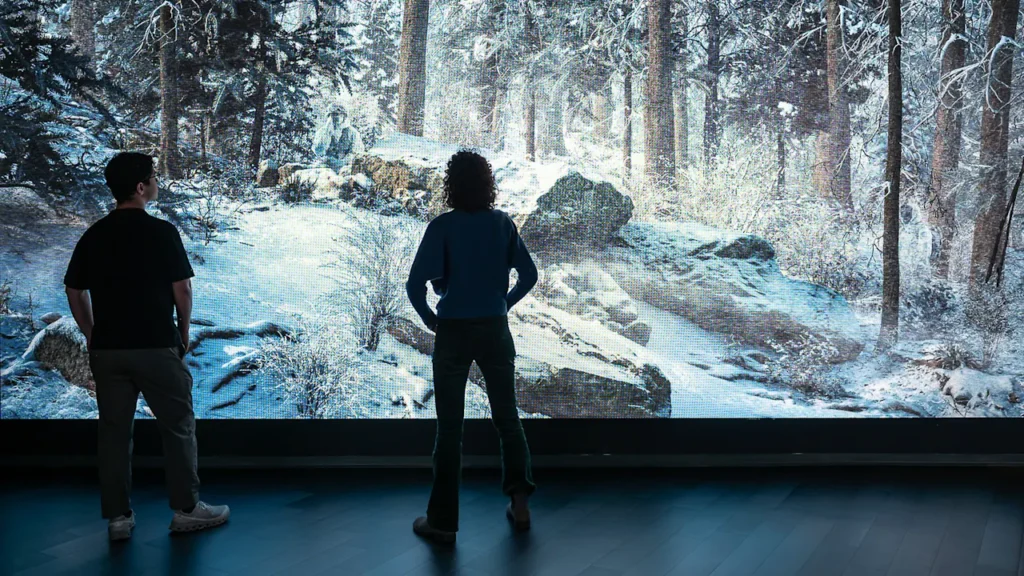
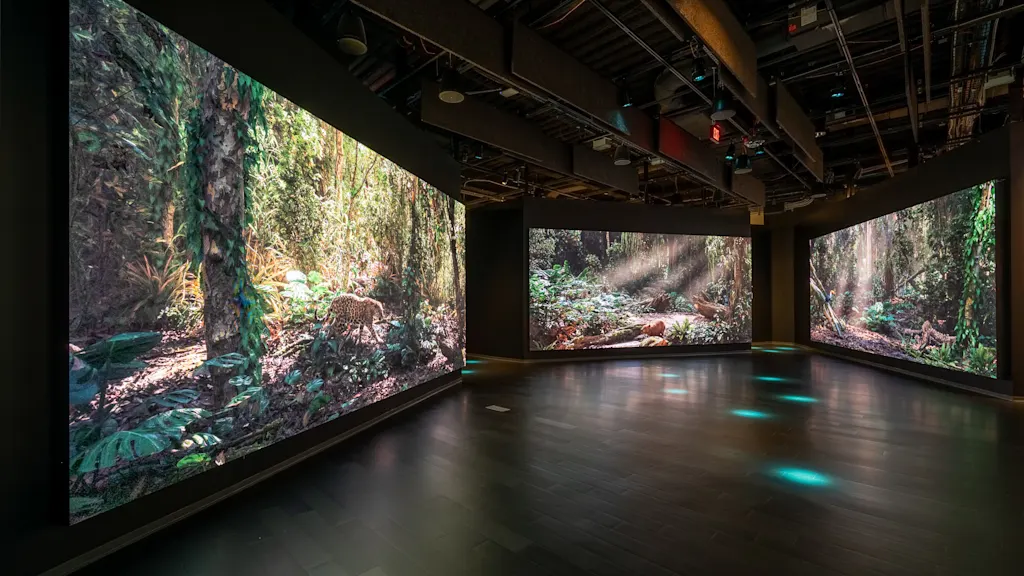
It takes a few moments to see the spotted jaguar slinking through the dense, sun-dappled jungle scene projected onto a wall inside the International Spy Museum in Washington, D.C. Soon after, the projection changes to a snowy forest where it takes even longer to notice one—no, two—human figures nestled among bushes and rocks, obscured by gravelly full-body suits and skin-concealing tactical gear.
The hidden figures, animal and human, are quintessential examples of the subject of Camouflage: Designed to Deceive, the museum’s clever and surprisingly wide-ranging new exhibition. From army fatigues to decoy tanks to double-agent disguises to the literal chameleons of the natural world, the exhibition explores the history and evolution of camouflage in its various forms and uses.
“We felt that it was in many ways the original deception,” says Kathryn Keane, VP of exhibitions and collections at the International Spy Museum. She calls camouflage an example of extreme evolution, and notes that it was first studied in the 19th century by scientists who recognized the biomorphological advantages animals had developed through color matching, disruption, self-decoration, and mimicry.
“[It’s] this unique and fascinating phenomenon that allowed animals to evade detection and survive,” Keane says. “And humans adapted it for many of the same reasons.”
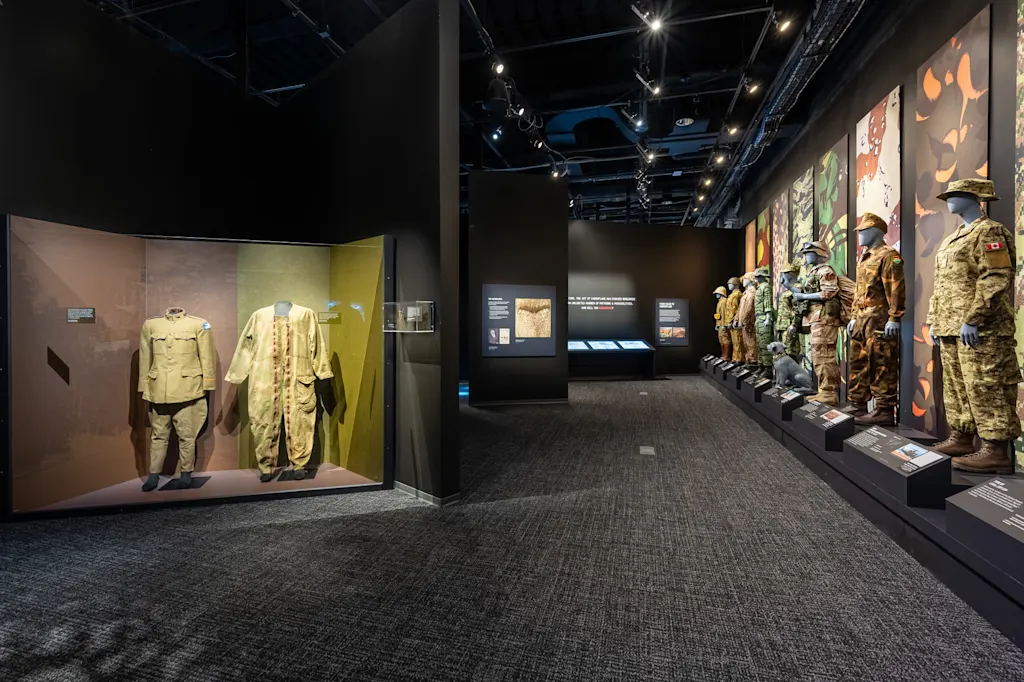
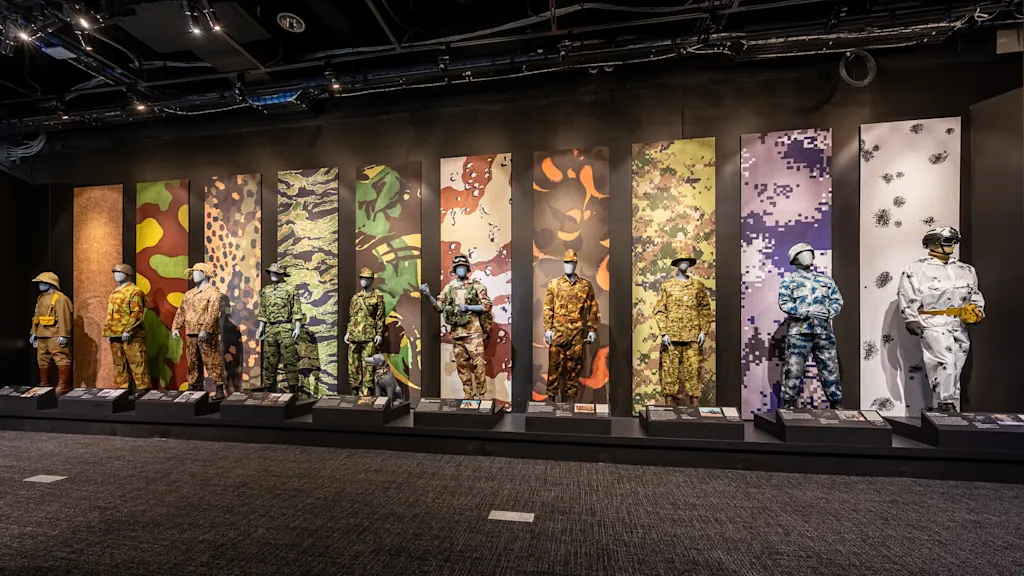
That’s how camouflage got its most common interpretation, in the form of camouflage military uniforms, of which the exhibition has a dozen full-size examples. But just as 19th-century scientists saw in animals, camouflage can take a wider variety of forms.
To tell that broader story, the museum worked with the experience design studio Local Projects, which helped craft a narrative for the exhibition and designed the physical—and highly visual—visitor experience. “An exhibition about camouflage is a designer’s dream, really, because camo itself is this really unique kind of design,” says Nathan Adkisson, creative director of Local Projects.
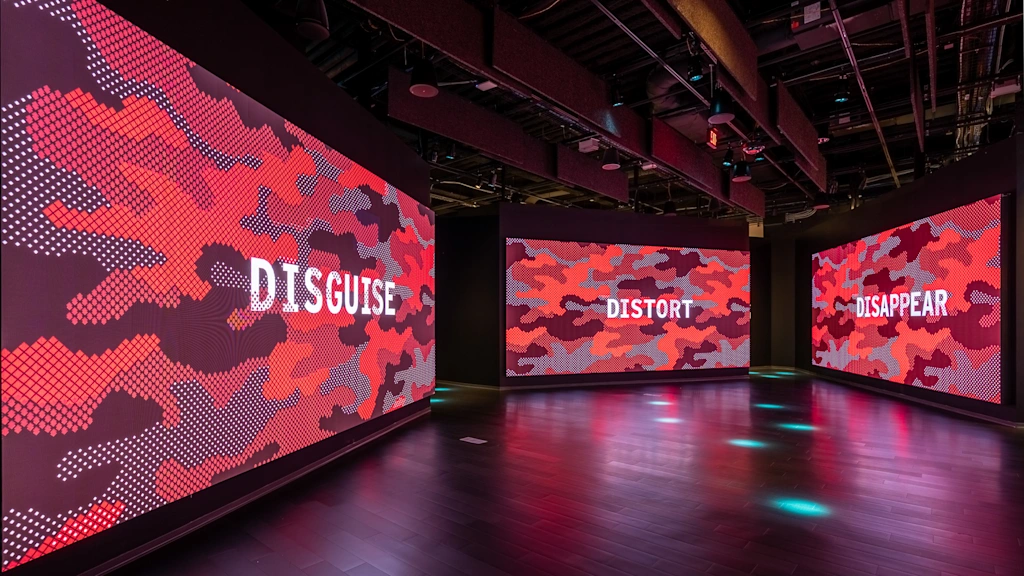
Pulling from the museum’s collection of more than 10,000 artifacts from the world of spycraft and intelligence, Local Projects broke down the topic of camouflage into four main categories: Disappear, Distort, Disguise, and Deceive. Each is given its own gallery in the museum’s 6,000-square-foot temporary exhibition space.
The Disappear gallery includes those camo uniforms, from the first khakis worn by British soldiers in 19th-century India to the snow-blending gear being worn in forests today by Ukrainian soldiers. The Distort gallery focuses on misdirection, most notably in a scale model of the zebra-like “razzle dazzle” designs used on battleships during World War I. The Disguise gallery shows how spies have used everything from false beards to hyperrealistic face masks to conceal their identities. The Deceive gallery includes examples of what some spies have done to blend into everyday situations, appearing so normal as to fade into the background.
Other highlights include a model of Boeing Wonderland, the ersatz suburban development that was built like a stage set to conceal a Seattle-area airplane factory during World War II. A tilted mirror above the model gives visitors a sense of just how convincing this would have been to an enemy warplane flying overhead. There’s also a child-friendly interactive component that lets visitors create their own camouflage pattern and virtually apply it to fatigues or sneakers. Another interactive piece shows how facial recognition cameras work, and the ways some people have been able to deceive them.
“Probably my favorite thing about the exhibition is this ability to talk about a design phenomenon that’s actually had an impact on history,” says Keane.
The exhibition goes beyond battlefields and spycraft to show how camouflage has entered art, pop culture, and fashion. Looking both to the past and to the future, the exhibition offers a window into the ways camouflage continues to be shaped by new technology.
One gallery displays EagleEye, the AI-enabled augmented reality headset designed for the U.S. military that gives soldiers advanced optical abilities that can essentially see through the camouflage used by opponents on the battlefield. Another delves into deepfake videos and the ways technology can be used to distort reality.
“The story isn’t just a historical story, it’s one that still is relevant today,” says Adkisson. “My hope is when people leave the exhibition they will go out onto the sidewalk and through their day actually looking around a little bit more asking themselves that question, ‘What am I not seeing here? What else is going on?’”