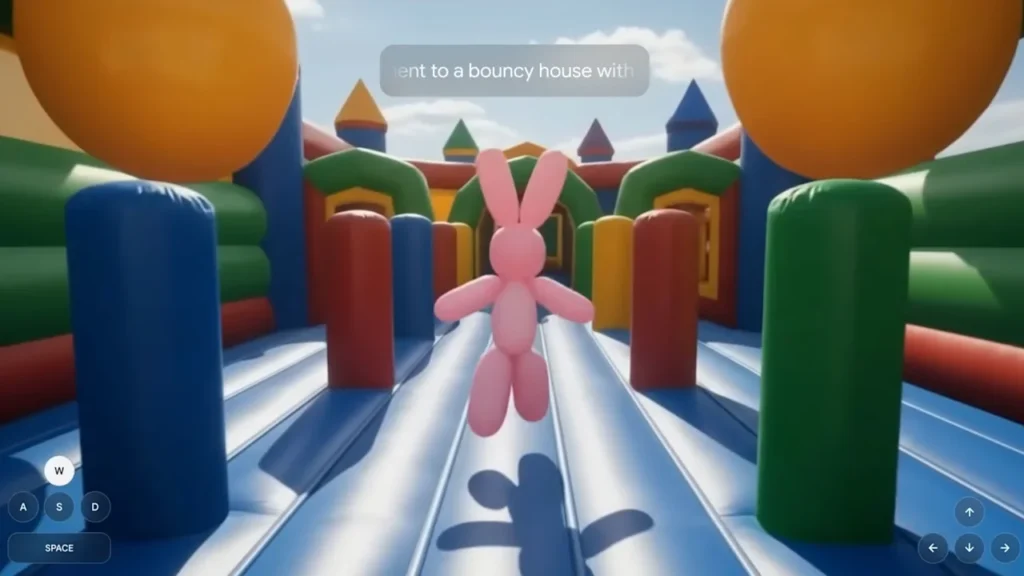
Last week, Google released Project Genie, a powerful new AI-powered platform for videogame design.
Project Genie, which is currently only available for Google’s AI Ultra subscribers, uses AI to build virtual worlds.
That sounds interesting, if not necessarily revolutionary. Videogame developers already model and build virtual worlds all the time.
Project Genie’s simple concept, though, belies the tech’s potential impact. The new system, and the Genie 3 model behind it, have the potential to forever change how videogames are built and played.
Model the World
Most videogames today rely on a handful of game engines to render their virtual worlds so they look realistic for players.
Engines like Unreal and Unity have long dominated the space. To build a game within them, developers first create virtual spaces, populating them with 3D digital models of objects, characters, buildings and the like.
They then release players into their worlds. As a player explores, the game engine renders the currently visible portions of the virtual world in near real-time, creating the seamless experience of wandering through a realistic environment.
Game engines revolutionized game design because they allowed developers to hand off messy and complex things like physics and lighting to the engine.
Instead of worrying about modeling how fur moves in a breeze or how fast bullets travel, they could focus on creative jobs like building delightfully scary monsters or realistic weaponry.
Game engines come with their own set of limitations, though. Although players are free to explore a world as they please, developers still generally need to create every element of that world themselves.
Today’s virtual worlds are massive. Players could reportedly spend as many as 130 real-world hours exploring the worlds inside games like No Man’s Sky without seeing the same part twice.
But even so, everything in that virtual world had to be put there on purpose. The worlds feel huge, but nothing in them is truly new.
Worlds on the fly
Google’s new Project Genie is different. Rather than creating a world piece by piece, the new tool allows developers to upload concept art or even a simple text prompt.
Google’ Genie 3 model, which underlies the system, then transforms those inputs into a seamless, virtual space that players can move within.
Crucially, though, Project Genie’s worlds aren’t bounded, like the worlds of traditional game engines. Genie 3 imagines its worlds on the fly, literally creating them fresh as a player explores.
That means Genie’s worlds are effectively infinite. As a player reaches the bounds of the world, the Genie 3 model simply expands them, imagining new parts that have never existed before.
In an example video, Google shows a developer asking the system for an undersea world. Project Genie spins up a virtual coral reef environment, with the player controlling a realistic-looking fish.
As the fish swims around the reef, Project Genie adds new parts seamlessly. As the player-controlled fish swims upwards, the system even creates realistically-shimmery water above the virtual reef.
The user could presumably have their fish leap from the ocean into the air, and Project Genie would go right on imagining new parts of the world—perhaps an ocean landscape complete with (hopefully friendly) seagulls, buoys and boats.
Truly open worlds
Currently, Project Genie has some serious limitations. It can only perform its magic for about 60 seconds at a time, before its imagined worlds go off the rails.
It’s also limited to 24 frames per second—impossibly slow for a modern game, where FPS can easily hit 120 on a powerful computer. Practically, this means Project Genie’s worlds have movement that’s too choppy for real world use.
Project Genie’s demo games also lack actual gameplay elements, like rules and goals. You can only swim around as a fish for so long before getting bored–even if the virtual reef around you is being automatically generated by an insanely powerful AI.
The bones are there, though. And the implications for the future of gaming are massive.
As the Genie 3 model improves, game designers could use it to create worlds that players could explore forever. Each time players loaded a game, they’d be experiencing something completely new—and they’d never run out of territory in which to play.
Genie 3 could potentially also create bespoke models of a world, tailored to individual players. Imagine playing a game like Grand Theft Auto, but with the action taking place in your hometown—whether you live in Los Angeles or Lincoln, Nebraska.
And Genie could create entirely new kinds of games–ones where the player actively participates in building the world. Because Genie can accept prompts and imagery, players could provide input on the places they’d like to explore. Genie could then build them a custom world based on their ideas.
Traditional game designers are clearly taking note. The stocks of gaming companies like Nintendo and Roblox promptly dropped when Project Genie was announced.
So-called “open world” games—where players explore an environment for hours on end, sometimes without specific goals–are already massively popular. Making those worlds truly open and unbounded using Genie would almost certainly make the games more compelling—and better selling.
For now, Project Genie is a cool demo. Soon, though, its AI magic could spell disruption for an entire industry.