Editors’ Highlights are summaries of recent papers by AGU’s journal editors.
Source: Journal of Geophysical Research: Solid Earth
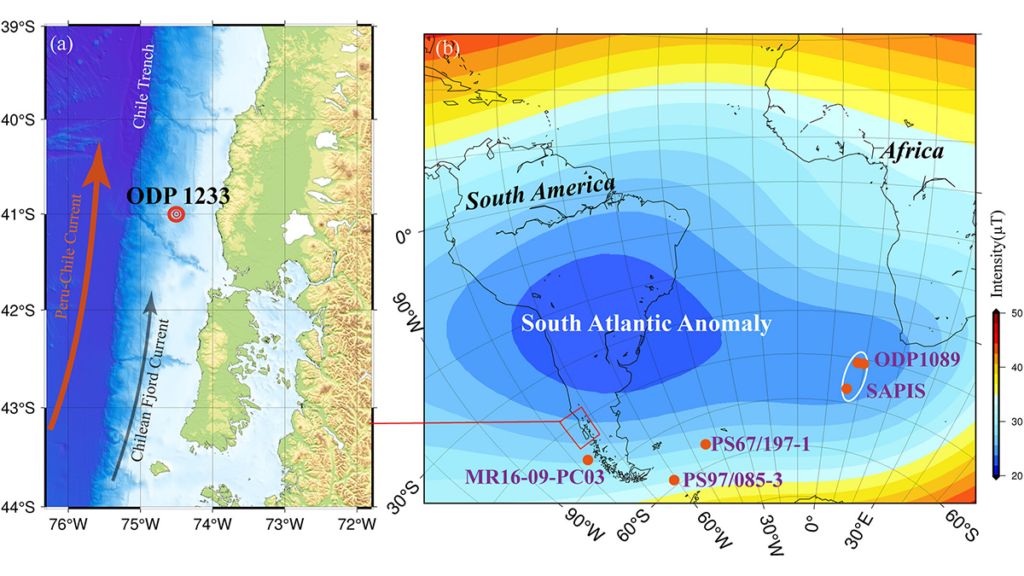
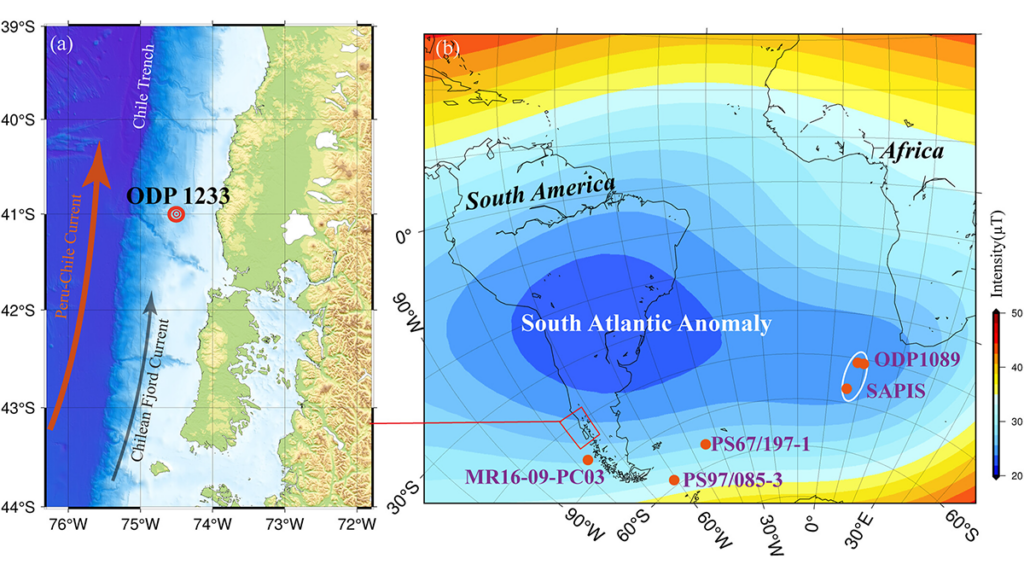
Understanding geomagnetic field variability within the South Atlantic Anomaly (SAA) over the past tens of thousands of years is crucial for reconstructing its origin and anticipating its future evolution.
Liu et al. [2026] present high-resolution paleo- and rock magnetic data from ODP Site 1233, spanning a period of normal secular variation between the Laschamp (~41 ka) and the Norwegian-Greenland Sea excursion (~64.5 ka). Because reliable relative paleointensity (RPI) estimates require a detailed characterization of the magnetic mineral assemblage, the authors thoroughly examine the magnetic carriers and apply a normalization strategy that accounts for their magnetic properties while rescaling amplitudes to a common reference frame.
This approach yields a RPI record that correlates closely with both regional and global paleointensity stacks. Notably, these data reveal exceptionally weak geomagnetic field strengths in the SAA region during a global transition from a high-field to a low-field state. Such behavior suggests that a paleo-SAA may have exerted a dominant influence on global field morphology, remarkably similar to the situation observed today!
Citation: Liu, J., Nowaczyk, N. R., Huang, Y., Luo, X., Wang, H., Han, F., et al. (2026). Paleosecular Variations in the South Atlantic Anomaly Region Over 65–40 ka — Revisiting Site ODP 1233. Journal of Geophysical Research: Solid Earth, 131, e2025JB032061. https://doi.org/10.1029/2025JB032061
—Agnes Kontny, Associate Editor, JGR: Solid Earth
Text © 2026. The authors. CC BY-NC-ND 3.0
Except where otherwise noted, images are subject to copyright. Any reuse without express permission from the copyright owner is prohibited.