Source: Journal of Geophysical Research: Biogeosciences
From 1948 to 1953, a gold mine called Giant Mine released about 5 tons of arsenic trioxide per day into the environment around Yellowknife, Northwest Territories, Canada. Emissions declined from the 1950s until the mine closed in 2004, but the surrounding landscape remains highly contaminated with arsenic.
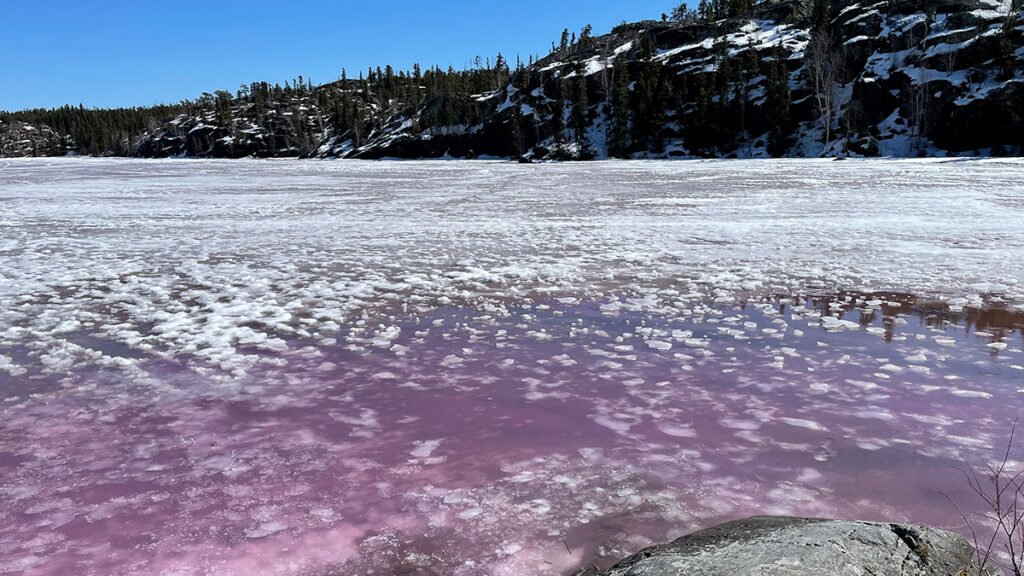
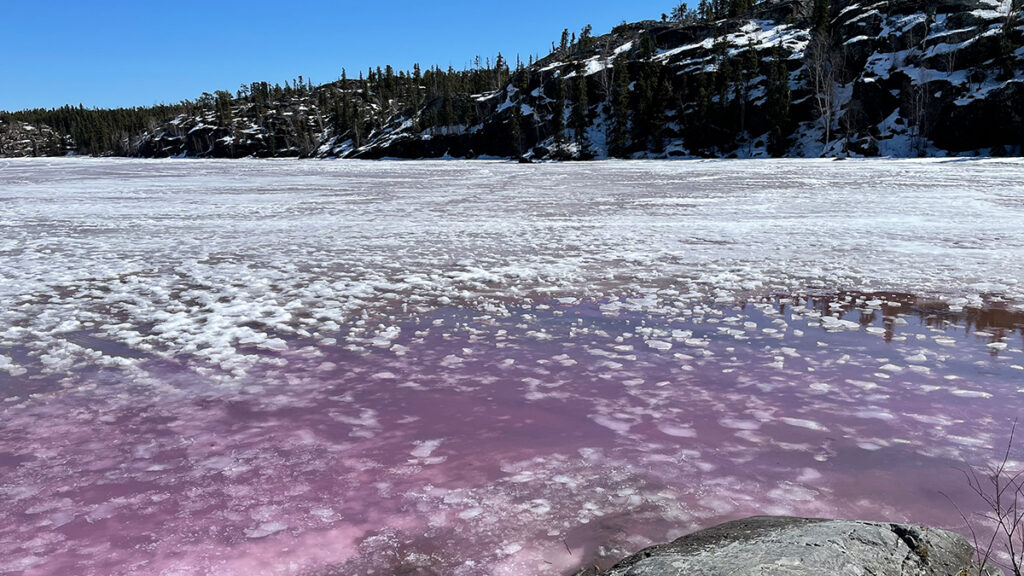
Little et al. recently studied how the spring thaw influences arsenic levels in four Yellowknife area lakes and how phytoplankton populations alter arsenic biogeochemistry during this transition period. The researchers sampled each lake twice per year in 2022 and 2023: once in late April, before the beginning of the spring thaw period, and once 7–10 days later, when the thaw had begun but the ice was still thick enough to safely walk on, making sample collection feasible.
Sammy’s, Handle, Frame, and Jackfish lakes spanned a gradient of arsenic contamination levels when measured before the thaw in 2022—from 5.5 micrograms per liter in Sammy’s Lake to 350 micrograms per liter in Frame Lake. In Handle, Frame, and Jackfish lakes, arsenic levels went down as the spring thaw began, but Sammy’s Lake followed the opposite trend. The difference likely lies in how much arsenic the lakes contained to begin with. With Sammy’s Lake starting at such a low level, arsenic from meltwater exacerbated the contamination. In the other three lakes, the concentration of arsenic in meltwater was lower than or similar to the starting concentration in the lake, so meltwater diluted the contamination.
Arsenic exists mostly in two oxidation states: arsenite and the less toxic, less mobile arsenate. Because arsenate is more stable under oxic conditions, the influx of highly oxygenated snow and ice meltwater during the spring thaw period was accompanied by a predictable shift in the predominant form of arsenic in the lakes.
The winter of 2022 was significantly colder than 2023, with the difference reflected in the thickness of the ice: 76–130 centimeters in 2022 compared with 65–72 centimeters in 2023. The warm winter did not alter the final arsenic concentration or speciation in the water at the end of the thaw. However, an increase was observed in plankton communities in more mature life stages and in taxa that are more competitive in warmer conditions. This result is important, the authors say, because late winter and spring thaw plankton community dynamics set the stage for the following open-water season. (Journal of Geophysical Research: Biogeosciences, https://doi.org/10.1029/2025JG009231, 2026)
—Saima May Sidik (@saimamay.bsky.social), Science Writer

Citation: Sidik, S. M. (2026), How the spring thaw influences arsenic levels in lakes, Eos, 107, https://doi.org/10.1029/2026EO260051. Published on 6 February 2026.
Text © 2026. AGU. CC BY-NC-ND 3.0
Except where otherwise noted, images are subject to copyright. Any reuse without express permission from the copyright owner is prohibited.