Editors’ Highlights are summaries of recent papers by AGU’s journal editors.
Source: AGU Advances
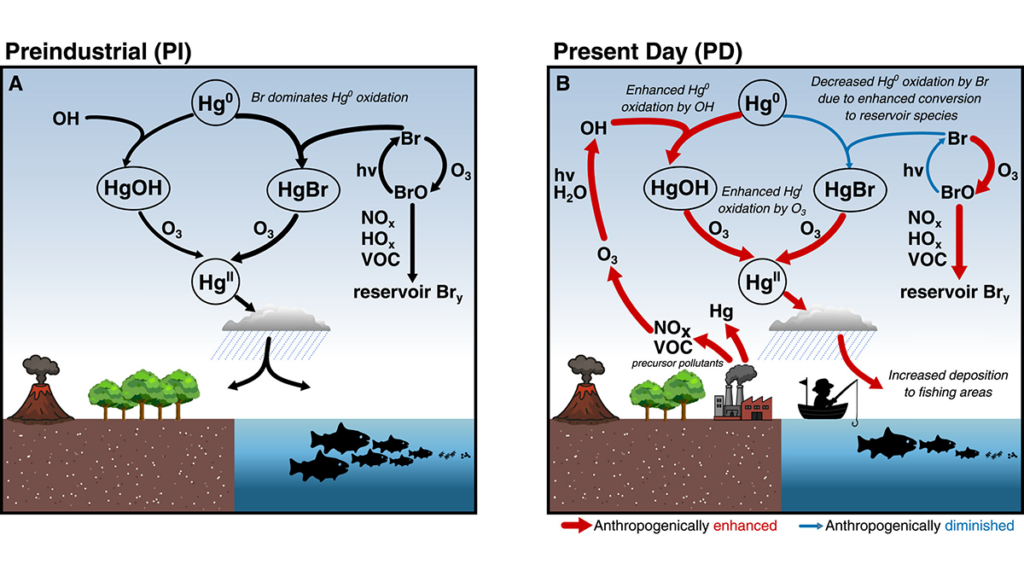
The amount of time that mercury (Hg) spends in the atmosphere determines its global spread, and therefore the distribution of this toxic pollutant, even to remote ecosystems. Generally, previous studies have assumed the chemical lifetime of elemental mercury (Hg0) has been constant throughout history, mirroring the conditions of present-day (2010–2019). However, since pre-industrial times (about 1850), anthropogenic emissions have altered the concentrations of oxidants that affect the lifetime of Hg0, including bromine radicals (Br), hydroxyl radicals (OH), and ozone (O3).
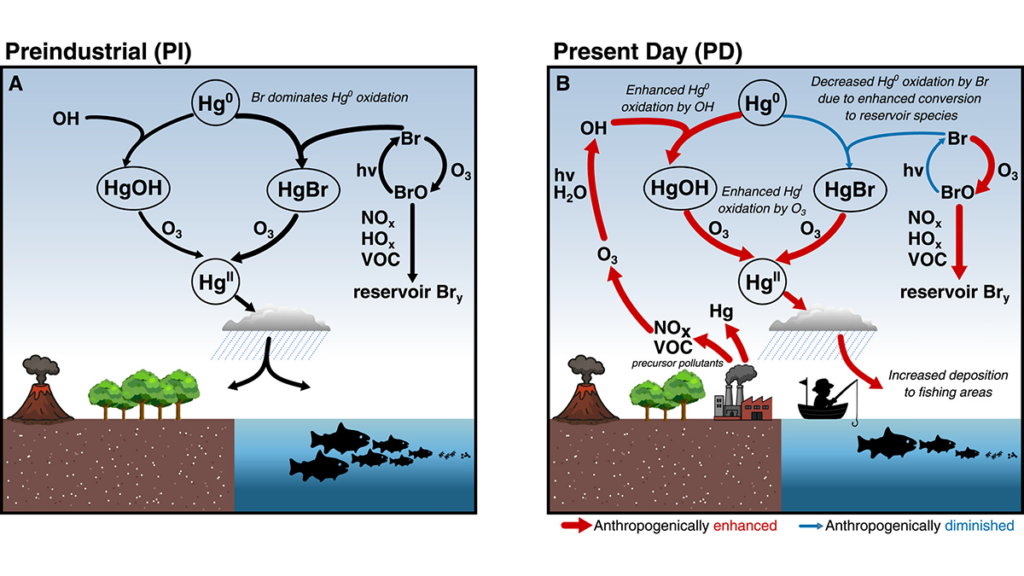
Feinberg et al. [2026] use a state-of-the-art chemistry-climate model to analyze the effects of the changes in background composition between 1850 and now to examine the resulting effects on mercury deposition into water around the world. The increasing concentrations of OH and O3 lead to 16% faster Hg0 oxidation in today’s Northern Hemisphere, while the increased partitioning of Br to reservoir species slows Hg0 oxidation by 20% in the Southern Hemisphere relative to the 1850 atmosphere. These regional oxidation changes shift the pattern of where Hg deposits to the surface.
The shifts in Hg0 oxidation enhance deposition by 15% to tropical and subtropical oceans, which are critical regions for Hg exposure risks. The 1850 atmosphere, however, was more conducive to the spread of Hg to the remote Southern Hemisphere extratropics. This finding significantly affects the interpretation of the Hg deposition historical records from natural archives. This study reveals that the changing atmospheric composition has been a previously overlooked factor when considering human Hg exposure risk via altered Hg deposition patterns.
Citation: Feinberg, A., Sonke, J. E., Cuevas, C. A., Li, M.-L., Acuña, A. U., Fernandez, R. P., et al. (2026). Shifts in atmospheric composition since the preindustrial era modified the transport and deposition of mercury. AGU Advances, 7, e2025AV002158. https://doi.org/10.1029/2025AV002158
—Don Wuebbles, Editor, AGU Advances
Text © 2026. The authors. CC BY-NC-ND 3.0
Except where otherwise noted, images are subject to copyright. Any reuse without express permission from the copyright owner is prohibited.