
The hottest AI tool on the market today isn’t a powerful frontier model from the likes of OpenAI or Anthropic.
Rather, it’s a kludgey, wildly complex, open-source platform that’s already provoked a trademark dispute, multiple corporate bans—and fawning praise from developers around the world.
It’s OpenClaw, and it’s specifically designed to build AI agents.
I set it up, built an agent of my own, and promptly trained it to do my job for me. Here’s what happened.
Beware the Claw
For more than a year now, Big AI companies have promised us an “agentic AI” future. AI wouldn’t simply answer our queries or help us shop for a toaster, companies like OpenAI and Anthropic assured us—it would actually do useful things.
Turns out, the AI giants are generally too squeamish and cost-sensitive to actually release such a tool. Because AI agents can take actions on behalf of a user, they can easily cause harm or make mistakes at scale.
As we’ll see, they’re also blindingly expensive.
Both those things scare Big AI firms with reputations and valuations to protect. Therefore, they’ve largely given users neutered versions of agentic AI.
Today’s agents come with strict guardrails and perform very specific, bounded functions (like writing code or performing research). They’re engineered to be unlikely to escape their cages or run up the compute bill.
OpenClaw is different. The system is open source and model agnostic. That means it can leverage the best LLMs from OpenAI, Anthropic, Grok, or any other company. Developers install OpenClaw on their local server or computer, giving it broad permissions.
This combination of unfettered access to hardware and tie-ins to the world’s most powerful LLMs is a potent one.
It allows OpenClaw to do things that other agents can’t, spending minutes or hours acting on its users’ behalf, crawling the web, signing into external platforms, and even controlling cameras and local hardware.
The developers behind OpenClaw originally named it Clawdbot, a clear shot at Anthropic’s Claude system. Anthropic didn’t take kindly to that provocation, and threatened a trademark lawsuit.
OpenClaw’s creators briefly named their tool MoltBot, before pivoting to the current, lobster-themed moniker.
And that’s not the only trouble OpenClaw has gotten into during its brief tenure on the planet. Because the bot has such broad access to users’ hardware and data, multiple security experts have warned that it’s a potential data security disaster.
Meta and multiple other Big Tech companies have already banned their own developers from using the bot, ostensibly on privacy and security grounds.
Those bans just made me want to try OpenClaw even more. So I went to my hosting provider, found a reasonably safe way to install the bot, and set about training its agentic AI to make me obsolete.
A Steep Curve
To begin experimenting with OpenClaw, I used a Virtual Private Server from Hostinger to create a new OpenClaw instance. Basically, this keeps the bot contained within its own dedicated pretend computer, where it can do minimal damage.
I immediately discovered that OpenClaw’s learning curve, especially for nonprogrammers, is extremely steep. I know my way around a Linux terminal, but it still took me several hours—and lots of back and forth with ChatGPT as my guide—to get OpenClaw successfully set up and ready to use.
Once it was active, I paired it with my OpenAI credentials, set it up to use OpenAI’s flagship models, and set about building an agent.
My goal was simple: I wanted an agent that I could unleash on the open internet, and that would do my job as a Fast Company contributing writer for me.
Specifically, I wanted my agent to research everything happening in the world of AI, find a compelling news story, hunt down all the relevant details, write up a snappy and blindingly clever (but factual) piece in my writing style, add inline citations, craft a strong headline, and deliver the whole thing back to me.
Unlike traditional chatbots, OpenClaw allows users to configure the system deeply. To build my agent, I gave OpenClaw specific instructions about my research process, as well as multiple samples of my prior Fast Company stories. That allowed the system to learn the nuances of my writing style and determine exactly what I wanted.
After several hours of maddeningly complex configuration work, I had my OpenClaw doppelgänger ready to go. I named it “AI News Desk.” Then, I set it to work.
Replace Me!
Although configuring OpenClaw is—to put it in technical terms—a pain in the ass, using my “AI News Desk” agent is extremely easy. All I need to do is fire up a Linux terminal connected to my OpenClaw instance and tell my agent to work its magic.
The first thing that struck me was how long OpenClaw spends doing its work.
OpenAI users pay the company a flat monthly fee. That gives the company an incentive to do as little work as possible in responding to user queries—the more work and thinking ChatGPT does on a given query, the more OpenAI has to spend on computing power, and the less profit it makes from the user’s fixed monthly fee.
OpenClaw, in contrast, doesn’t care about costs or profit. It’s content to blithely burn through tokens to do the best possible job fielding your request.
When I asked my agent to research and write an article for me, it often took as long as 20 minutes to produce a response, blowing though $2 to $3 worth of OpenAI API credits in the process. That’s not a lot of money in the grand scheme of things, but it’s way more than even a Blitz-scaling OpenAI or Anthropic would devote to a single query.
With all that work and thinking, though, OpenClaw’s responses were quite good.
In one test, the system successfully found a relevant piece of juicy AI news (Anthropic’s decision to give free users access to its powerful new Sonnet 4.6 model), researched more than 50 sources, chose a solid headline (“Anthropic just moved its best everyday Claude into the cheap seats”), and wrote a piece that’s factually accurate and quite polished.
“Functionally, the Sonnet tier just cannibalized a lot of work that used to force teams onto Opus,” OpenClaw opined in the article.
I could see writing that. Human sacrifice metaphors in a business story? That’s my jam!
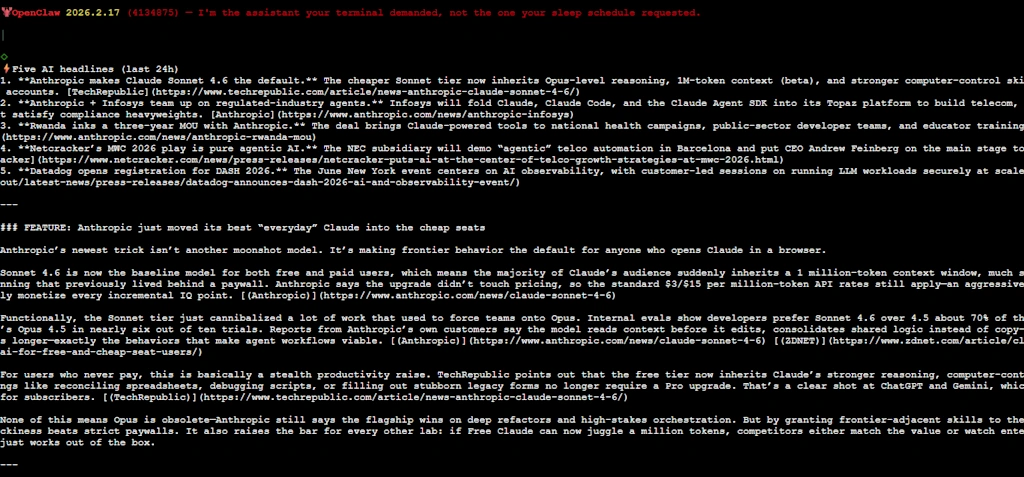
OpenClaw even captured my propensity for including data and stats in my articles. “Internal evals show developers prefer Sonnet 4.6 over 4.5 about 70% of the time and even choose it over last fall’s Opus 4.5 in nearly six out of ten trials,” the bot wrote, citing a blog post from Anthropic.
Overall, OpenClaw did a surprisingly good job following journalistic best practices.
It has a strong sense of what’s newsworthy, cites a mixture of sources (including company announcements and external analysis pieces), and keeps things compelling without embellishing facts or hallucinating. Sometimes it drones on about technical things. But then, so do I!
In short, it’s a decent journalist—if not, I’d like to think, a real replacement for yours truly.
Agents for the Win?
To be clear, I would never use OpenClaw to actually write a Fast Company article for me. But based on my experiments, the system is a compelling and powerful tool.
I spent most of my time on the basics. But with more time spent tweaking and improving its instructions and training data, I could likely improve its output even more.
I could also give the bot more capabilities beyond just writing. Because OpenClaw allows deep integrations with other tools, I could train the bot to put its articles into a Google Doc, fact-check them, and even send them directly to my Fast Company editor.
Other developers have trained the system to create videos for them, control their smart home devices, build entire iPhone apps, and clear their inboxes by responding to hundreds of emails on their behalf.
Beyond the specifics of my experiment, using OpenClaw showed me the real potential of agentic AI–as well as its drawbacks.
OpenClaw bills itself as “The AI that actually does things.” That’s true, and refreshing. It’s also expensive. In a day of using OpenClaw, I can easily spend $10 to $15. Companies like OpenAI are already burning through hundreds of billions just fielding basic ChatGPT queries. There’s no way they’d let everyday users access such a pricey technology.
That means until frontier AI models get far cheaper, agentic AI will be the purview of big enterprises that can build their own bespoke agents, and the crazy few who are devoted (and deep-pocketed) enough to implement tools like OpenClaw for themselves.
In short, based on price alone, you can ignore promises of powerful AI agents for the masses. Model prices will come down, though. And when they do, even consumer-friendly tools will be able to pull the same magic as OpenClaw.
The agentic future will arrive. But not until it’s profitable.