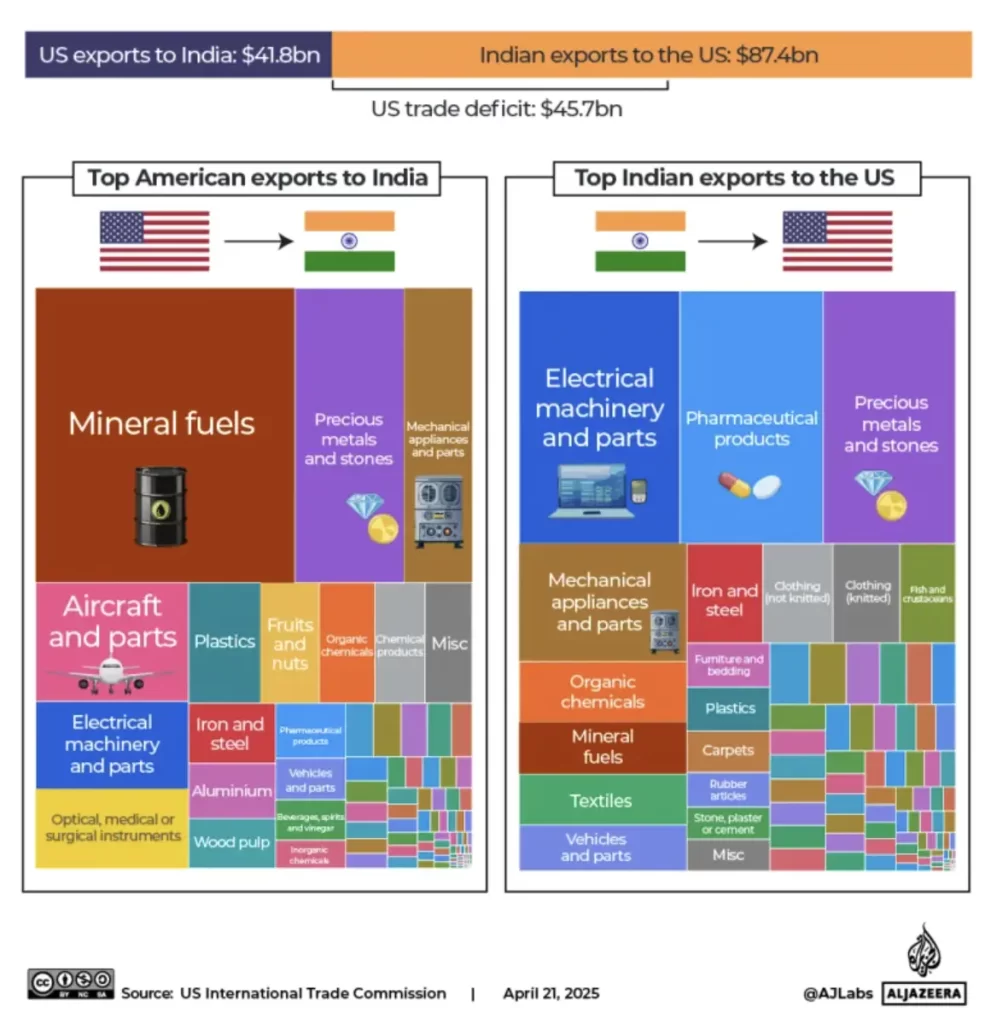
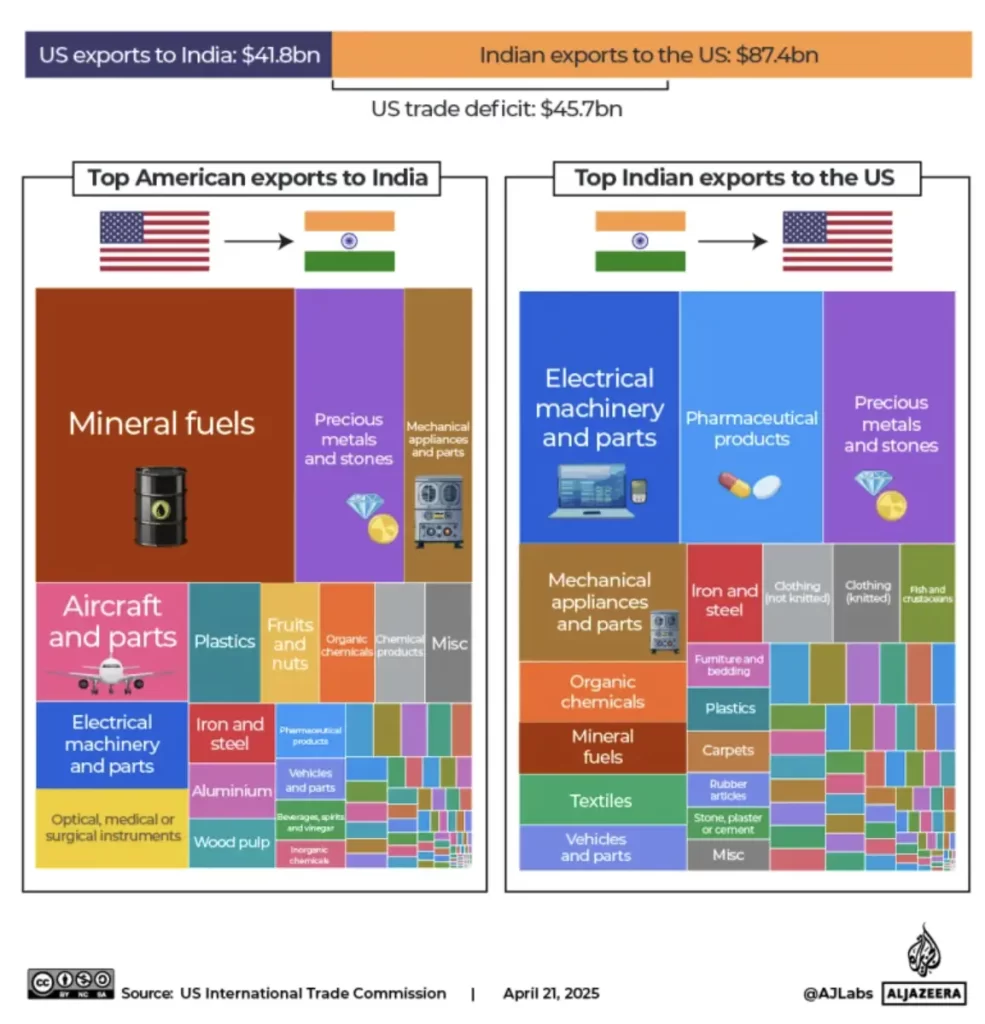
Trade between the U.S. and India has expanded rapidly. In 2024, their total goods and services trade reached about $212.3 billion (up 8.3% year-on-year). U.S. goods exports to India were roughly $41.5 billion, and imports from India about $87.3 billion. This left a U.S. goods trade deficit of about $45.8 billion (around 5% higher than in 2023).
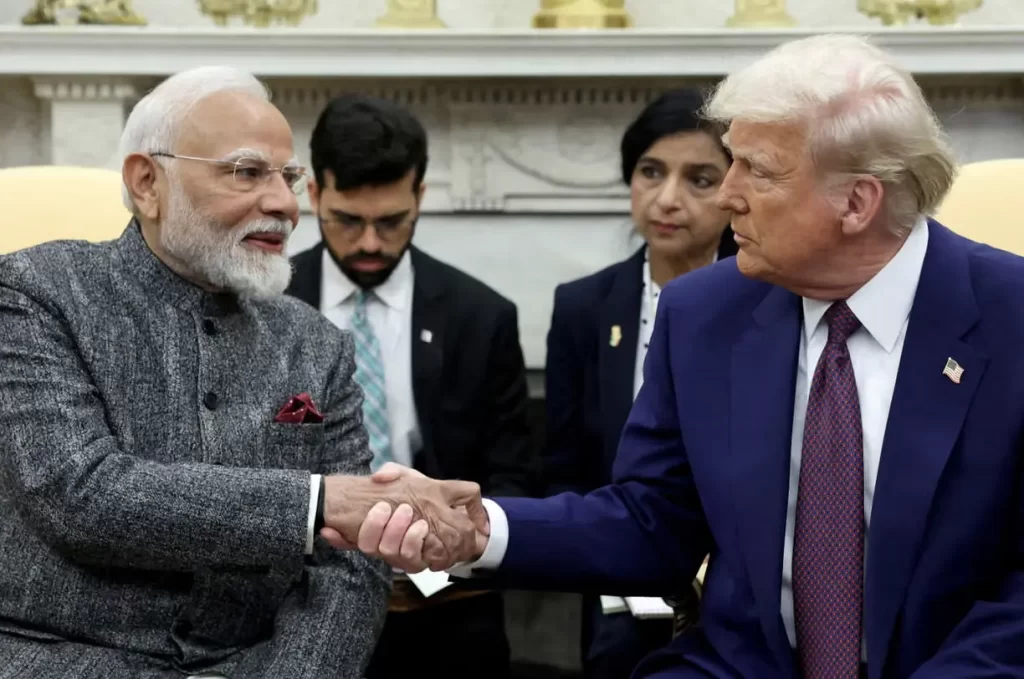
These imbalances have driven both governments to seek a deal. In early 2025, President Trump and Prime Minister Modi agreed to negotiate a bilateral trade pact to narrow the gap. U.S. officials noted that India’s average applied tariff (about 17%) is far above the U.S. rate (~3.3%), and each side pledged to work on lowering tariffs and non-tariff barriers on the other’s goods.
Critiques of Uneven Exchange
Some analysts argue the proposed terms favour the U.S. They note U.S. tariff cuts would cover only about 55% of India’s current exports, meaning many goods get no new relief. Former Finance Minister P. Chidambaram complained the draft deal is “heavily tilted” towards American interests. India’s Commerce Minister Piyush Goyal counters that an 18% U.S. tariff (down from 25%) is already very low, and it will boost labour-intensive Indian exports (textiles, leather, gems). In other words:
- Tariff coverage: A Delhi think tank found only ~55% of Indian exports gain from U.S. tariff cuts.
- Political critique: Chidambaram – the deal is “heavily tilted” towards the U.S.
- Government view: Goyal – 18% is among the lowest U.S. tariffs, helping India’s textiles, leather, and gems industries.
- Farmers’ concerns: The U.S. fact sheet even listed “certain pulses” among items for tariff cuts. Indian farm unions warn that cheap U.S. grains or oils could flood markets and depress domestic prices. Peasant leaders have already protested proposals to open these sensitive sectors.
These critiques reflect a tension: exporters fear continued barriers, while farmers fear being undercut. The outcome will depend on which products enter or escape the final deal and on how swiftly both sides cut duties.
Domestic Tariff Simplification Efforts
Meanwhile, India has been simplifying its own tariff regime. Finance Minister Sitharaman says tariffs are under “continuous” review as part of reform. In the 2024-25 budget, India dramatically cut its import duty bands, going from 15 general rates down to just eight (including a 0% band). Ahead of the 2026 budget, officials signalled plans to shrink those bands further (to perhaps five or six) and to remove many discretionary exemptions. These changes aim to align customs duties with the new GST tax structure and India’s industrial goals, while reducing paperwork and disputes.
Even after those cuts, India still uses many rates. Officials note that of roughly 8,000 industrial tariff lines, about 6,000 now carry duties of 10% or less, reflecting that most import lines are taxed at single-digit rates. However, litigation is still a problem: a recent parliamentary report found 75,592 customs cases pending in December 2024. The simplification agenda thus focuses on standardising classification and duty levels to clear these backlogs and make customs more business-friendly.
Make in India Strategy’s Tariff Structure
The Make in India initiative has prioritised protecting certain domestic industries via tariffs. WTO data show India’s simple average (MFN) tariff was about 14.3% by 2020/21. But this average masks variation. About two-thirds of India’s tariff lines are 10% or lower; in fact, 10% and 7.5% duties alone cover over half of all tariff lines. The tradeoff is that a small share of products face very high taxes. For example, alcoholic beverages can be taxed up to 150%, and many agricultural goods and motor vehicles carry 100% tariffs. These steep rates are defended as necessary to nurture young domestic firms (protecting them from price competition). Critics counter that such a patchwork of rates (India had 15 MFN bands until 2025) can distort market signals, even if it serves short-term industrial goals.
Global Pressures and Risks
Finally, India’s tariff strategy is influenced by global economics. The WTO now warns that world merchandise trade could shrink by 0.2% in 2025 (and by as much as 1.5% if trade tensions worsen). DG Okonjo-Iweala has cautioned that this uncertainty “acts as a brake on global growth”, especially hitting exporters. Similarly, the IMF highlights that rising protectionism (“geoeconomic fragmentation” of blocs and tariffs) could cut India’s export demand and raise energy costs. On the other hand, India’s own central bank notes that strong domestic consumption and prudent policies make the economy relatively “less vulnerable to global headwinds”. In other words, robust local demand helps cushion the impact, but policymakers remain alert to shocks.
Conclusion
Across all these dimensions, India’s tariff policy is a tight balancing act: it seeks to protect and grow domestic manufacturing, respond to farming and social concerns, and avoid clashes with trading partners – all while operating under the cloud of uncertain global trade. The result is a carefully calibrated “tariff tightrope” where even small adjustments can have big impacts on industry and inflation. By monitoring trade flows and economic indicators, India tries to keep that balance – though critics say it is a continuing challenge.
Written By – Krishna Murugappan
The post India’s Tariff Tightrope appeared first on The Economic Transcript.