Editors’ Vox is a blog from AGU’s Publications Department.
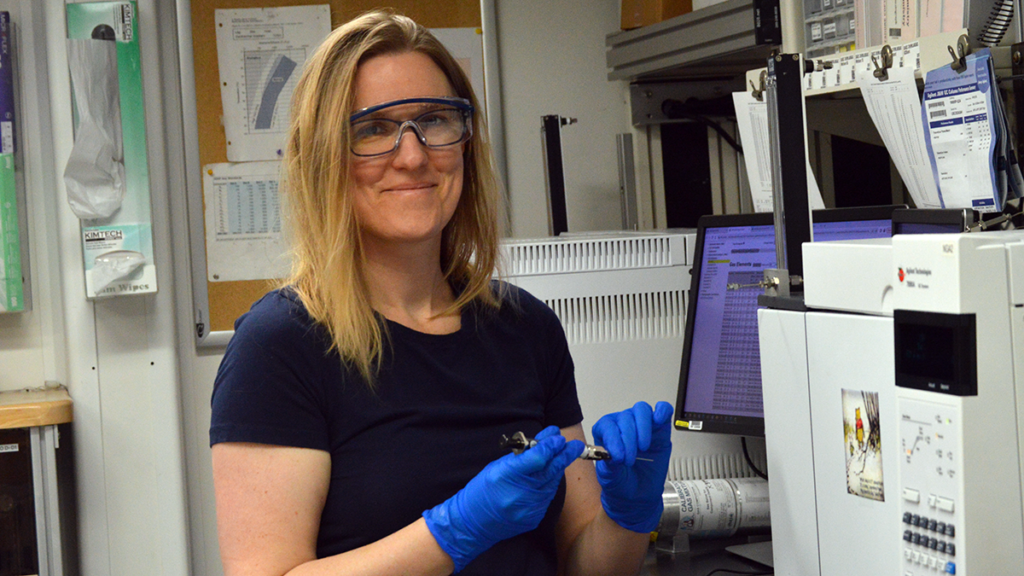
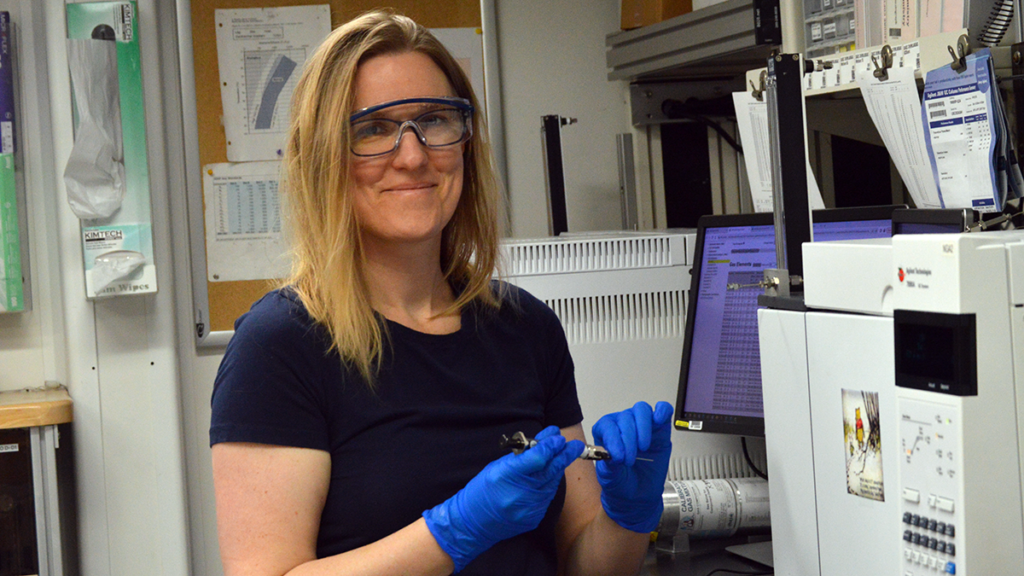
AGU Publications is thrilled to welcome Dr. Sarah Feakins as the new Editor-in-Chief of Paleoceanography and Paleoclimatology. Here, we asked her some questions about her own research interests and her vision for the journal.
What are your own areas of scientific interest?
My laboratory at the University of Southern California specializes in compound specific isotope geochemistry to reconstruct past climate. My focus is on plant wax biomarkers that have yielded powerful insights into vegetation and hydroclimate change on all continents. To hone my craft and proxy toolkit, I’ve worked on fundaments of isotope biogeochemistry characterizing how plants record these signals, for example pairing ecohydrology and organic geochemistry to determine fractionations in subtropical and tropical regions. Beyond plants, we’ve tracked their molecules in soil profiles and rivers to show how plant production is transported to sediments and studied variations downcore in lakes and ocean sediments to track changes through time.
Connections with the students in my lab and scientists around the world allow access to interesting study areas and multiple proxies to maximize our collective insights into past environments. We collaborate with labs that analyze microbial membrane lipids which allow powerful insights into past temperature, salinity and water column stratification. Other collaborators include those who study pollen and other microfossils to expand the evidence, as well as modelers to help test our ideas about cause and effect and evaluate proxy-model mismatch. I try to keep my thinking fresh and flexible by working widely across climate and vegetation zones and reading widely to expand beyond my research experiences – a broad training ground that editorial work offers intrinsically.
What does it mean to you to serve as Editor-in-Chief of Paleoceanography and Paleoclimatology?
From the moment I entered graduate school I knew that I wanted to work with my feet in the oceans and my eyes on land, and as Paleoceanography expanded to include Paleoclimatology under Ellen Thomas’ leadership, it became my natural home for publishing my research. Many of my research group’s papers have been published in this journal in recent years, and with additional paleoclimate research the University of Southern California is one of the top few institutions publishing in Paleoceanography and Paleoclimatology.
After 4 years as Editor of all things “paleo” at Geophysical Research Letters, as well 9 years of cumulative AE experience at various journals including Paleoceanography and Paleoclimatology, I have accumulated considerable editorial experience. I am honored to be the new Editor-in-Chief where my two main tasks are to shepherd the publication of papers in this dynamic and relevant field, and to help cultivate community interest and involvement in the important and collective task of peer review, by development and promotion of an active editorial board and by sending the wider community the latest interesting science to read, and share their expertise on.
What makes Paleoceanography and Paleoclimatology special?
I’m grateful for the leadership of my predecessor, Matthew Huber who has been a promoter of the relevance of past climate research on the future predicament we find ourselves in, for example through his leadership of the Miocene community effort in recent years, dubbing the term #MioceneIsTheFuture. He doesn’t only appreciate the climate modeling work that is his expertise but equally celebrates knowledge generation through the insights of biology, vital given the codependency of climate and life, and the contributions of geochemistry, to understanding, and potentially fixing, the climate crisis.
Looking through the latest issue of Paleoceanography and Paleoclimatology with papers from before my arrival, there are so many papers that I want to read on a wide range of topics, showcasing excellence in our discipline and diversity of approaches. I am already enjoying working together with authors, reviewers, journal staff and the editorial board – and I aspire to steadily carry the interdisciplinary torch for the Paleoceanography and Paleoclimatology community.
What are some of the challenges of leading this journal?
AI sounds very confident while it makes mistakes, i.e., lies to us.
In society and in academic publishing too, the rise of artificial intelligence has burst onto the scenes as a “game changer” and one that is disruptive to many established publishing protocols. AI already changes the landscape of reading, writing, discourse, knowledge generation and likely our brains’ thinking process itself. Some immediate and fast-moving changes will require us to be responsive to the need to attribute and acknowledge the increasing use of AI within a variety of tools from spellcheckers and grammar tools to image processing. Certainly, there are discrete tasks where AI has demonstrable skill, for example, the ability to rapidly adjust code to improve figures and annotate code for sharing – such efficiencies in workflows are already showing huge advantages. In contrast, we know the “hallucinatory” risks: AI sounds very confident while it makes mistakes, i.e., lies to us.
In an era of fake facts and AI, fact checking is vital if you are to use these tools, as authorship responsibility lies in authors’ hands. Journals, authors and reviewers will all be wittingly or unwittingly testing the enhanced abilities and errors possible with such methods, so as a community we need to find ways to harness the power of these approaches, to protect against the pitfalls, and as always to demonstrate critical thinking, ethical integrity and transparency when engaging with ‘black box’ processes – these are just a few of the AI induced challenges and possibilities that scientists and publishers must grapple with as a community. We also must strive to maintain individuality and human interest – this article was written without the use of AI, but are you reading an AI summary or my carefully chosen words right now?
The labor of service should be proportionate to the benefits.
Global changes in the funding and population shifts across the global landscape of academic research are also dramatically changing, with a huge volumetric increase in China and attrition risks in other parts of the world and other communities suffering from fundings shortfalls and ongoing systemic challenges to participation. Efforts to support engagement of different communities must also be attendant to the benefits and labor tasks involved so that the accolades and burdens are equably shared – we should strive towards achieving a balance where the labor of service should be proportionate to the benefits of publishing. Bringing Chinese researchers onto the editorial boards has been something Paleoceanography and Paleoclimatology has been leading the charge on with Matthew Huber at the helm, and I’m carrying that further with interests in engagement and integration efforts that seek to make all our efforts and expertise more visible with Associate Editors’ biographies and links to websites – please take a look!
How do you plan to take the journal forward in the coming years?
Clearly we are in a time of environmental change. A pervasive crisis for oceans and atmosphere from the invisible pollutants including carbon dioxide, with the negative impacts of accelerating warming frequently in the news headlines. Increasingly the degree of damage can be attributed using models so that we can with confidence say how much worse these fires, floods, hurricanes and storms were made by the human-caused changes to the atmosphere. In addition, loss of habitat, species loss and invasive species are all biosphere changes readily apparent today.
Plain language statements are a great place to summarize lessons from the past to a wider audience.
I often find that the scientists most concerned about climate and biosphere change are those that research the profound transformations that have taken place in the past. For example we know sea level changed by 120 meters at the end of the last ice age and that interglacials – warm times – have had sea level that differed by tens of meters – so it is not hard for our community to imagine the modeled future scenario of meters of coastline change – although the attendant infrastructural damage and societal transformation is something entirely new for society to grapple with. Geochemists have tools for solutions at their fingertips – tracking ocean acidification, carbon burial, and timescales of change. The past is interesting for the range of events that unfolded, including climate-life extinction events, cyclical variability and gradual change, to abrupt transitions punctuating periods of calm stability. Papers that make the connections from the past to future relevance have largely untapped potential to affect policy and we can assist that process by learning to translate clearly from our field-specific language with plain language statements which are a great place to summarize lessons from the past to a wider audience.
I will work tirelessly to help the global Paleoceanography and Paleoclimatology community voice their research progress and societal relevance in the coming years.
—Sarah Feakins (feakins@usc.edu;  0000-0003-3434-2423), University of Southern California, United States
Citation: Feakins, S. (2026), Introducing the new EIC of Paleoceanography and Paleoclimatology, Eos, 107, https://doi.org/10.1029/2026EO265008. Published on 12 March 2026.
This article does not represent the opinion of AGU, Eos, or any of its affiliates. It is solely the opinion of the author(s).
Text © 2026. The authors. CC BY-NC-ND 3.0
Except where otherwise noted, images are subject to copyright. Any reuse without express permission from the copyright owner is prohibited.