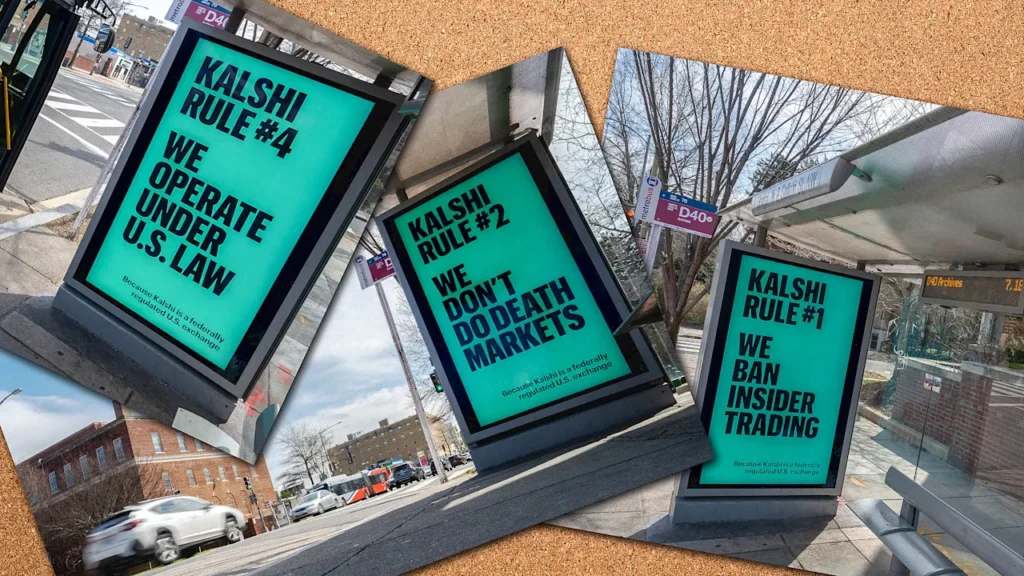
Usually, when Washington, D.C., commuters are inundated with mint green-tinted ads in March, it means the Shamrock Shake is back at McDonald’s.
This year, the eye-catching color instead appears in a full-court-press ad campaign for prediction market platform, Kalshi, which uses that shade in all its branding. Unlike seasonal milkshake ads, though, the targeted barrage of billboards, bus stop signs and metro station posters isn’t meant to reach all residents within the nation’s capital; just lawmakers and their staffers.
It’s all part of a big bet by Kalshi to avoid regulation—one that seems destined to not pay out.
Each variation of these ads touts a different “Kalshi Rule” meant to reassure observers that absolutely nothing shady is going on in this market, despite whatever they may have heard.
Worried about recent reports of anonymous traders making a mint from suspiciously timed, ghoulish bets related to the war in Iran? Well, you must be thinking of unenlightened competitor Polymarket, because Kalshi bans insider trading and doesn’t “do” death bets. (In a bit of moral housekeeping, after the initial strikes on Iran, Kalshi froze all its traders’ wagers on when Ayatollah Khamenei would be killed, while Polymarket did not.)
In fact, you might even say, as one of the ads rather defensively does, that Kalshi “operate[s] under U.S. law”—a claim generally just assumed of most publicly operated businesses.
Given all the bad publicity around prediction market trades involving the Iran War, Kalshi is currently hoping to decouple itself from Polymarket (despite the two sharing strategic advisor Donald Trump Jr.) in the public imagination. Or at least the public imagination in Washington D.C., where people who might regulate these markets live and work.
From bets to “event contracts”
Ever since its 2018 founding, Kalshi has attempted to help shape the regulations around U.S. prediction markets. The company’s executives were careful early on to present Kalshi not as a betting site, but rather a financial exchange offering “event contracts.” In 2020, Kalshi secured approval from the Commodity Futures Trading Commission (CFTC) as a Designated Contract Market, giving it a sheen of federal regulation before officially launching in 2021.
By getting licensed right out of the gate, Kalshi could argue its trades amounted to derivatives on the national stage—rather than bets whose legality might be challenged from state to state. Then, just in time for the 2024 election cycle, the company triumphed over the CFTC’s eventual efforts to block traders from making political event contracts, opening up a Donald Trump-shaped can of worms.
All hot streaks come to an end, though, and some chilly weather may be headed for Kalshi. The company is now staring down a blizzard of bills aiming to further regulate it.
A trio of U.S. states—Washington, Nevada, and Arizona—are currently suing Kalshi, alleging the company breaches state gambling laws by running prediction markets. On the national stage, Sen. Jeff Merkley and Rep. Jamie Rask recently introduced a bicameral bill that would ban betting on prediction markets for elections, government and military acts, and sports. Meanwhile Sens. Adam Schiff and John Curtis are pushing bipartisan legislation to amend the Commodity Exchange Act, redefining platforms like Kalshi as a mode of gambling. (Someone unfamiliar with the byzantine nuances of prediction markets might note that placing a wager on how long a government shutdown will last sure looks an awful lot like gambling.)
Given all this recent legislation, Kalshi’s poster bonanza in D.C. seems more akin to lobbying than marketing. Either way, it will probably backfire.
Beating the odds
Assuming the average politician who sees the ads isn’t one of the 40 Democratic lawmakers who just sent a letter to the Office of Government Ethics about insider trading, what will they think about the platform’s claim of having banned insider trading? Perhaps they will think to take a look at Kalshi’s website for an explanation of its approach to the matter.
If they did, they would find a glaring loophole or two. While Kalshi does prevent certain “high-risk individuals,” including politicians and staffers, from trading in specific markets, it says nothing about how Kalshi might prevent friends and family of high-risk individuals placing bets on their behalf.
No wonder Reps. Adrian Smith and Nikki Budzinski just introduced a bipartisan House bill that would bar the president, members of Congress, senior federal officials—and all of their families—from making trades in prediction markets.
If Kalshi had intentionally designed an ad campaign meant for inviting further scrutiny into its practices, it scarcely could have made one more effective than what’s currently on display. The list of Rules invites observers to think deeply about the shockingly few guardrails already placed on Kalshi, which of them could be easily circumvented, and how hard the company is working to avoid any further guardrails—all in the guise of being proudly compliant.
It’s certainly possible that lawmakers will be moved by these ads’ claims and decide to help guide Kalshi to its least regulated potential future.
But I wouldn’t bet on it.