Along the shores of Lake Louise––some 5,000 above sea level where the Victoria Glacier feeds directly into a new bathing facility––Matteo Thun has designed BASIN Glacial Waters to function as both architectural frame and sensory mediator, a space where the physiological effects of thermotherapy meet the raw power of protected wilderness. With an opening last September at Fairmont Chateau Lake Louise, this marks the first thermal bathing facility in North America to fully integrate European sweat culture traditions with glacial-fed hydrotherapy at this scale.

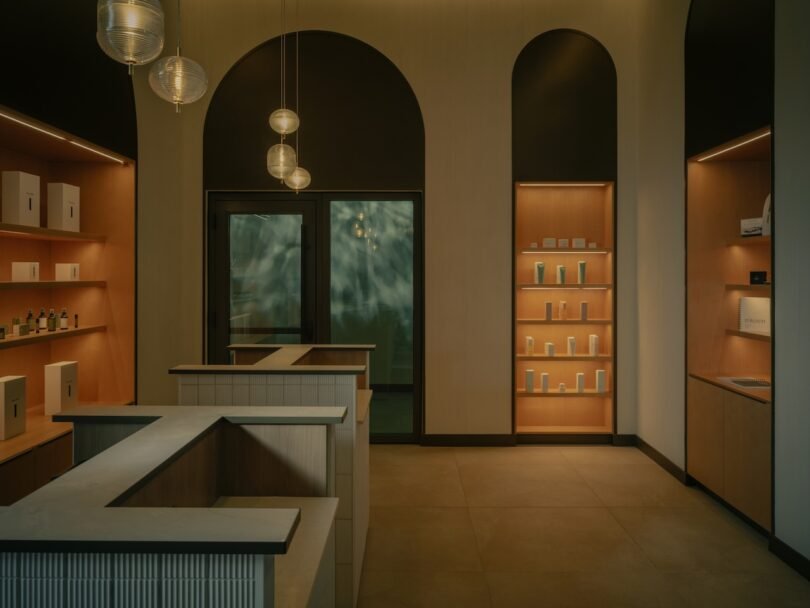
Raised in the Dolomites and experienced in alpine architecture across the Alps, Thun understands how light behaves at elevation and how thermal contrast intensifies in thin mountain air. The facility appears embedded into the landscape rather than imposed upon it. Dramatic arched windows mirror the original 1920s hotel architecture flooding interior spaces with shifting natural light, which creates dynamic shadows throughout the day.


Sustainably-sourced, Canadian-wood beams span the ceiling, their mass calibrated to balance acoustic absorption with visual warmth. The wood will patina under exposure to steam and temperature fluctuations, gradually, baking the aging process into design and specification. Material transformation is intrinsic to the spatial narrative.

“BASIN sets a new worldwide standard for thermal spa luxury and will be a flagship for Fairmont’s new wellbeing platform,” says Emlyn Brown, Senior Vice President of Wellbeing, Strategy, Design & Development at Accor. “We’re confident that this is the most exciting wellness opening of 2025, representing a groundbreaking shift to the meaning of wellness within the breathtaking Canadian Rockies.”

Traditional Finnish and Bio Saunas offer varying humidity levels within nearly identical formal envelopes, revealing how invisible atmospheric shifts can fundamentally alter spatial experience. Beyond them, the outdoor Aufguss Sauna reframes ritual as architecture in motion: an Aufgussmeister circulates oil-infused steam in slow, deliberate choreography, transforming a static enclosure into a dynamic sensory chamber.

Within the steam rooms, humidity reaches 100 percent, rendering the air tactile—almost liquid—as if immersion begins before the water is ever touched. Nearby, the circular reflexology pool and Kneipp Walk use calibrated shifts in depth and temperature as a form of spatial guidance. Here, movement is directed by sensation rather than signage; the body becomes both compass and participant.

A Himalayan salt wall anchors the Silent Salt Relax lounge, subtly ionizing the air while radiating a gentle, enveloping warmth that establishes a microclimate distinct from adjoining rooms. In the Hot Stone Room, heated slab beds store and release thermal mass directly into the body, allowing material warmth—not ambient air—to serve as the primary heating strategy.


Outdoors, a wood-paneled terrace extends the experience into open air. Benches are positioned with quiet precision, aligning seating plane, deck surface, and sightline so that nothing interrupts the visual dialogue between occupant and glacier. It is a final calibration—architecture dissolving into atmosphere, body into landscape.


To learn more about the convergence of design and wellness, visit thebasin.com.
Photography courtesy of Fairmont Chateau Lake Louise.