CHICAGO — I’m a chair person. In particular, I have a thing for improbable, clever seats that aren’t always great for actually sitting on. Sometimes my family complains.
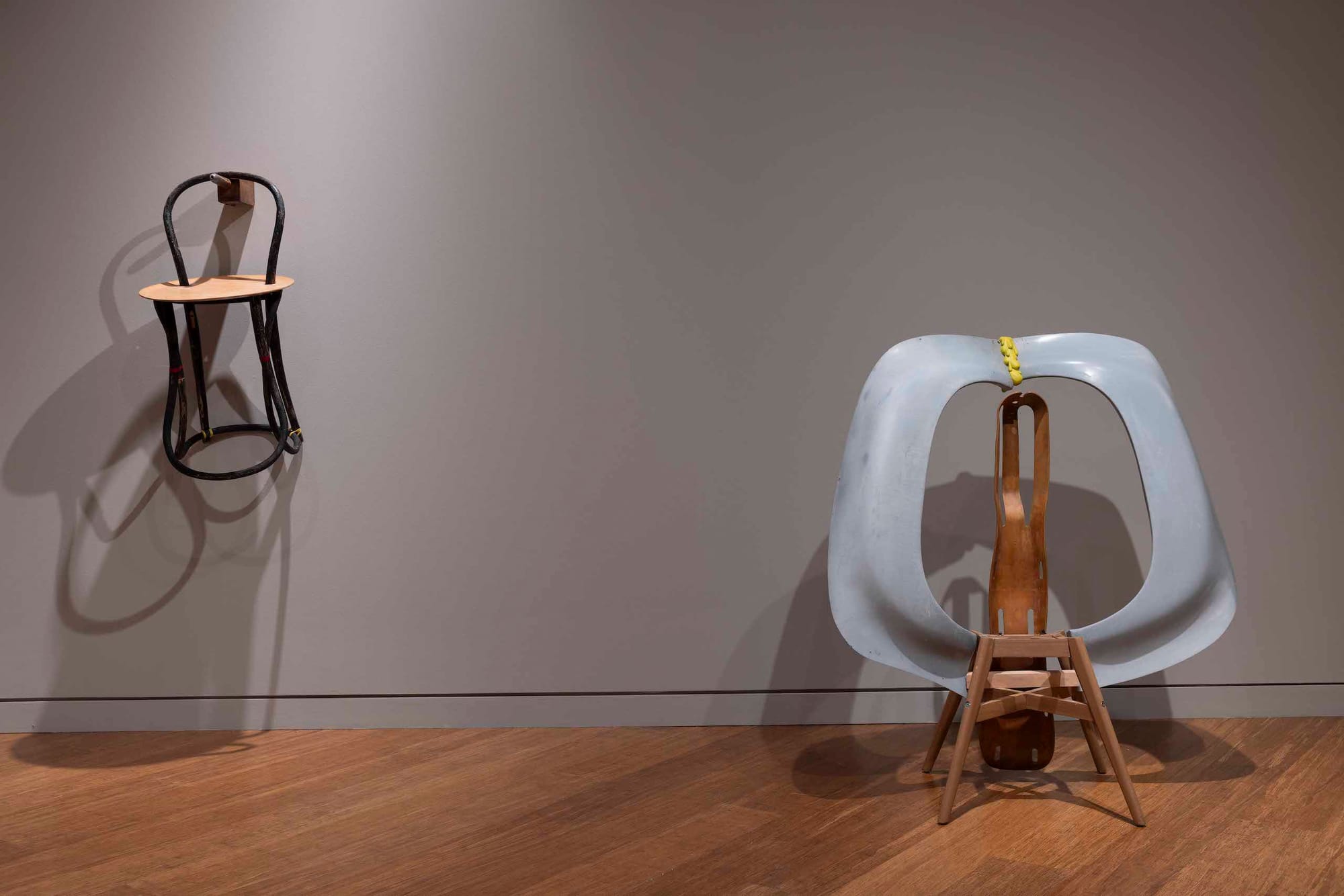
Multiple examples of such objects can be found in the group show The Heresy of Legacy, currently on view at Volume Gallery, which recently decamped to a new and larger location a few blocks from their old place in West Town. The exhibition title is a bit on the nose, but the experimental chairs are delightful. A 2003 riff by the late master woodworker Garry Knox Bennett jams Gerrit Rietveld’s “Zig Zag” with an old-school ladder back by literally inserting a miniature ladder into its seat back. Matt Olson/OOIEE takes apart an imitation Marcel Breuer “Cesca” then puts it together again, upside down and backwards, yet somehow still functional. Norman Kelley shows what happens when a roll-top desk and an armchair have a baby.

Plenty more fun with high design can be had at Chair-ish, Alex Chitty and Norman Teague’s two-person show at the Cleve Carney Museum of Art in Glen Ellyn (all works 2026 unless otherwise noted). Chitty is a sculptor known for taking high-design objects as her raw material; Teague is an exceptionally artful furniture designer. Both are well loved and well represented locally, but they have never worked together before. Indeed, the exhibition isn’t exactly a collaboration, though it was originally meant to be. Chair-ish has them working in parallel, prompting one another, offering revealing comparisons, and giving each other the kind of permission needed to do something as heretical as saw a Charles and Ray Eames chair into pieces.
Yes, they really did. The evidence sits unceremoniously in a corner of the gallery.
I know modernist design well enough to feel scandalized by a pile of Eames chair scraps, not least because some were vintage fiberglass. Chair-ish carries that frisson throughout, because all of it has been cobbled together from bits and pieces of original furniture, or replicas, by historically important designers and manufacturers. Is it less iconoclastic to take liberties with a knockoff than an original? Probably. It’s certainly a lot less expensive. Chitty and Teague do both, though curiously, Chitty’s wall labels make clear what’s what and by whom, where Teague mostly just notes the raw materials out of which a Knoll table was made. Either way, the liberty they both take with this precious old stuff is refreshing. It cuts deep, too: in the exhibition video, the artists discuss how, as a White woman and a Black man, they have often felt left out of the historical design conversation. Sometimes the best kind of reverence is irreverence, 1st Dibs and Design Within Reach be damned.

Chitty’s deal is illuminating the abstract artiness of design components, something her wall works bear out with wit. Her “Brace” paintings — four are in the show — are comprised of simple cherrywood frames crisscrossed with thick jute webbing, held in place by upholstery tacks. If you were to carefully cut off the seatback of Jens Risom’s classic 1943 design for Knoll and hang it on a wall, the effect would be similar. Chitty more or less does just that in a second series, Configuration, consisting of bright green metal panels dotted with rust and mounted in unusual white steel casings. For those in the know, the signature green’s a tip-off, but regardless the materials list states that these are in fact shelving pieces from USM Haller’s iconic modular system, in production since 1965. They’re gorgeous.
In her floor sculptures, Chitty arranges comical life-sized humanoids out of everything from spindly Arthur Umanoff stool legs to tubular Mies van der Rohe parts and elegant Yngve Ekström armrests. Teague also leans anthropomorphic, especially in “Eames Face,” a totemic figure composed of three wooden chair parts, among them an ottoman bearing its Herman Miller label like a badge.
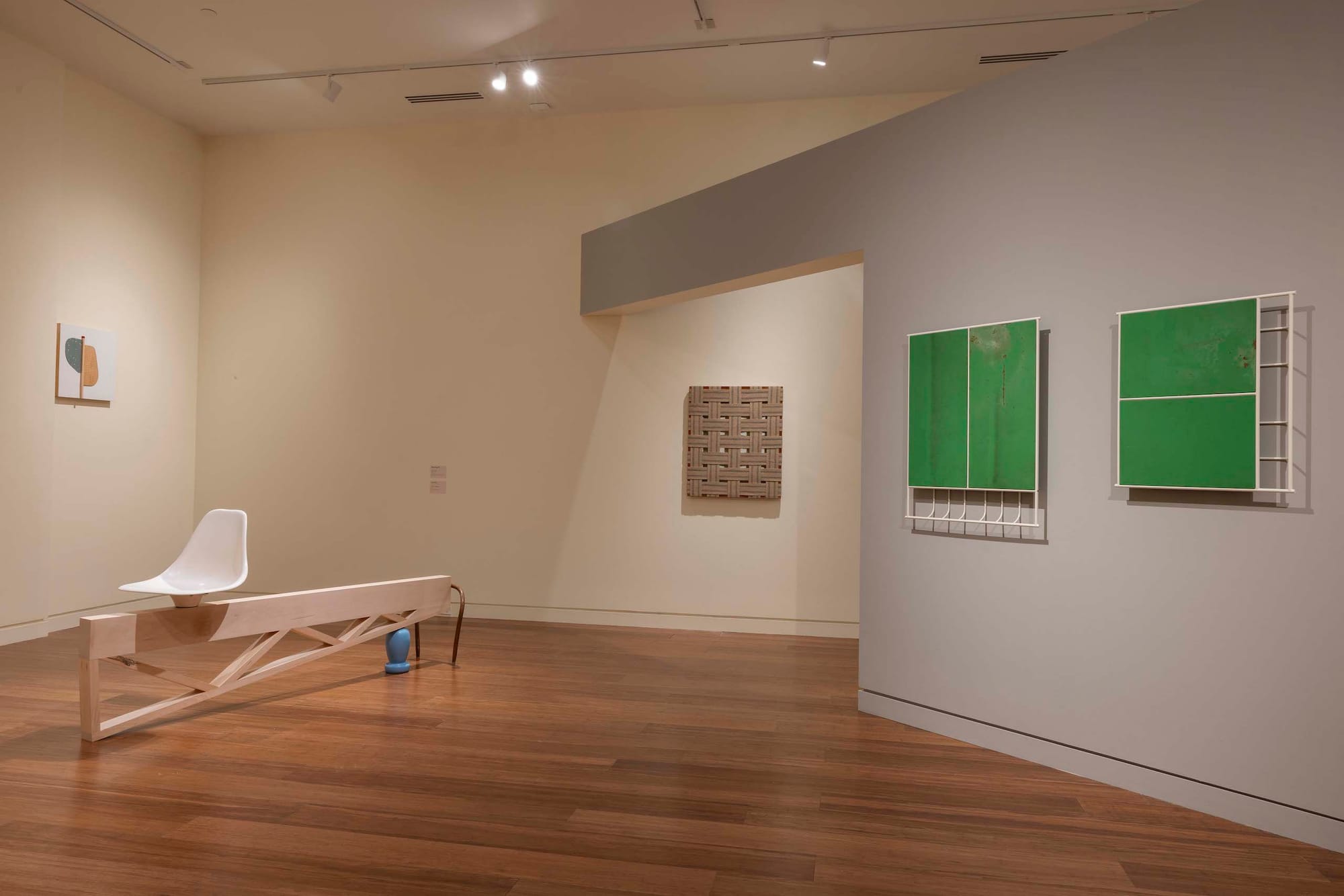
Under the auspices of Norman Teague Design Studio, Teague produces fully functional designs for sitting, storage, and display. For Chair-ish he was able to eschew the concomitant constraints of usability, durability, and reproducibility, and build charming concoctions like “Truss Chair,” best described as the result of a bridge falling in love with two very different chairs at once; a vertiginous rocker (in any case already occupied by a woven basket); and the truly bizarre “Pollinia” armchair, featuring car parts and a molded plywood leg splint that was the Eames’s contribution to World War II.
The one true collaboration in Chair-ish is the “Eames/Judd/Shapiro/Teague/Chitty Bench.” How many people does it take to make a bench? A whole lot: The piece is named not just for its comfortable orange Eames seats, but also for the Donald Judd-inspired plywood bench that serves as their base, along with Matt and Danny Shapiro, brothers who helped with various elements of the exhibition. Not mentioned in the title but listed in the materials are three more folks, designers of the found chair legs that give the bench extra stability and style. Working together, presently, posthumously, knowingly, and not, they built the only place in the exhibition where viewers are finally allowed to sit down. So do, and rest awhile.

The Heresy of Legacy continues at Volume Gallery (1700 West Hubbard Street, Chicago, Illinois) through March 28. The exhibition was organized by the gallery.
Chair-ish continues at the Cleve Carney Museum of Art (425 Fawell Boulevard, Glen Ellyn, Illinois) through April 11. The exhibition was organized by CCMA Assistant Curator Julia Walker.