Calling all space vendors, scientists, and STEM students: NASA needs even more of your help building the next generations of space stations, lunar infrastructure, and space science.
In a sweeping overview on Tuesday, NASA Administrator Jared Isaacman and space program leaders delivered an urgent and overhauled vision to advance American leadership in space commerce and scientific exploration.
After decades of a space agency spread too thin, losing skills, money, and time serving too many stakeholders, the streamlined revamp calls for aligning NASA goals and workflows with commercial and international partners on a clear mission to build a competitive commercial ecosystem in low-Earth orbit and a sustained lunar presence on the moon.
A main motive is China. America is launching Artemis II astronauts to a lunar loop next week for the first time in half a century and returning humans to the surface in 2028, barely ahead of China’s plans to land its own explorers on the moon by 2030.
“We find ourselves with a real geopolitical rival, challenging American leadership in the high ground of space,” said Isaacman. “Success or failure will be measured in months, not years. This time, the goal is not flags and footprints. This time, the goal is to stay. America will never again give up the moon.”
Going back to the Moon
Since taking the helm in December, Isaacman has been reviewing old supply chains and initiatives, seeking to cut bureaucracy through sweeping regulatory changes that also empower workers, engage industry feedback, and accelerate execution. Last month, NASA announced its revamped Artemis mission schedule to standardize the Space Launch System (SLS) rocket configuration, and an additional low-Earth orbit (LEO) mission next year for further Orion capsule and spacesuit testing to reduce risk, and push its moon landing to 2028, with an eye toward increased surface landings.
“We’re following the proven stepwise approach that was demonstrated by the Apollo missions to methodically reduce risk incrementally and increase the likelihood of mission success,” said Lori Glaze, the Exploration Systems Development Mission Directorate acting associate administrator. “Each step needs to be big enough to make progress, but not so big that we take unnecessary risks.”
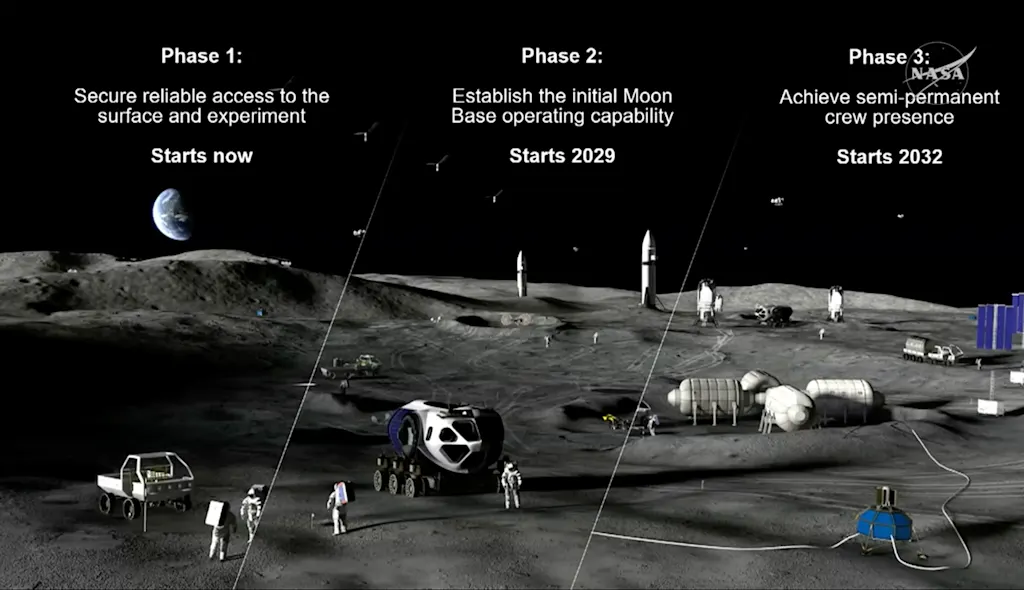
NASA now calls for pausing the proposed lunar orbiting Gateway to focus on a Moon Base, expected to cost some $20 billion over seven years, utilizing private and international partners. (NASA might leverage the Gateway architecture for the Moon Base and future missions.) Those plans will roll out over the next decade in three main phases involving more frequent landings to both accelerate learning and deliver science and technology payloads for a semi-permanent habitat, excavation sites, and communications network, followed by heavier infrastructure for a permanent base, mission cargo returns, and sustainable human presence on the moon using extracted oxygen, hydrogen, water, and rare earth elements.
“It does look like science fiction, but we’re planning to turn that into reality,” said Moon Base program executive Carlos Garcia-Galan.
Next-generation space stations
Meanwhile, NASA will shore up its LEO presence by transitioning to a coordinated network of next-generation commercial stations that gradually replace the aging International Space Station (ISS) without a gap in human presence in space. Under this approach, NASA would procure a government‑owned Core Module that attaches to the ISS, followed by approved commercial modules that would later detach into free flight. As one of many customers purchasing commercial services, NASA would stimulate the economy through private astronaut missions, commander seat sales, joint missions, multiple-module competitions, prioritizing research with high commercial potential, and prize‑based awards.
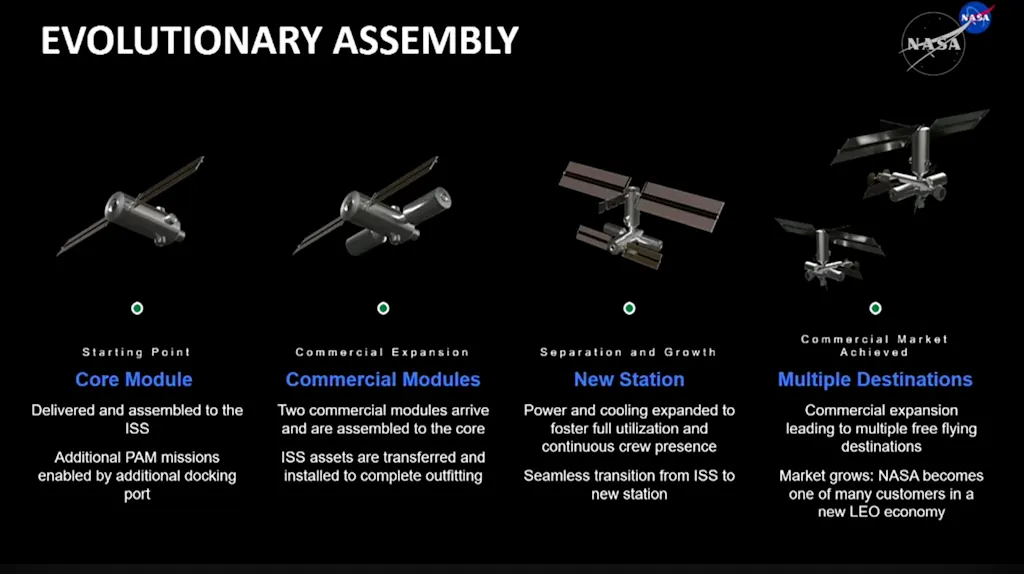
“Our objectives in low-Earth orbit have not changed,” said ISS program manager Dana Weigel. Those are to maintain America’s superiority in space, to conduct groundbreaking human research and technology development, and to use LEO as a proving ground for exploration. “We want to expand commercial access to space, stimulate commercial demand, and foster economic growth.”
Nuclear power on Mars
The event also unveiled NASA’s Space Reactor‑1 Freedom, the first nuclear-powered interplanetary spacecraft, which launches to Mars in late 2028. A coupled nuclear reactor, power conversion, and electric propulsion thruster system, Freedom provides power where solar arrays are ineffective.
On the way, it will demonstrate efficient mass transport and advanced nuclear electric propulsion in deep space. At Mars, Freedom will deploy the Skyfall payload of Ingenuity‑class helicopters for continued exploration, providing high-rate, direct-to-Earth communications, with an eye toward an industrial base for future power systems for long‑duration missions.
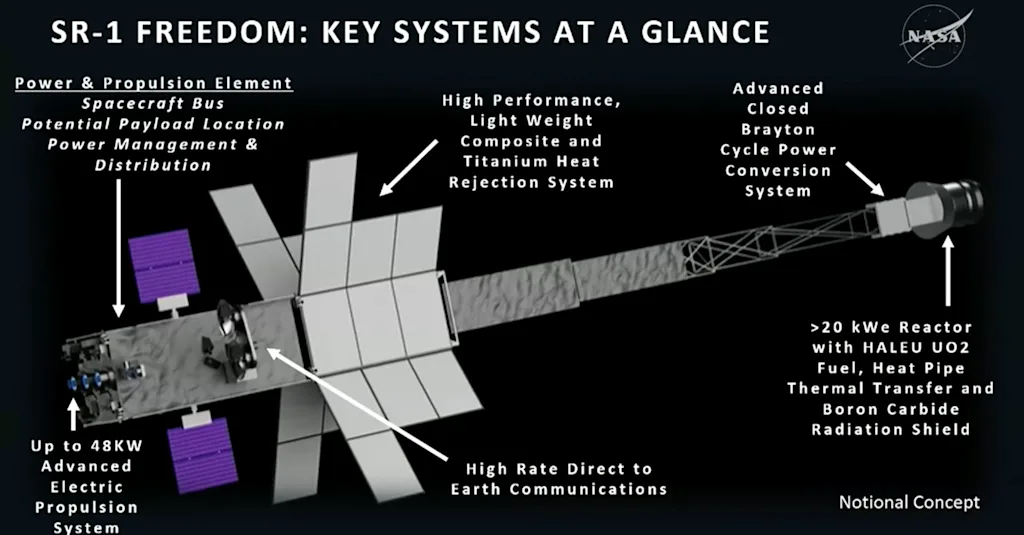
“Overall, a fission-powered spacecraft carrying science to Mars is not just a tech demo. It is the first freight run on the transcontinental railroad of the solar system,” said Fission Surface Power program executive Steve Sinacore.
A Golden Age of discovery
NASA is also planning a slate of ambitious scientific missions. The Nancy Grace Roman Space Telescope will launch as early as fall to further our understanding of dark energy. Next year, a new Earth science mission will measure how convective storms begin to improve extreme weather predictions up to six hours before storms occur, while the ESCAPADE (Escape and Plasma Acceleration and Dynamics Explorers) mission is en route to Mars to study how the solar wind impacts the Martian atmosphere.
In 2028, the Dragonfly nuclear-powered octocopter will embark on a six-year journey to Saturn’s moon Titan to probe for organic molecules indicating the origins of life. That same year, NASA will launch the European Space Agency’s Rosalind Franklin ExoMars Rover containing NASA’s Mars Organic Molecule Analyzer (MOMA) mass spectrometer, for the most advanced detection and analysis of organic matter ever conducted on Mars. By the early 2030s, NASA’s DAVINCI mission (Deep Atmosphere Venus Investigation of Noble gases, Chemistry, and Imaging) will send a spacecraft and a descent probe to Venus to determine whether it was once habitable.
“Many of the technologies that have the most promise for the health and safety of America can only be derived from work done in space, and we cannot afford to fall behind or cede leadership,” said Science Mission Directorate associate administrator Nicola Fox. “We must evolve how we explore.”
Increased initiatives
NASA will support these efforts through an expanded Commercial Lunar Payload Services (CLPS) program, expediting up to 30 robotic rovers, hoppers, and drones from industry, researchers, and international partners to the lunar and Martian surfaces.
To this end, the agency is modernizing its infrastructure and rebuilding its core engineering, technical, and operational competencies, converting thousands of contractors to civil service positions, expanding opportunities for interns and early‑career professionals, and starting initiatives, such as Space Force, to recruit top talent. It will also increase its outreach through grants and public educational programs.
“NASA is no longer the only game in town, and we don’t have exclusivity on all the good ideas. So, we welcome industry’s input,” says Isaacman. With industry bringing competitive dynamics, improved capability, and lower costs, “we should then shift our attention to what no one else is capable of—to explore farther out into the solar system.”