OpenAI’s first artist in residence is launching a new company that aims to turn your thoughts into actual products. Today, entrepreneur and roboticist Alexander Reben announces Phyzify, a lab using AI tools to rapidly prototype physical objects based on your imagination.
“There’s a huge gap between idea and [bringing that] thing into existence,” says Reben, cofounder of Phyzify. “And I really think AI and robotics and quantum computing and all the technology that’s about to come is going to accelerate [closing] that gap [and] make walking across that bridge a lot easier.”
But what Reben has in mind is far greater than just 3D printing. He’s envisions Phyzify as a platform where AI handles the entire execution of an idea, from potential prompts to multitudes of physical outputs. For example, translating music into paintings that an artist could sell as merch. On top of that, he sees Phyzify handling the backend of the more mundane aspects of product development, from securing domain names to filing patents and trademarks.
Phyzify closed a pre-seed round led by Logan Kilpatrick, product lead for Google AI Studio, DeepMind. Kilpatrick was drawn to Phyzify as an investor because he sees 2026 as “a huge year” for physical AI and generative media—and he believes Phyzify is at the front of the wave.
“Alex has a unique ability to bring new ideas at the intersection of AI and Art to life,” Kilpatrick said in an email. “I saw this first hand working with him at OpenAI, and now I couldn’t be more excited to back him as he and the team build the tools and platforms to enable people to bring their ideas to life.”
Phyzify is a natural evolution of Reben’s career that sits at the intersection of advanced technology and creative experimentation. In 2010 at MIT Media Lab, Reben’s graduate research focused on social robotics. One of his early creations, Boxie, became the inspiration of the character Baymax in Disney’s Big Hero 6.
In 2014, Reben became the director of technology and research at Stochastic Labs, a residency program in Berkeley convening minds across tech, art, and science. He’s made headlines for his various AI-based artworks. And in 2024, he was announced as OpenAI’s first artist-in-residence, where he spent the better part of the year gaining access to the company’s technology to explore how AI systems can participate in artistic practices.
And now, Reben wants to push the boundaries of AI and creativity even further with Phyzify—but with a clear intent on keeping humans at the center of it all.

“Looking to the future of automation and a lot of the research and papers and things people have been thinking about, it’s still pretty clear that asking the questions, being creative, imagining is something that makes sense for humans to keep doing,” Reben says. “That’s something that’s very, very hard for an AI to do, if not ultimately impossible.”
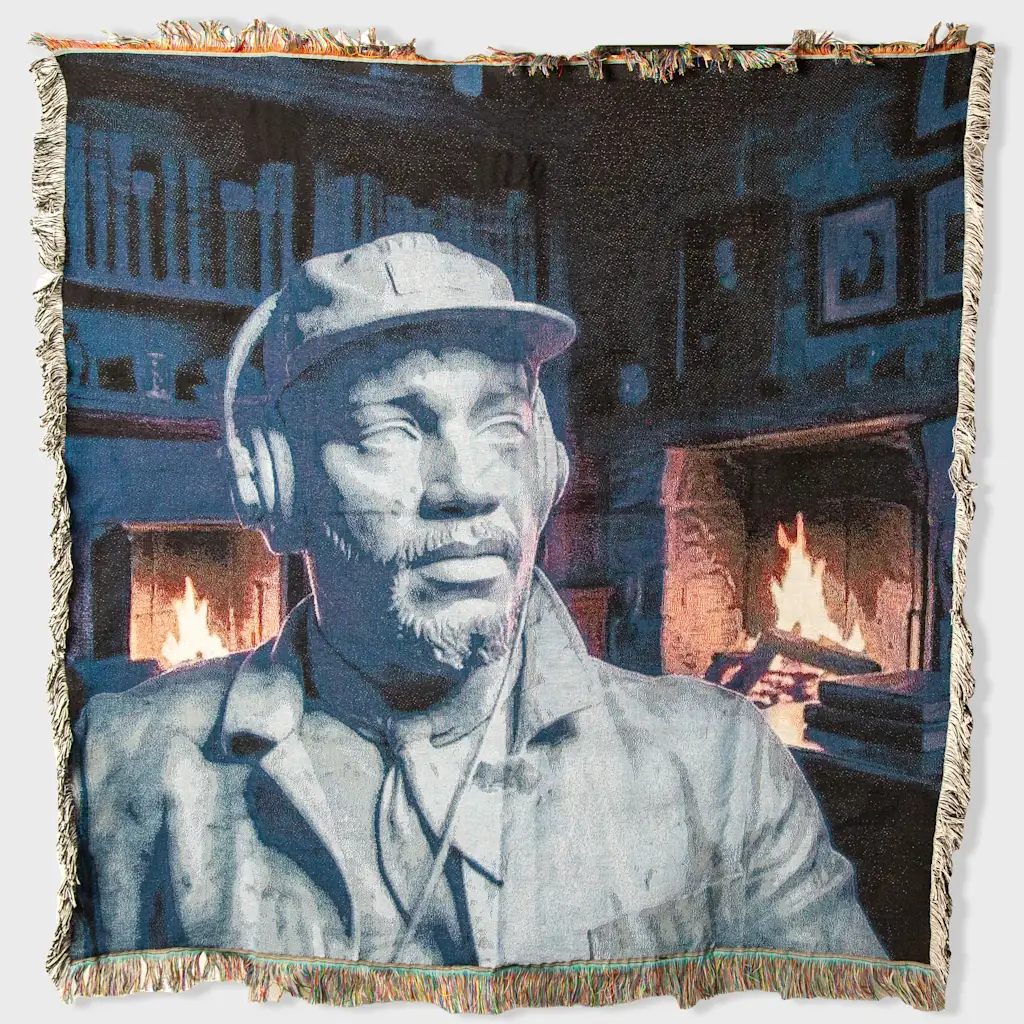
The company’s lab is headquartered in a North Carolina factory where they’re primarily working with fabric looms to transform AI-based concepts to physical products. In a virtual demo, I controlled various creative expressions of my webcam feed via a MIDI controller. Apparently there were more than 604 sextillion AI-generated options to choose from—I did not get through all of them. Once I locked in my choice, I could see a live feed of my image being woven on a loom in real-time and the tapestry was sent to my office the next day.
“This idea of bringing stuff [into] the physical realm needs a starting place,” Reben says. “Fabric is something that’s quite intriguing given it’s turned into so many different objects as well. So even the post-processing steps after creating a unique piece of fabric is fairly unlimited.”
As it expands across mediums, Phyzify is collaborating with five creative professionals in fashion, music, food, gaming, and more to help stress test and experiment with various interfaces and physical outputs.
“There’s an element of exploration right now,” says Jake Witzenfeld, cofounder of Phyzify. “The platform will be the accumulation of the tools that come out of what we’re doing at the lab.”
Phyzify is implementing an array of creative tools from across the advanced technology landscape, but it’s also building its own tools and systems with the goal of launching a consumer facing product in a year. Eventually, the company hopes to create mass market products, limited edition drops, art pieces, and more.
But outside of pushing products, Reben wants Phyzify to push against synthetic capitalism, an economy where the products and the means through which they’re produced are handled entirely by AI without any human involvement. To Reben, machines and AI have mastered how to make things. And humans should decide what’s worth being in the world and why.
“If we retain control of that,” Reben says, “and we can help move that forward, I think that’s an important mission to have.”