Smell is the sense most closely associated with memory, our olfactory systems nestled right next to the hippocampus. A whiff of cologne on a crowded subway car or an unmistakable trace of a beloved baked good in a nearby shop can instantly transport us to a different time and place. Since 1883, Italian perfumery Satinine has studied the art of scent, and now presents its newest space, Oficina Milanese, designed by Mara Bragagnolo, which treats memory through scent as something spatial, tactile, and alive.

A modern interpretation of the traditional portineria, or concierge, the stately doors open onto a distinctly Milanese sequence of spaces, each facet mirroring the culture of the city beyond. Bragagnolo positions hospitality as a principle of architecture, drawing from the entrance halls of historic buildings—thresholds where the act of arrival becomes ceremonial. Here, that gesture unfolds across a series of distinct yet connected environments: a reception-like portineria that reframes exchange as ritual, a more intimate sensory room for discovering fragrances in quiet seclusion, and a curatorial space designed for rotation, collaboration, and dialogue with art and design.

Integrity is essential to understanding the longevity of a perfume house established nearly 150 years ago. Throughout, the lighting, stonework, tile, and millwork are not only locally sourced but shaped through close collaboration with Milanese artisans, reinforcing a supply chain rooted in proximity and care. Every furnishing element—from the oak boiserie to the custom lighting fixtures—was made by hand, carrying forward a lineage of craft that feels vehemently relevant rather than nostalgic.

The care and attention to detail evident throughout the space, combined with the provenance of the hands that created it, marks Oficina Milanese as distinctly respectful of its surroundings. It underscores a larger truth: that Milan’s identity is inseparable from its material culture, and that authenticity is not declared but built, surface by surface.

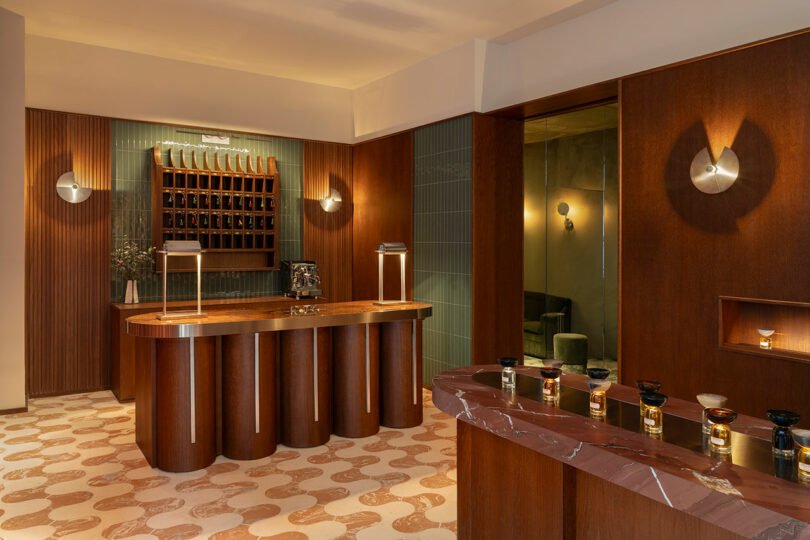
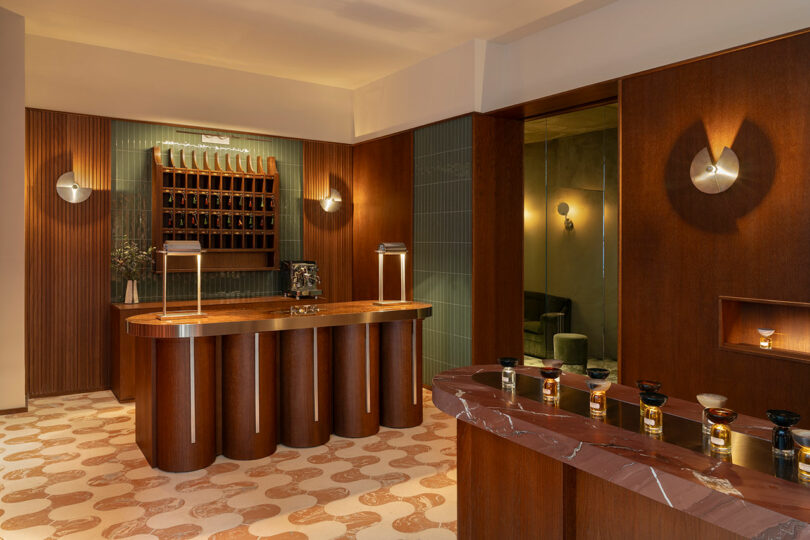
As scent is emotional, so too are the details featured in the space. Lombard terracotta tiles, laid according to traditional techniques, ground the interior in regional history, while glossy ceramic tiles arranged vertically nod to the facades of Milanese apartment buildings. Cathedral glass partitions diffuse light with a quiet luminosity, recalling the thresholds of historic entryways. Against this, oak paneling introduces warmth, set in deliberate contrast to cardinal marble, burl wood, and satin-finished steel. The sensorial experience gently oscillates between softness and precision.

The lighting, developed in collaboration with lighting designer Martina Frattura, bathes the space in a muted, diffused glow that boasts a silky, enveloping “satin” effect in subtle reference to the brand itself. It is less about illumination than atmosphere, softening edges and extending time within the room.
Art Deco sensibilities meet a color drench in the lounge area, where sage velvet wraps the room in a kind of quiet opulence. Round forms paired with slender metallic verticals introduce height and rhythm, while curtains provide a sense of retreat from the city’s constant movement.

A sliding door with colored glass panes seals the space from view when necessary, a nod to the stained glass windows that punctuate Milan’s churches. Directly to the left, a burlwood bar inlaid with the brand’s name encapsulates the project’s ethos. Highly polished and meticulously crafted, it transforms the expected gesture of welcome into something more enduring—an invitation to linger. Flanked by twin chrome lamps, their reflective surfaces catch and refract the surrounding materials, embedding the space in a subtle play of light and texture.

As Satinine looks toward the future, it does so not in defiance of the past, but through a careful continuation of it where craftsmanship becomes a contemporary language, and simple gestures, repeated with intention, become ritual.
To learn more about Satinine’s Oficina Milanese or designer Mara Bragagnolo, visit satinine.com and marabragagnolo.com, respectively.
Photography by Tiziano Ercoli & Riccardo Giancola.