Source: Earth’s Future
Sandy beaches account for approximately a third of the world’s ice-free coastlines. These sandy shorelines are responsible for sediment and water retention, provide a buffer against rising water levels, and offer habitats for shorebirds and sea turtles.
Beaches are constantly rearranged and shifted by storms, winds, erosion, tides, changing sea level, and climate cycles like El Niño. Human activity, such as damming rivers and building coastal infrastructure, can exacerbate erosion or buildup on a beach.
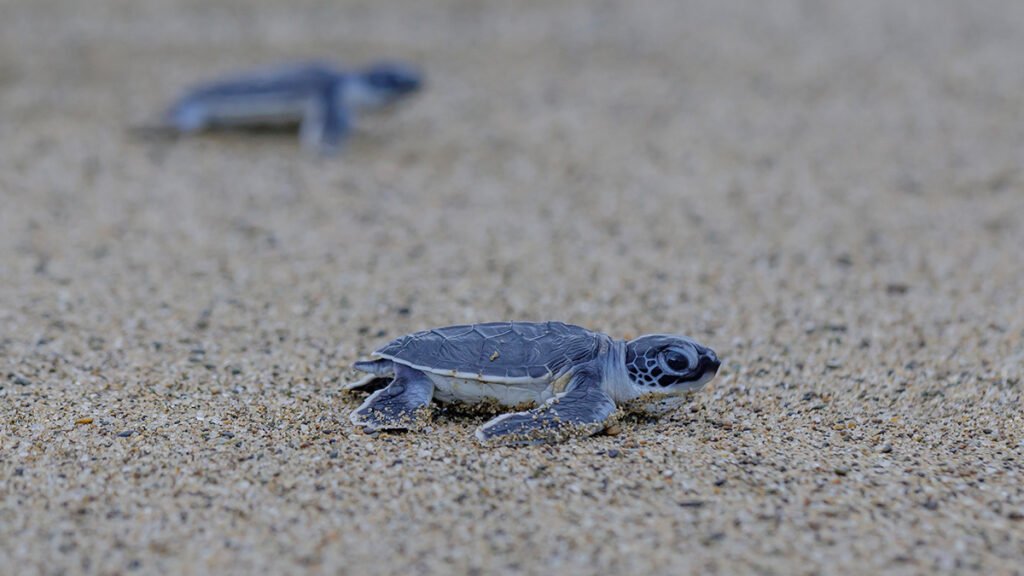
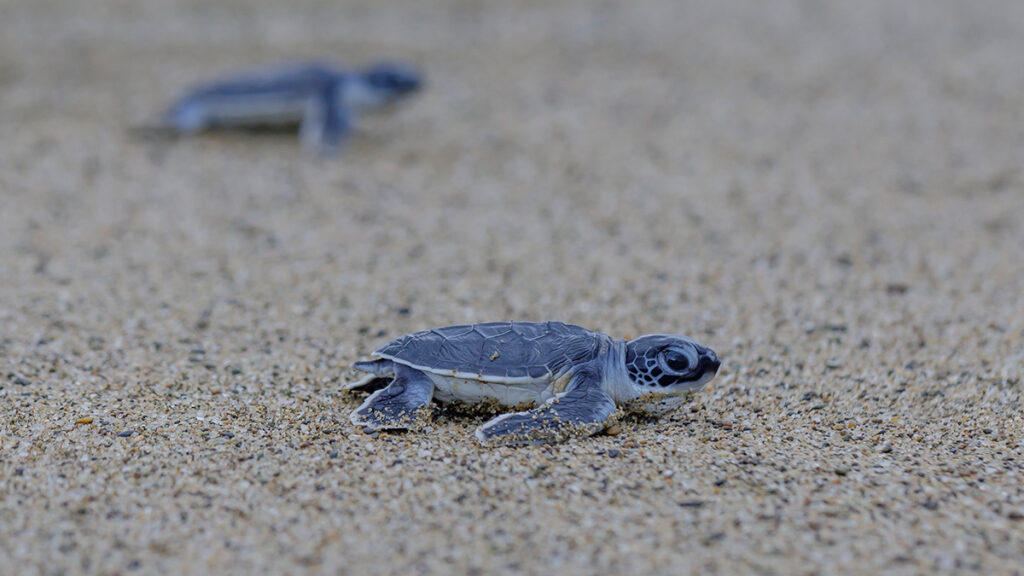
Though sea turtles have been a part of these dynamic ecosystems for millennia, their populations have faced significant decline in recent centuries. Their slow population growth rate means that they are particularly vulnerable to rapid changes in their environment, such as current erosion and sea level rise rates.
Previous studies used a “bathtub” approach to estimate the consequences of sea level rise for turtle beaches, simply adding projected sea level rise to a fixed beach elevation model. But this method doesn’t capture the ongoing morphological response of the beach itself and misrepresents the risk that nesting sea turtles face as their habitats shrink.
Christiaanse et al. aimed to build a more accurate picture of that risk. By combining satellite-derived shoreline data (CoastSat), shoreline modeling (Coastal One-line Assimilated Simulation Tool, or CoSMoS-COAST), and global elevation and infrastructure datasets, they examined shoreline trends on nine important nesting beaches from 1980 to 2024 and projected shoreline change from 2025 to 2100 under various sea level rise scenarios. They also estimated accommodation space, or how much room beaches had to shift inland.
Vulnerability to erosion and sea level rise varied considerably across the nine beach sites—and even across different sections of the same beach. Seven of the nine sites are predicted to experience shoreline retreat, the researchers found, but La Escobilla, Mexico, and João Barrosa, Cape Verde, are the least vulnerable because they will likely continue accreting sand instead of eroding. In contrast, three of the sites, including Long Beach, Ascension Island; Dirk Hartog Island, Australia; and Alagadi, Cyprus, are likely the most vulnerable because projected erosion may exceed the available space for those beaches to move inland by 2100, potentially affecting sea turtle nesting grounds. This study can provide a framework for future conservation efforts, the researchers suggest, to protect sea turtle habitats as climate conditions continue to change. (Earth’s Future, https://doi.org/10.1029/2025EF007191, 2026)
—Rebecca Owen (@beccapox.bsky.social), Science Writer

Citation: Owen, R. (2026), Sea turtles, shrinking beaches, and rising seas, Eos, 107, https://doi.org/10.1029/2026EO260087. Published on 16 March 2026.
Text © 2026. AGU. CC BY-NC-ND 3.0
Except where otherwise noted, images are subject to copyright. Any reuse without express permission from the copyright owner is prohibited.