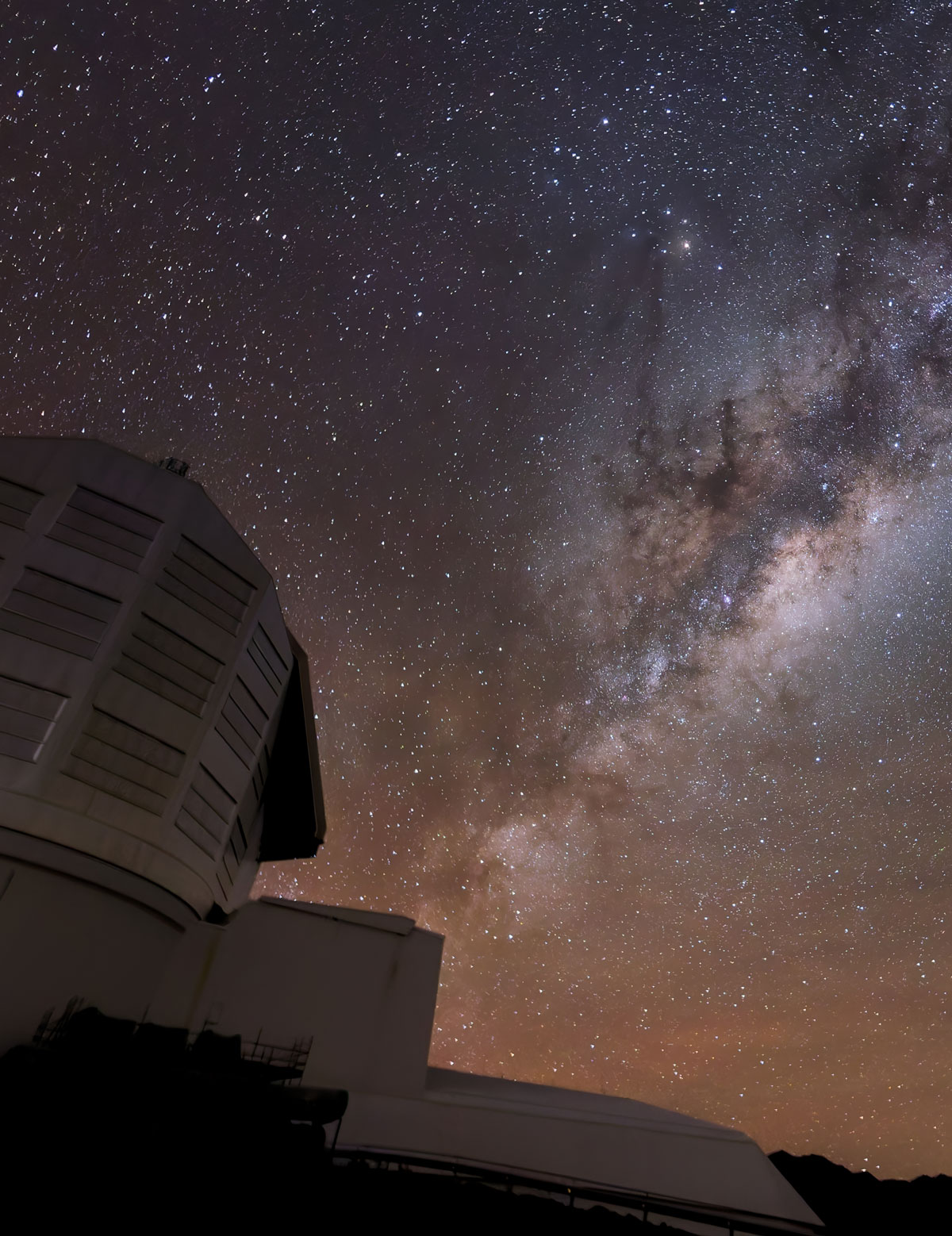
Look up at the dark night sky, and you’ll be treated to a symphony of astronomical phenomena centuries or millennia in the making. Planets make slow circuits around the Sun. Stars burn for billions of years while they crawl through the Milky Way. Galaxies perform a slow, stately dance around each other as the universe makes them inevitably drift apart.
Yet interspersed with these slow, almost eternal phenomena are bursts of quick activity: A black hole belches hot gas, a star goes supernova, asteroids collide, a comet whizzes past.
Astronomers can spot these “blink and you’ll miss it” events only if they’re looking at everything everywhere all at once all the time.
That’s exactly what the Vera C. Rubin Observatory is designed to do.
“The whole field of astronomy is about to be completely revolutionized by this dataset,” said Sarah Greenstreet, an astronomer at the National Science Foundation National Optical-Infrared Astronomy Research Laboratory (NSF NOIRLab) and the University of Washington in Seattle who studies asteroids and orbital dynamics. “We want to make sure that everyone gets to share in all of the exciting discoveries and science that we get to do with Rubin.”
“I’m really excited about the potential for Rubin Observatory to rewrite the textbooks.”
With a big, sensitive eye, rapidly repeating observing cadence, and decade-long survey, this observatory is poised to provide an unprecedented look at quickly evolving astronomical phenomena within the solar system and beyond.
“My science is changing because of Rubin Observatory,” said Meg Schwamb, a planetary astronomer at Queen’s University Belfast in the United Kingdom studying solar system formation and big data for astronomy. “If you ask me, ‘What do we know about the solar system today?’ and then you ask me next year, and in 2 years, my answer is going to be very different. I’m really excited about the potential for Rubin Observatory to rewrite the textbooks.”
Survey of Space and Time
The observatory that will study quickly changing phenomena came about anything but swiftly. The Vera C. Rubin Observatory, jointly funded by the NSF and the U.S. Department of Energy’s Office of Science, has been in the works since the early 1990s.
Astronomers initially conceptualized it as a large-aperture telescope capable of unlocking the mysteries of dark matter. That initial focus is why it was eventually named after astronomer Vera C. Rubin, who discovered evidence that some dark, unseen matter must be holding spinning galaxies together.
But astronomers soon realized that such a telescope would have tremendous capabilities in mapping the solar system, too. Creating an inventory of the solar system became one of the Rubin Observatory’s four science goals, as did exploring objects that change position or brightness over time, like asteroids and comets. Eventually, much of the observatory’s technological and data infrastructure was designed with solar system science in mind.
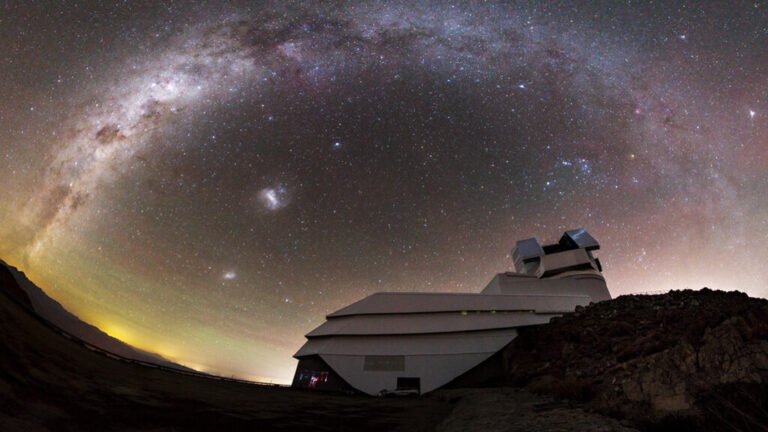
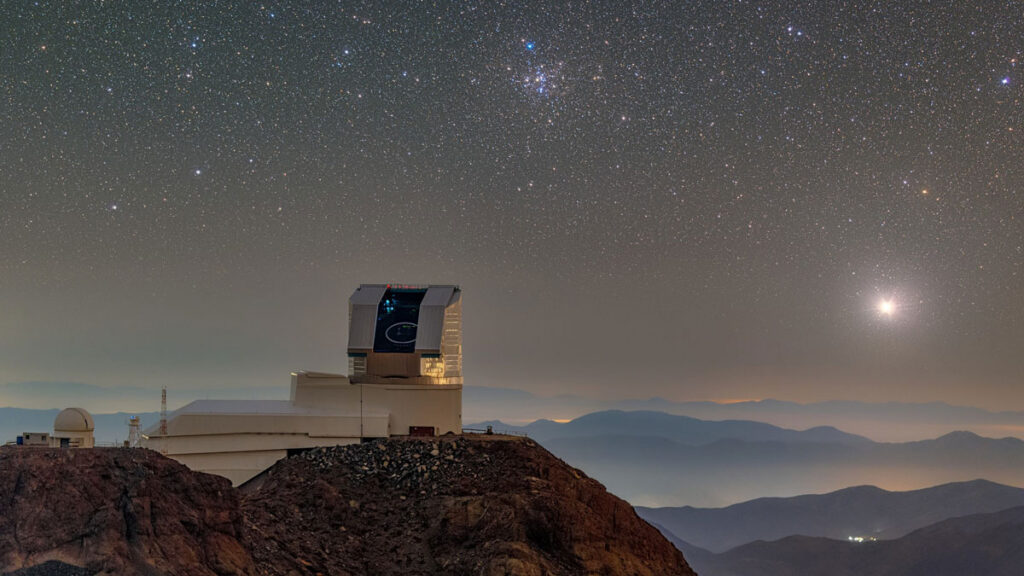
The observatory’s telescope, the Simonyi Survey Telescope, has an eye 8.4 meters (27.6 feet) across and is equipped with a 3,200-megapixel, car-sized digital camera. The LSST Camera, the largest ever built, can capture a slice of the sky 45 times the area of the full Moon every 5 seconds.
“The scale of it is a bit like when you have a space mission.”
Rubin is perched at 2,647 meters (8,684 feet) above sea level at Cerro Pachón in the Chilean Andes, which will allow it to escape most of the weather and atmospheric effects that plague ground-based telescopes. The observatory will image every point in the Southern Hemisphere sky 800 times over a 10-year period, document objects’ positions and brightnesses in multiple wavelengths, and analyze whether or not those objects have changed at all since the last time they were imaged. This time-lapse record of the universe will be the Legacy Survey of Space and Time, or LSST.
“The scale of it is a bit like when you have a space mission,” said Benoit Carry, an asteroid and planet formation researcher at Observatoire de la Côte d’Azur in France. “You tend to work on a space mission for a couple of decades before it flies, and then you have to operate the space mission for a decade. LSST is that kind of project.”
A Census of Asteroids
There are about 1.5 million known asteroids in the solar system. Most of them populate the asteroid belt between Mars and Jupiter, but there are plenty more strewn throughout the solar system, chasing or being chased by planets or clustering together in the space between. Some travel perilously close to planets, including Earth.
But 1.5 million is likely a gross underestimate of the true number of asteroids that are out there. Current telescopes can spot asteroids only down to about 10 meters in size and only then if the asteroids reflect enough light or make a nuisance of themselves, like if they collide with each other or block light from a brighter, more distant object.
Rubin’s larger aperture allows it to collect more light in a single glimpse, so even smaller and fainter asteroids will be visible.
Simulations conducted by Schwamb and her colleagues suggest that Rubin will detect more than 5 million new solar system objects over the span of 10 years: 3.7 million (2.7 times more) main belt asteroids, 89,000 (2.3 times more) near-Earth asteroids, 1,200 (7–12 times more) centaur asteroids that orbit between Jupiter and Neptune, and 32,000 (6 times more) trans-Neptunian objects in the Kuiper Belt and beyond. Around 70% to 80% of all those objects will be discovered within the first 2 years of the LSST, Schwamb explained, and the survey will track those objects’ movements over 10 years.
Not only will Rubin enable astronomers to map the locations and movements of millions more asteroids, said Carry, but it also will provide some information about the objects’ compositions and whether they change over time. The LSST Camera will observe objects in multiple wavelengths at the same time, from the near ultraviolet to visible to the near infrared, which can help identify some basic surface chemistry.
With a more complete census of asteroids of all sizes and compositions, planetary scientists will be able to better understand the demographics of small rocky objects, begin to identify trends or strange clustering, and spot the truly rare or anomalous asteroids.
Scientists had an early glimpse of this potential in Rubin’s first-look images. During its commissioning period in 2025, a quick (for Rubin) 10-hour look near where the Milky Way stretches across the sky revealed roughly 2,000 asteroids that had never been seen before.
Greenstreet’s team analyzed those data and found that 19 of those asteroids spin faster than once every 2.2 hours, classified as “superfast.” One asteroid 700 kilometers across broke the record for the fastest-spinning large asteroid, completing one rotation in just under 2 minutes.

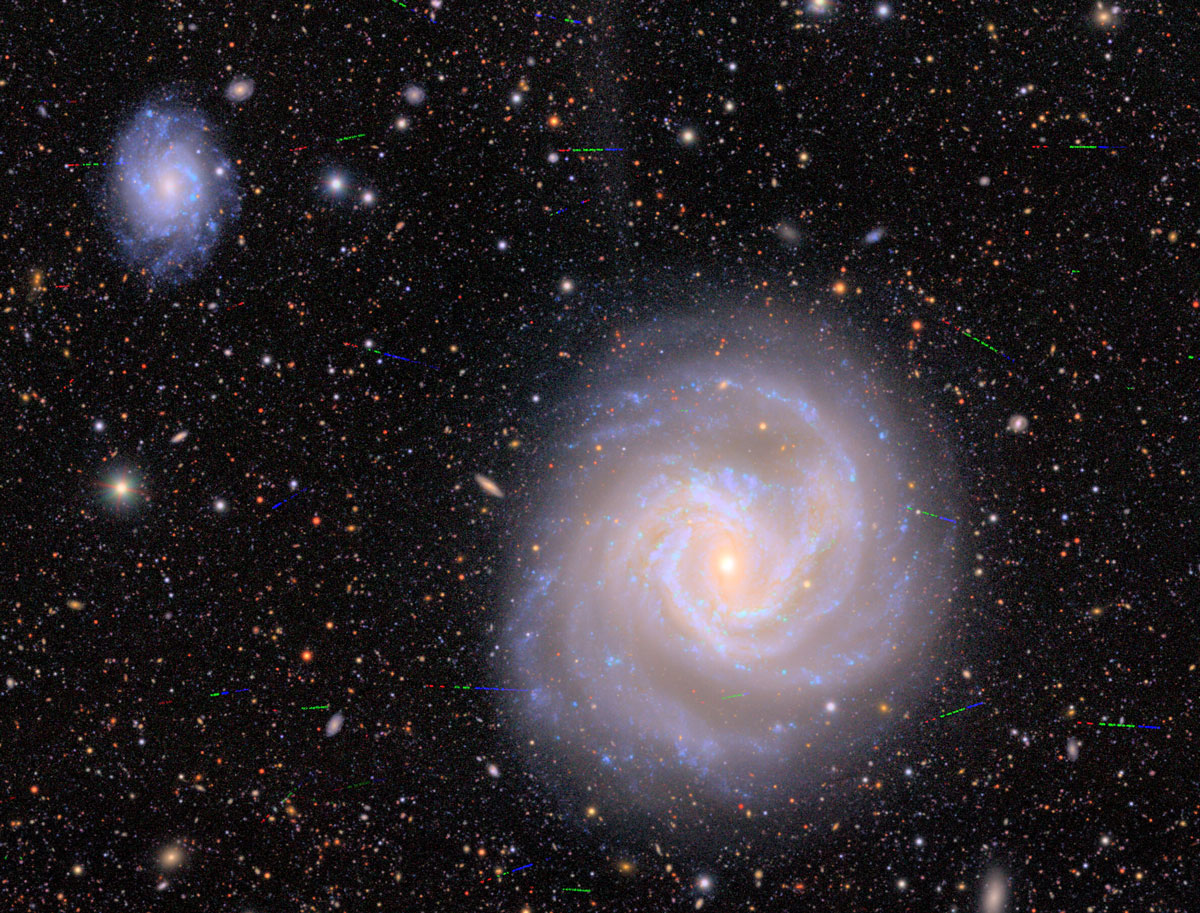
“When an asteroid this large is rotating this quickly, it has to mean that the asteroid is made of solid material that has quite high strength, because otherwise the asteroid would break apart,” Greenstreet said.
“These are just some of the very first testing images from the Rubin Observatory, and we already found a record-breaking asteroid in that dataset.”
The data from the commissioning period are not the same as what LSST will produce: The first-look data stared at the same patch of sky for a prolonged period, good for measuring asteroid rotation rates, rather than sweeping across the sky in quick bursts. But Greenstreet said that over the course of 10 years, LSST will build up a similar dataset that will enable similar measurements.
“These are just some of the very first testing images from the Rubin Observatory,” Greenstreet said, “and we already found a record-breaking asteroid in that dataset.”
Inbound and Active
When it comes to objects that change dramatically in a short time, comets take center stage. Most comets come from the region beyond Neptune’s orbit that is populated by small icy bodies. But right now, we have only a vague idea of how many objects are out there and what their sizes, compositions, and orbits are.
Most have been discovered serendipitously or after they’ve already made their way close enough to Earth to detect.
At that stage, water ice sublimation dominates comets’ spectra and makes it difficult to know what trace ices and gases had been released before, explained Rosemary Dorsey, a planetary scientist studying small solar system and interstellar objects at the University of Helsinki in Finland.
“Outside of Jupiter’s orbit, there are other ices and gases that drive the activity,” Dorsey said. “But because we typically don’t discover the comets before that, we don’t know if they’ve been active even further out.”
Rubin, however, will spot smaller and fainter comets at points much earlier in their journeys and could detect that activity. The survey’s longevity will also allow planetary scientists to discover and track smaller icy trans-Neptunian objects and fill in the map of the outer solar system, Dorsey added.
Survey simulations predict not only how many objects of different types Rubin will detect but, crucially, how many it won’t.
What’s more, survey simulations like the ones that Dorsey and her colleagues created predict not only how many objects of different types Rubin will detect but, crucially, how many it won’t. Combining those two estimates would allow astronomers to calculate the true populations of small solar system objects, including trans-Neptunian objects.
But comets aren’t the only active small objects the solar system has to offer. Henry Hsieh was particularly excited at the likelihood that Rubin would detect more active asteroids, those that sometimes unexpectedly behave like comets and spew material into space. With only about 50 active asteroids known, they are considered relatively rare. But are they really? Rubin could boost that number 20-fold.
“Up until now, it’s been, ‘Okay, here’s one, let’s study it. Here’s another one. Let’s study it,’” Hsieh said. “Rubin is going to take it to a whole new level.”
Hsieh, who studies active asteroids and asteroid composition at the Planetary Science Institute in Tucson, Ariz., likened the upcoming boost to how the field of exoplanets has evolved in the past 3 decades. At first, there were a handful exoplanets that astronomers studied relentlessly. Eventually, detection surveys discovered thousands of exoplanets, which enabled astronomers to look for population trends.
Simulations suggest that Rubin will detect more than 5 million new solar system objects over the span of 10 years.
“You can’t really do that with 50 [active asteroids],” Hsieh. “It’s not bad, but with 1,000 you can get a much better feel for the trends.”
Bridging the gap between comets and asteroids are small objects that originated beyond the Sun’s gravitational clutches: interstellar objects, or ISOs. Astronomers have discovered three interstellar interlopers so far, and all three were discovered by chance. Dorsey’s simulations predict that Rubin will detect between 6 and 50 interstellar objects over LSST’s 10-year duration. She explained that the actual number of detections will depend on how many interstellar objects actually exist (unknown) and whether they tend to be large or small (also unknown).
One hurdle to answering those questions is that the three known ISOs were all detected by different surveys, each with their own observing thresholds and detection biases. Rubin’s ISO detections would sidestep that challenge.
“Fifty interstellar objects in 10 years would be phenomenal and make for a very exciting decade of research,” Dorsey said. But even with a more conservative estimate, “to have a self-consistent sample of even six ISOs will be a great advancement. That keeps me optimistic.”
What About Planets?
Rubin cannot look directly at the planets themselves, which are far too bright for such a sensitive instrument. No images of planetary aurorae, weather, or surface impacts will be forthcoming.
But that doesn’t mean that Rubin won’t contribute to our understanding of the planets, too, albeit indirectly.
Asteroids, comets, and other small objects are the remnants of planet formation, explained Carry. Their current orbits hold tracers of past gravitational interactions with planets. While most solar system formation theories agree that the giant planets—Jupiter, Saturn, Uranus, and Neptune—shifted around the solar system during a period of instability, theories disagree on which planets moved, by how much, and in which direction.
“LSST is going to provide us a snapshot of the population of small bodies today with the tools to actually play the movie backward.”
Each potential migration pattern would have left its own distinct marks on the distribution of asteroids, comets, and other icy bodies, Carry explained. As Rubin identifies, tracks, and measures the colors of millions of objects, astronomers will be looking to those data to validate, or refute, some of the leading theories of solar system evolution.
“LSST is going to provide us a snapshot of the population of small bodies today,” Carry said, “with the tools to actually play the movie backward and try to get as close as possible to the distribution post-planetary formation.”
“…with a bit of work, and a twist of lemon,” Carry joked.
And then there’s Planet 9, a hypothetical ninth planet larger than Earth but smaller than Neptune that might orbit 43 billion kilometers (27 billion miles) from the Sun. Astronomers have not seen any direct evidence that this planet exists. An odd alignment of the orbits of a dozen or so icy objects in the outer solar system suggests that something planet sized could be exerting gravitational influence that far out.
“This is the survey that will determine whether Planet 9 is real or not.”
However, the orbital data for the objects in question come from several different telescopes and surveys, and it’s hard to reconcile all the information in a consistent way, Schwamb explained. Those discrepancies have kept the Planet 9 debate alive.
“This is the survey that will determine whether Planet 9 is real or not,” Schwamb said. Orbital data for thousands of trans-Neptunian objects will all be processed by the same pipeline, eliminating much of the existing uncertainty. Either distant icy objects will show the suggested orbital alignment, or they won’t. “I think in the next year or two, we’re going to know that answer.”
“A Tsunami” of Data
“It’s going to be a tsunami. We never had something producing that quantity of data every day.”
The LSST will collect around 15 terabytes of data per day and send out an estimated 10 million alerts per night, notifying astronomers of anything and everything that has changed in the sky between one image and the next.
“It’s going to be a tsunami,” Carry said. “We never had something producing that quantity of data every day.”
“Every 30 seconds, it says, ‘Here’s 10,000 changes. Here’s 10,000 more,’” said David Trilling, an asteroid researcher at Northern Arizona University in Flagstaff.
It would be impossible to keep up with the fire hose of data even if every astronomer on Earth spent 24 hours a day on the task. Fortunately, they don’t have to. Teams around the world have spent more than a decade creating tiered alert broker systems that will automatically sift through LSST alerts and pass along only a small fraction of them. Astronomers can curate their alerts on the basis of their area of interest.
“Rather than every astronomer out there listening to an alert stream,” Trilling explained, “we have a layer between the telescope and the user, this broker ecosystem in the middle, that listens to that alert stream and says, ‘Okay, asteroids go this way, supernova go this way, variable stars go this way.’ Then the asteroid people are only listening to the asteroid stream, the supernova people, only the supernova stream, and so on.”
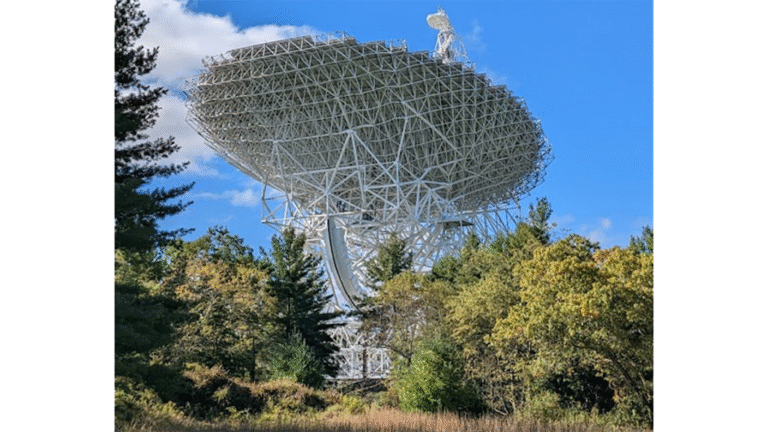
Scientists modeled this system after those currently operating at the Zwicky Transient Facility in California, an observatory that has been monitoring changing astronomical phenomena since 2018. The facility’s data stream is less than a tenth of what will be coming from Rubin, but it has been crucial for developing, debugging, and test running the LSST alert broker systems, Trilling said. Rubin’s brokers have also been tested on simulated alert streams and commissioning tests.
“The first year of Rubin is going to be crazy for everybody, because we’ve never worked on a project like this, but after a while, it’ll be fun,” Trilling said.
Even after going through the brokers, the data quantity will be enormous. Teams are building pipelines to process the alerts they receive and perform uniform analyses of objects’ positions, trajectories, and colors. Individualized software packages can then focus on answering specific science questions.
“This is at the intersection of computer science, machine learning, AI, and astronomy,” Carry said.
“If you’re at the biggest research university with lots of infrastructure, you have access, and if you’re at a underresourced local institution of higher ed—a regional university, community college, anything—you have the same access.”
What’s more, Rubin’s open data model and lack of proprietary period will ensure equitable data access to scientists and students around the world.
“If you’re at the biggest research university with lots of infrastructure, you have access,” Trilling said, “and if you’re at a underresourced local institution of higher ed—a regional university, community college, anything—you have the same access.”
“There may be a generation of students coming who have passed through lesser-resourced schools but who have the same expertise, the same training, and the same science ‘oomph’ that students at better-resourced schools have,” Trilling said. “Because all you need is a laptop and a way to connect to the data stream.”
The Odd, the Rare, and the Unknown Unknowns
“We’re really entering the era of big data for astronomy,” Greenstreet said. “Within the first year alone of the Rubin Observatory’s LSST survey, we expect that it’s going to collect more astronomical data than every telescope has collected throughout history combined…and we’re going to run the survey for 10 years.”
Whether they study small, rare, fast, or temporary phenomena, astronomers who study the changing universe are eagerly anticipating how Rubin and its LSST will revolutionize their science—and they have no doubt that it will.
“There will be a lot of interesting new fields or subfields that might come out, but also just interesting twists to existing fields that we just weren’t able to do before,” Hsieh commented.
Some people are hoping to answer a specific question whose answer would be a big leap for humankind, while others are open to exploring wherever the data may take them.
“What science do I want to do? I don’t know!” Schwamb said. “It’s going to depend on what we see, and there’s absolutely going to be something we’re not expecting.”
—Kimberly M. S. Cartier (@astrokimcartier.bsky.social), Staff Writer
Citation: Cartier, K. M. S. (2026), Small, faint, or fast, Rubin will find it, Eos, 107, https://doi.org/10.1029/2026EO260056. Published on 1 April 2026.
Text © 2026. AGU. CC BY-NC-ND 3.0
Except where otherwise noted, images are subject to copyright. Any reuse without express permission from the copyright owner is prohibited.