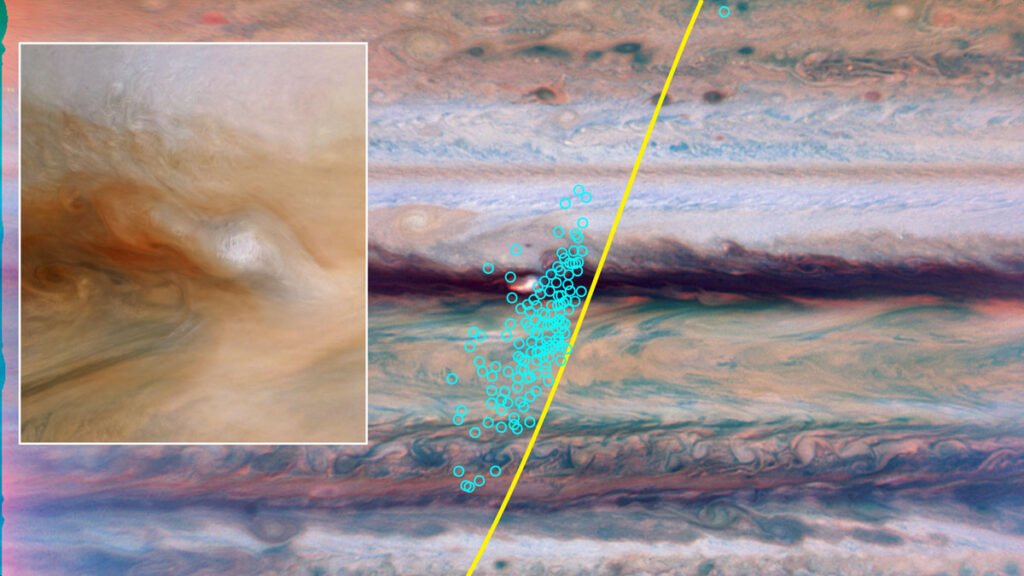
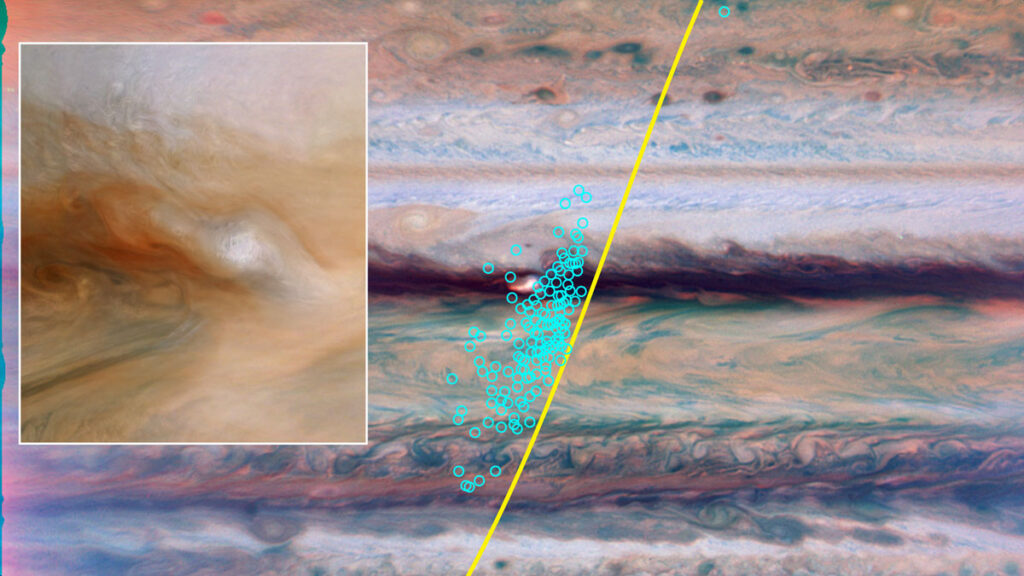
Source: AGU Advances
Jupiter’s lightning has long been of interest to planetary scientists, as it marks stormy spots where researchers can look to learn more about convection in Jupiter’s atmosphere.
Observing lightning from a distance can be tricky, so scientists have focused on the bolts that are easiest to study: strong flashes that strike at night. As a result, some studies have concluded that lightning bolts on Jupiter are all similar to the strongest lightning on Earth, known as “superbolts.” This conclusion was recently questioned, however, when the high-sensitivity star tracker camera on NASA’s Juno spacecraft detected faint, shallow lightning.
Wong et al. took a closer look, focusing on a period in 2021 and 2022 when lightning in Jupiter’s North Equatorial Belt was highly localized within powerful, isolated storms the researchers labeled “stealth superstorms.” This unusual meteorology allowed researchers to pinpoint the location of lightning more accurately.
Instead of looking only at visible light, the scientists used data from the Microwave Radiometer instrument and the Waves experiment—radio wave detectors carried by Juno, which has been orbiting Jupiter for the past 10 years. Radio waves are just one form of electromagnetic radiation produced by lightning, but they’re an especially informative form because scientists can study them even when clouds or other components of the atmosphere block visual cues. The approach allowed the researchers to look beyond the strong nocturnal bolts other researchers have focused on.
Lightning radio pulses in the stealth superstorms occurred at a rate of three flashes per second, which is similar to flash rates in some previous nightside imaging studies, the researchers report. The strength of these bolts, however, is still up for debate. It’s possible some bolts are similar in intensity to the average bolt found in Earth’s atmosphere. But because of large differences between the radio frequencies of the Jupiter and terrestrial lightning signals analyzed, it’s also possible that some bolts are up to a million times stronger than terrestrial lightning. (AGU Advances, https://doi.org/10.1029/2025AV002083, 2026)
—Saima May Sidik (@saimamay.bsky.social), Science Writer

Citation: Sidik, S. M. (2026), Stealth superstorms reveal lightning on Jupiter: Beyond the superbolt, Eos, 107, https://doi.org/10.1029/2026EO260090. Published on 23 March 2026.
Text © 2026. AGU. CC BY-NC-ND 3.0
Except where otherwise noted, images are subject to copyright. Any reuse without express permission from the copyright owner is prohibited.