Want more housing market stories from Lance Lambert’s ResiClub in your inbox? Subscribe to the ResiClub newsletter.
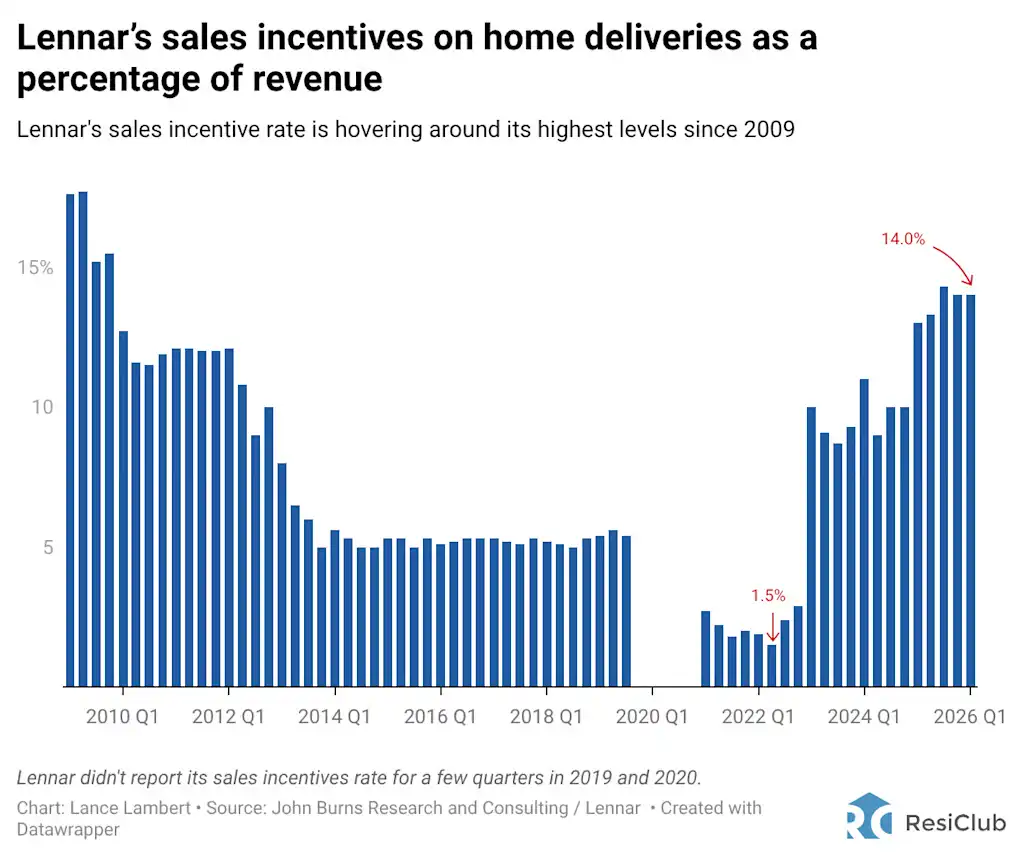
To maintain sales in this softer housing market environment, Lennar spent an average of 14% of the final sales price on incentives in Q1 2026—back to its 2010 levels.
Put another way, a $450,000 home sold with a 14% incentive rate translates to $63,000 spent on buyer incentives. That’s a lot of incentives.
Ever since the pandemic housing boom fizzled out, homebuilders like Lennar have compressed their gross margins—which hit all-time highs during that boom—in order to deploy bigger incentives to entice homebuyers. Indeed, at the height of the pandemic housing boom in Q2 2022, Lennar’s incentives rate was just 1.5%.
Giant homebuilders like Lennar have had to aggressively increase incentives across certain pockets of the Sunbelt, in particular—like Austin and Southwest Florida—to prevent an even bigger pullback in sales volumes.
The silver lining for Lennar—America’s second-largest homebuilder, which has a $22 billion market cap—is that while its incentive rate is at a decade-plus high, the upward jump has slowed, remaining at 14% for back-to-back quarters.
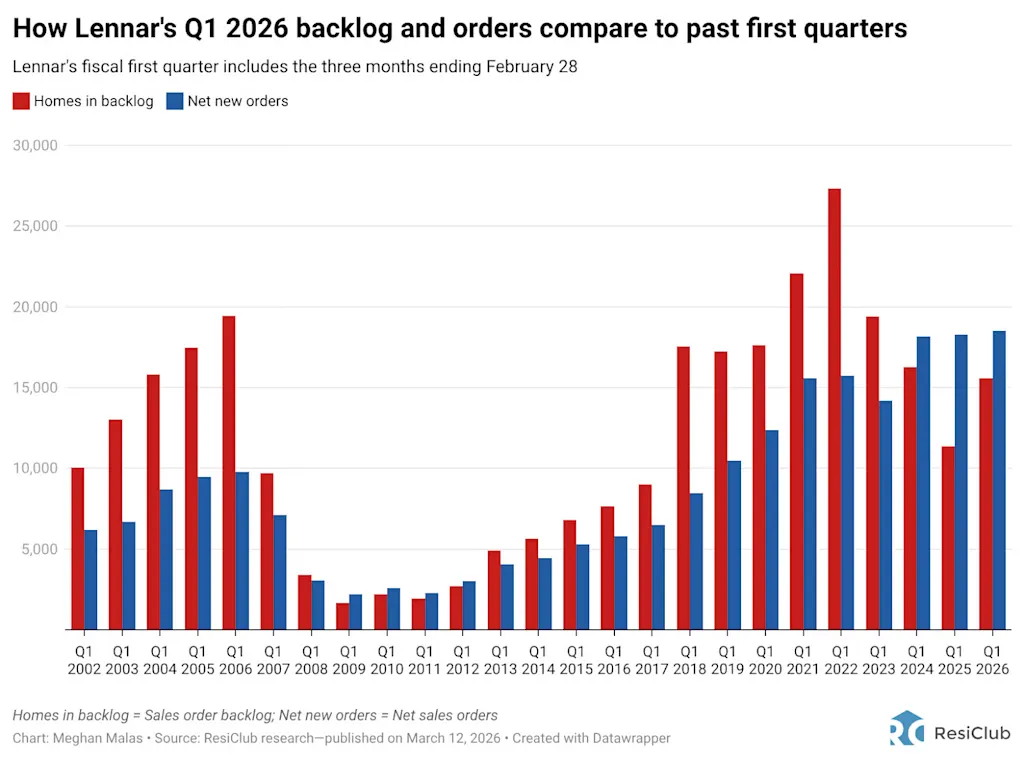
While Lennar’s gross margins and incentives are at 2010 levels, its aggregate net new orders are hovering around all-time highs.
Lennar’s net new orders, by Q1:
- Q1 2015 —> 5,287
- Q1 2016 —> 5,794
- Q1 2017 —> 6,483
- Q1 2018 —> 8,456
- Q1 2019 —> 10,463
- Q1 2020 —> 12,376
- Q1 2021 —> 15,570
- Q1 2022 —> 15,747
- Q1 2023 —> 14,194
- Q1 2024 —> 18,176
- Q1 2025 —> 18,355
- Q1 2026 —> 18,515
Since the rate shock occurred and the pandemic housing boom fizzled out in 2022, Lennar has been the most aggressive among the giant homebuilders in deploying the volume-over-margin strategy. The builder believes that doing so has helped it gain market share while some other builders were more conservative.
Here’s what Stuart Miller, CEO of Lennar, said on the company’s March 13 earnings call:
“We use margin as a circuit breaker, and we continue to refine and improve our asset, light land, light manufacturing platform. We have not pulled back and waited for the market to improve. We have maintained volume and focused on building improved business programs to bring costs down so that we can remain profitable and still provide needed housing supply. While in our first quarter, margins and our bottom line continue to reflect the affordability driven realities of the current market housing market, we also saw continuous improvement in all facets of our underlying cost structure that has set us on a course to stabilize and improve margins as we continue to produce volume and meet the market at affordability.”
Miller added: “We believe that we are closer to an inflection point for Lennar than at any time in the past three years.”