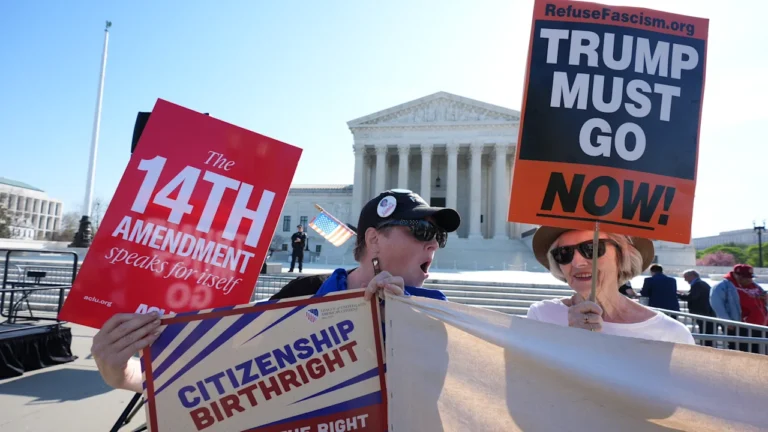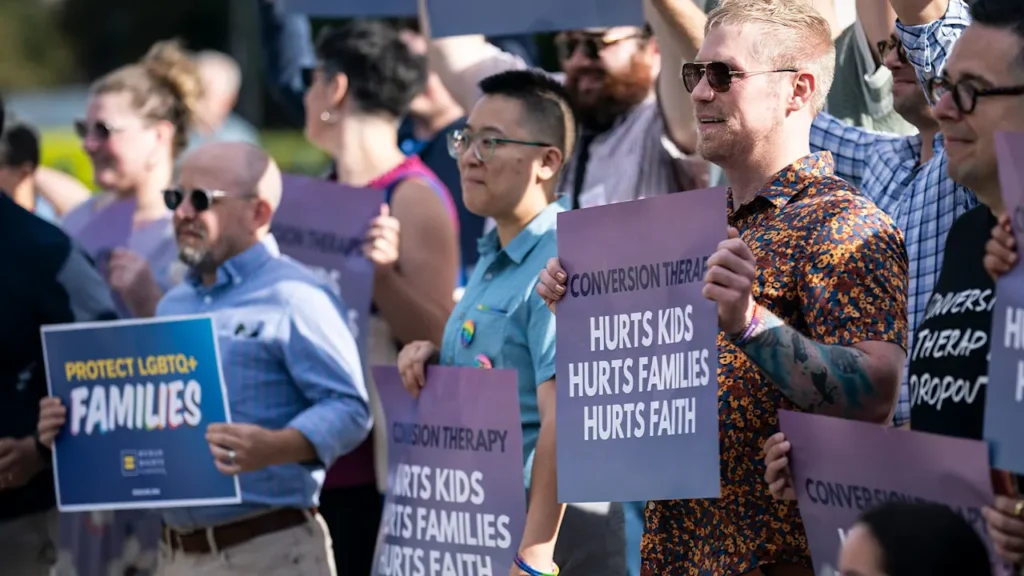
In 2019, Colorado adopted a law prohibiting conversion therapy for minors. It defined the controversial term as any practice or treatment attempting “to change an individual’s sexual orientation or gender identity.” But a talk therapist from the state, Kasey Chiles, said the law inhibited her right to free speech in her practice—and as of a ruling on Tuesday, March 31, the Supreme Court voted overwhelmingly in her favor.
The Supreme Court decided 8-1 to strike down Colorado’s ban on conversion therapy for minors, setting a precedent that could undermine similar laws in 23 states and the District of Columbia. Writing for the majority, Justice Neil M. Gorsuch justified the decision via the First Amendment.
“Colorado may regard its policy as essential to public health and safety,” Gorsuch wrote. “Certainly, censorious governments throughout history have believed the same. But the First Amendment stands as a shield against any effort to enforce orthodoxy in thought or speech in this country.”
“Every American possesses an inalienable right to think and speak freely, and a faith in the free marketplace of ideas as the best means for discovering truth,” the opinion continued. “However well intentioned, any law that suppresses speech based on viewpoint represents an ‘egregious’ assault on both of those commitments.”
Crossing ideological lines
Though the Supreme Court currently has a conservative majority, the 8-1 outcome reflects an unprecedented move by liberal justices Elena Kagan and Sonia Sotomayor, who sided with that majority. Only one justice, Ketanji Brown Jackson, dissented, warning that “the fallout could be catastrophic” for medical care in America.
“Before now, licensed medical professionals had to adhere to standards when treating patients: They could neither do nor say whatever they want,” Brown wrote in her dissension. “The Constitution does not pose a barrier to reasonable regulation of harmful medical treatments just because substandard care comes via speech instead of scalpel.”
Indeed, conversion therapy has proven time and time again to be markedly harmful to queer people, not just anecdotally, but by leading medical researchers. The American Psychological Association recognizes that undergoing conversion therapy is linked to myriad mental health issues, including depression, anxiety, suicidal thoughts and behaviors, substance abuse, and post-traumatic stress.
A study out of UCLA also found that LGB individuals who experienced conversion therapy had 92% greater odds of lifetime suicidal ideation, 75% greater odds of planning to attempt suicide, and 88% greater odds of attempting suicide compared to other LGB people. (The study did not account for trans individuals who’d been through conversion therapy.)
The Supreme Court’s decision ignores that medical reality in favor of protecting free speech. In a separate opinion, Justice Kagan explained why she and Justice Sotomayor sided with the conservative majority. Kagan presented a hypothetical situation where Colorado had a law prohibiting the support or affirmation of LGBTQ+ identity for minors, saying that law would equally violate the First Amendment.
“Because the state has suppressed one side of a debate, while aiding the other, the constitutional issue is straightforward,” she wrote.
Kagan’s hypothetical law isn’t reality—but the harmful impact of conversion therapy has been proven. And the court’s decision is only its latest strike against LGBTQ+ rights in the U.S.
Another decision against LGBTQ+ Americans
In recent years, SCOTUS has repeatedly ruled against the rights of LGBTQ+ Americans, often citing the First Amendment.
That includes a 2023 case where the court ruled that a web designer could refuse to create a wedding website for a gay couple, and a 2018 case where a baker was permitted to deny a wedding cake to a queer couple on the basis of his religion. Both those cases also came from Colorado, spearheaded by the Arizona-based Alliance Defending Freedom.
The court’s latest decision also stands in contrast to a case from June 2025, where it ruled to uphold laws in 25 states that prohibit “gender affirming” puberty blockers and hormone treatments for minors. In that 6-3 decision, the court said it was deferring to state lawmakers’ choice to prohibit certain medical treatments, though that logic was seemingly abandoned in the Colorado case.
LGBTQ+ advocacy organizations have spoken out against the ruling, including the Trevor Project, a charity dedicated to preventing suicide among queer youth.
“The Supreme Court’s decision to treat the dangerous practice of conversion therapy as constitutionally protected speech is a tragic step backward for our country that will put young lives at risk,” Chief Executive Jaymes Black said in a statement. “These efforts, no matter what proponents call them, no matter what any court says, are still proven to cause lasting psychological harm.”