Editors’ Highlights are summaries of recent papers by AGU’s journal editors.
Source: AGU Advances
Liquid water from melting Greenland ice fuels sea level rise. Melting also stimulates further ice sheet mass loss by increasing solar energy absorption and weakening glaciers and ice shelves, thus enhancing iceberg formation. These contributions are difficult to map with standard techniques based on satellite imaging.
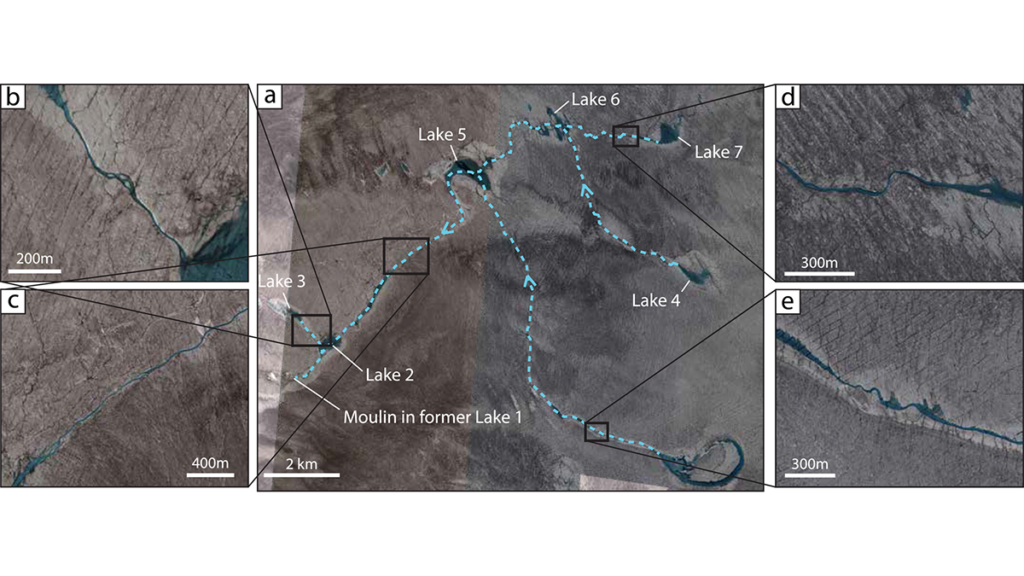
With the support of deep learning techniques, Ryan et al. [2026] propose an innovative method for analyzing high-resolution SkySat images. The authors find a substantial and previously undocumented contribution to sea level raise by the filling and draining of large and interconnected supraglacial lakes. In fact, they prove that the draining of large downstream lakes may trigger the simultaneous draining of smaller upstream lakes through the upstream propagation of perturbations along supraglacial rivers. The results shed new light on supraglacial lake drainage patterns and their contribution to sea level raise.
Citation: Ryan, J. C., Datta, R. T., & Cooley, S. W. (2026). Mechanisms of surface meltwater ponding and drainage on the Greenland Ice Sheet revealed using SkySat imagery and deep learning. AGU Advances, 7, e2025AV002030. https://doi.org/10.1029/2025AV002030
—Alberto Montanari, Editor-in-Chief, AGU Advances
Text © 2026. The authors. CC BY-NC-ND 3.0
Except where otherwise noted, images are subject to copyright. Any reuse without express permission from the copyright owner is prohibited.