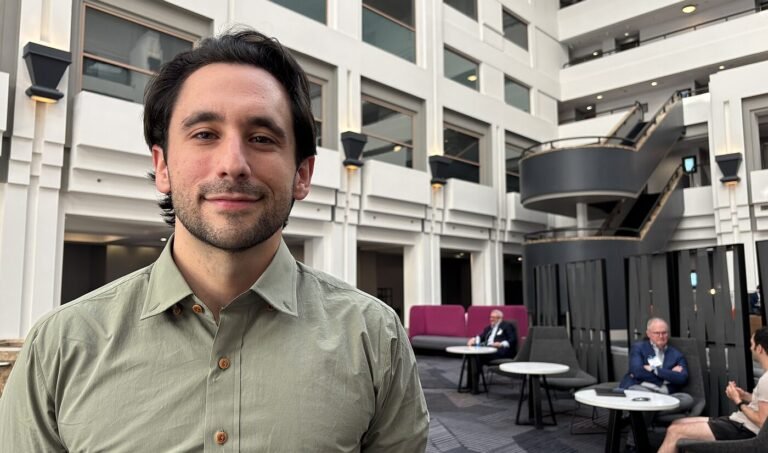
“I expect that in 2026 there will be the largest number of agtech and foodtech bankruptcies, restructurings, and fire sales to date,” predicted Adam Bergman at EcoTech Capital in a recent essay entitled The Ugly, the Bad, and the Good: The State of the AgTech and FoodTech Sector in 2026.
According to Bergman, a large cohort of “zombie” startups that have been propped up by investors over the past couple of years in the vain hope that things might get better will fail in 2026. While painful, he says, this correction should leave behind more resilient companies with viable paths to profitability in areas from ag robotics to food as medicine.
We caught up with him at the World Agri-Tech event in San Francisco to discuss how a lack of exits has created a vicious cycle: limited investable capital as existing funds hit the end of their life and struggle to raise new capital, and few new funds emerging as LPs shy away from a sector with weak returns.
AFN: In the ‘Ugly” section of your piece, you describe “zombie” companies that have been propped up by investors in the vain hope that things might get better – will their time run out in 2026?
AB: Those zombie companies probably are going to come to an end. I think what we’ve seen over the last few years is a lot of these companies had raised a lot of capital but hadn’t really delivered on their business.
And over the last year or two, you’ve seen a number of these companies go out and raise a safe round from internal investors just to keep them going for 12 months, but they weren’t really making any progress.
And now we’re getting to the point where these companies have been doing safe rounds for one or two years or even longer, and we’re not seeing any real market traction, so now their investors are having to get to the point where they realize we’re not getting traction. But they’re also getting to another point, which is the financing market is not changing, and it is closed for most companies, and it’s very difficult to raise new capital. And that’s not going to change in 2026 and it might not even change in 2027.
One of the keys is going to be, can these companies get to a size where they actually have some profitability? Because with profitability, we can get to them running without needing new capital, or we can get to a point where some of them can achieve exits.
AFN: Do these zombie companies deserve to be confined to the scrap heap, or are many of them companies that just need more time?
AB: The answer is both. Definitely this is a sector that’s going to need a long time to build companies successfully. But I think what also is apparent is that a lot of companies might have been funded with an expectation that they were going to change and achieve some scientific breakthroughs that just haven’t happened.
So I think a lot of the companies could succeed if they were given another 5-10 years, maybe some even longer, but there definitely are going to be some you could give them three decades and they’re going to still not have been able to build a business.
AFN: In the ‘bad section of your article, you note that a lack of exits has created a vicious circle. What do you mean and how do we get out of it?
AB: Explaining what has happened is much easier than giving solutions to get out of it. What’s happened is you’ve had a lot of investors put money to work in companies, and they’ve continued to fund these companies. But the challenge is very few of the companies have got to any level of scale where they can achieve an exit.
And a lot of investors would have gone back and looked at 2017 and 2018 when the likes of Blue River Technology [acquired by John Deere for $305m in 2017] and Granular [acquired by DuPont in 2017 for $300m] and then later Bear Flag Robotics [acquired by John Deere for $250m in 2021] and Prospera [acquired by Valmont for $300m in 2021] were able to get sales of $250, $300 million off a few million dollars of revenue.
They were really technology sales. We’re not seeing those today. I think today we call those acqui-hires, that you are going to spend a couple million dollars and bring a team in, rather than buying this company for a lot. So we’ve got to a point where there’s not a lot of exits.
You’re not seeing a lot of companies who’ve achieved scale, who have EBITDA or profitability and cash flow. So it’s not really attractive to a lot of buyers, and that’s what the problem is. We’re at a point where the corporates… the big ag chem guys, the Bayers, Syngentas, FMCS… a lot of them are in trouble. The Bayer Monsanto merger hasn’t gone as well; Syngenta is wrapped up in chem China; FMC is having financial problems; Corteva is in the middle of splitting. There are not a lot of buyers there, so all of a sudden you have a lack of corporate buyers.
And PE [private equity] is not going to come near this sector because it doesn’t have EBITDA cash flow. They’re not going to buy early-stage businesses that, in their mind, have lots of risk.
So we’re at a really difficult time where we’re not seeing exits, and when there’s no exits, you have two issues. One, the funds that are out there that have capital, they’re hoarding their capital for their existing portfolio companies, because they understand those portfolio companies will struggle to raise new outside capital, and those funds that have actually deployed all the capital are struggling to raise new capital because LPs look at the numbers and say, if this sector raised $40 billion and to date, you’ve probably had $8-10 billion go into companies that went bankrupt, and you’ve probably returned $2 billion of the money. Well, if you have $40 and you’ve returned $2, it’s not a good number, and that’s why we’re struggling to see new capital coming in… the exits haven’t been there.
AFN: This is rather a depressing picture that you’re painting. Is there light at the end of this tunnel?
AB: There’s light at the end of the tunnel, but I think we have to realize it’s not a 5-10 year time horizon. This tunnel is probably a 10-20 year time horizon. And I think we really need to understand that it’s just going to take longer. For companies and investors, it’s cost a lot, but they have learned a lot of lessons that are going to make them better and smarter as they build the companies of the future.
AFN: Every conference has got a panel ruminating on whether the VC model fits food and ag Does it, and if not, what other funding sources can be tapped instead. What does a more sensible model look like if we need one?
AB: I think the best starting option for early-stage companies is try to figure out how they go and get grants. I think people don’t appreciate what a $500,000, a million dollar grant can be for a company, rather than having to go out and take venture which, to some degree, they’ll struggle to find. Starting your capital flow with non-dilutive capital is the best place to be in.
I know the CVCs are less active than they used to be, but I think there’s a lot of value to trying to find the right corporate partner. And it’s not just the five or six names who show up at this conference. There are a lot of corporates out there who see value there.
Additionally, we see some activity in family offices. The challenge with most family offices is they do not lead deals. They’re more likely to follow, so you still need a lead.
And then the other area is sector specific venture. So people who understand food and ag. Maybe they still try to invest into an under 15-year time horizon, but they actually understand it better. It can help build businesses that will fit into that model.
AFN: In the ‘good’ section of your article, you say you remain pretty bullish on the sector long term?
AB: I think the industry has a bright future, and that’s because we have four different areas that I think are mega trends that are positively impacting this area.
The first is food security, which is going to be more and more important. We saw it rise to the forefront in 2022 when Russia invaded Ukraine, and we saw a number of countries stopping the flow of exports of agricultural products. And that was a big thing, because if you go back to World War Two, between World War Two and that time the food system had globalized. It became much more global. We saw a sea change.
And by the way, we started seeing that sea change back in 2012 in the Arab Spring. We saw a number of countries in Northern Africa who could not feed their people fall. And I think we saw a change in the GCC countries. So I think food security is a huge area. Even domestically in the US we’re not focusing enough on… Why is beef so expensive? Because we have the least amount of cattle that we’ve had since World War Two.
Number two is health and nutrition. It’s very clear that GLP-1s are not a fad. It is a trend. And the focus on health has risen to the forefront. Robert F Kennedy Jr has taken the mantle of MAHA [Make America Healthy Again] and is pushing health and nutrition to levels I don’t think anyone would have thought of… And by the way, they’re needed because we can’t continue paying the health care costs of a society where 60% of Americans are overweight and 40% are obese. So this is really important, and you’re going to see innovation for GLP-1 that’s not going to only impact the medical side, it’s going to have a real impact on the CPG sector.
The third area is sustainable food systems. We have a growing population. I don’t think it’s growing as quickly as people thought it might a couple decades ago, but it’s still growing, and we’re not going to have any more land, any more water, and we can’t use more crop chemicals than we do today. So we’re at a point where we know how many resources we’re able to use, and we’re going to have to find ways to grow more sustainably and viably, and there’s a lot of ways we can do that. So I think that is an area people are going to talk more about, which is, how do we improve resource efficiency in the agriculture sector, to get more production but with fewer resources?
And finally, the really big driver that wraps everything up is a continued innovation in technology and biotechnology. So one of the things I often say, which is very good for this industry, is that most of the technology that’s being used or thought is going to be integrated is developed in other industries. I often say, technology developed specifically for the ag sector takes a long time to get adoption, and it’s going to be used at such low quantities that its cost is going to be high. But if you’re taking automation and robotics from other industries, or you’re using AI developed in other industries, you’re going to have an advantage because it’s going to be proven, validated, scaled, and the cost structure is going to be down, and that’s going to help adoption happen, because we need to get the prices down to a point where you’re going to get an ROI for farmers.
Same thing with biotech. The biotech sector has changed dramatically in the last three decades, and you see an increased focus on synbio today. That’s going to continue, and I think you’re going to see lots of really interesting innovations that are going to hit throughout the whole food and ag system because of biotechnology. So the food and ag sector is going to take advantage of technology created in other areas that’s going to be adapted for these areas.
Further reading:
🎥 Ag’s new toolkit: AI, genomics, and robotics converge at World Agri-Tech
Buckle up, say investors as AI reshapes agrifoodtech: ROI may be “unusually tangible’
Leaps by Bayer’s PJ Amini on exits, epigenetics, AI-driven discovery and his ‘50% rule’
The post The good, the bad, and the ugly of agrifoodtech investing… in conversation with Adam Bergman appeared first on AgFunderNews.