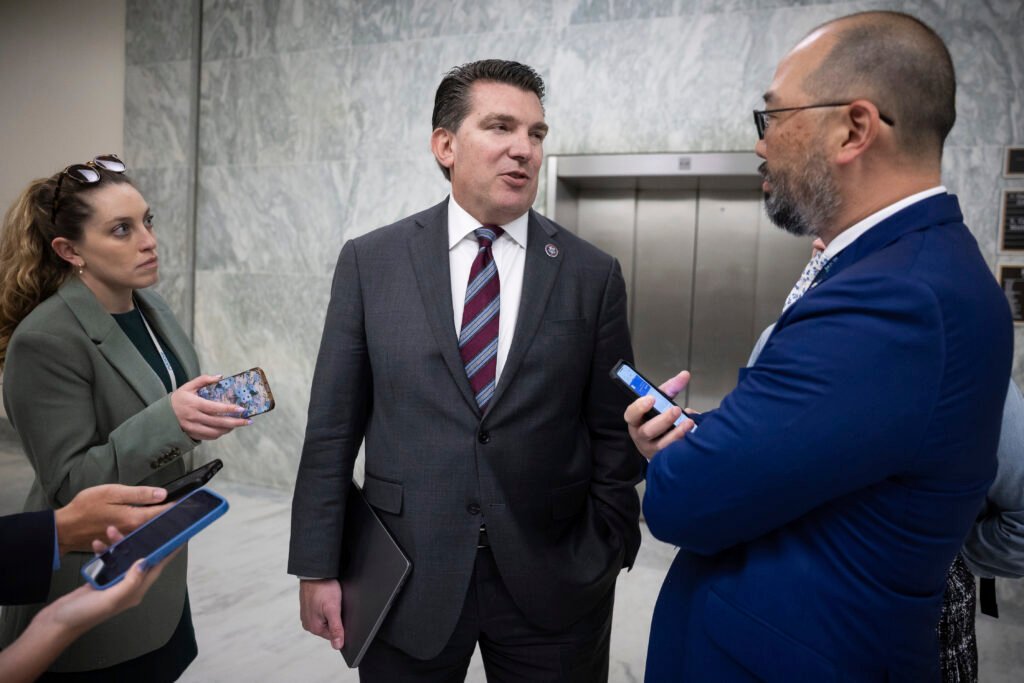
Tech companies desperately want Congress to pass a federal law this year blocking state rules on artificial intelligence, and many think their best shot lies with California Republican Rep. Jay Obernolte, a former computer engineer now serving his third term in the House.
There’s just one problem: House GOP leaders don’t appear to be listening to him.
AI industry lobbyists have been pushing Capitol Hill for months to pass a bill that would preempt the ability of states to enact AI laws, arguing it would stop a patchwork of conflicting state rules from impeding innovation.
Many see Obernolte, who co-chaired a bipartisan AI task force last Congress and has deep relationships across the aisle, as their greatest hope for action before the end of the year. They say his technical acumen and consensus-building approach on AI will be key to clinching an agreement with Democrats, necessary in a politically polarized Washington.
“If there is anyone in the House who can run point and cobble together the pieces on what meaningful federal AI standards and an AI package could look like, it’s Jay Obernolte,” said Tony Samp, principal AI adviser at lobbying firm DLA Piper, in an interview.
Obernolte is currently working on an AI bill that could pair preemption of state AI laws with a framework to regulate the technology, including new research infrastructure and safety checks on advanced AI models — a compromise that senior AI lobbyists now support after Hill Republicans failed twice last year to unilaterally block state AI regulations.
“You need to codify the federal regulatory framework for AI and, if you don’t do that … essentially you’re saying that there’s no regulation,” said Obernolte in a recent interview. “And I don’t blame people for being uncomfortable with that.”
But four senior tech industry representatives who want a deal, granted anonymity to discuss sensitive legislative talks, said Obernolte’s influence has so far been stifled by GOP leadership, and that he’s been largely absent from high-level Hill negotiations over the future of AI policy.
It’s a sign, they said, that Republican leaders may not be serious about reaching an AI compromise, despite President Donald Trump’s recent call for Congress to come up with a solution to thwart states from freelancing. Both the tech industry representatives and some Democrats instead worry that GOP leaders are refusing to budge on their stance that there should be minimal regulation of the technology — a position shared by some venture capitalists and White House officials.
House GOP leaders publicly insist they’re on the same page with Obernolte and share his goal of drafting consensus legislation that would preempt state AI laws, even as they have so far failed to embrace his ideas and, in fact, appear determined to pursue other tracks.
A spokesperson for House Majority Leader Steve Scalise said that while the Louisiana Republican supports a relatively hands-off approach to AI regulation, “preempting a patchwork of countless varying state laws does not mean no guardrails.”
Nonetheless, Scalise recently expressed skepticism towards any regulations on the sector — a stance that could make a political compromise on AI harder to achieve.
“A lot of these people that want to limit and regulate any industry, a lot of times, what they’re really trying to do is make it hard to do those things in America,” Scalise told reporters in early January. “We should maintain that edge, and we do it by innovating — not by regulating.”
The four tech representatives said they’ve so far seen little to suggest that leadership is interested in Obernolte’s plan for an AI accord. They said he should have been brought into the preemption effort last year, after Senate Commerce Chair Ted Cruz (R-Texas) fell short in his efforts to insert a ban on state AI rules into the GOP’s tax and spending megabill.
They also said Obernolte’s absence from last fall’s unsuccessful push by House leadership to insert a similar provision into the year-end defense bill was unfortunate, largely because it made a compromise tougher to achieve.
“It was a little surprising that one of their best players wasn’t even in the game during the latest push for federal AI standards,” said Samp.
Connor Chapinski, Obernolte’s communications director, downplayed the characterization that Obernolte is being kept away from the GOP’s high-level AI strategy. In a statement, he said Obernolte remains fully engaged with his leadership and the Trump administration around crafting “thoughtful legislation.”
Athina Lawson, a spokesperson for Speaker Mike Johnson, in a statement credited Obernolte’s chairmanship of the task force with giving members “a clearer understanding of how to responsibly leverage the opportunities of artificial intelligence.” She said GOP leadership is coordinating with the Trump administration on AI and plans to “work through committees of jurisdiction to build consensus” among Republicans.
The task force’s 255-page report — released by Obernolte and fellow California Rep. Ted Lieu, a Democrat, in December 2024 — laid out a slew of findings and policy recommendations related to AI. Yet despite some interest from the tech industry, the panel was not renewed by GOP leadership and its recommendations have gone virtually unheeded.
One senior GOP aide who works on AI policy, granted anonymity to discuss internal GOP strategy, said the report was produced under former President Joe Biden and was “somewhat outdated now that we have a new administration, a new dynamic in Congress.”
A senior Democratic aide who was closely involved with the task force, also granted anonymity to speak candidly, said it has become clear over a period of time that “Mr. Obernolte, for better or worse, had been sort of sidelined … He was like their lead guy on AI, put in a corner.”
Some Democrats are now looking to exploit what they perceive as a leadership gap on AI policy on the other side of the aisle. Lieu now co-chairs a new House Democratic Commission on AI, convened by House Minority Leader Hakeem Jeffries (N.Y.) and co-chaired by Reps. Josh Gottheimer (N.J.) and Valerie Foushee (N.C.). In the absence of bipartisan action, they plan to formulate their own plan for regulating the fast-moving technology.
“The White House has led the industry astray, down a bad path,” Lieu said in an interview. “Steve Scalise is very opposed to any kind of legislation at the federal level. … And that’s now resulted in three things the tech industry wanted to avoid, which is, backlash from the public, backlash from bipartisan members of Congress and multiple states regulating their industry.”
Gottheimer, in a recent interview, said, “I think Republicans have certainly ceded the turf.”
There are signs that GOP leaders are starting to feel pressure to legislate on AI. Ohio Rep. Jim Jordan — chair of the Judiciary Committee, which has jurisdiction over AI issues like privacy, surveillance and intellectual property — suggested in a Monday interview that “I don’t know about moving anything, but we’re definitely talking about AI.”
Jordan added that one of his staffers had just informed him that his panel should ramp up those discussions.
Gabby Miller contributed to this report.