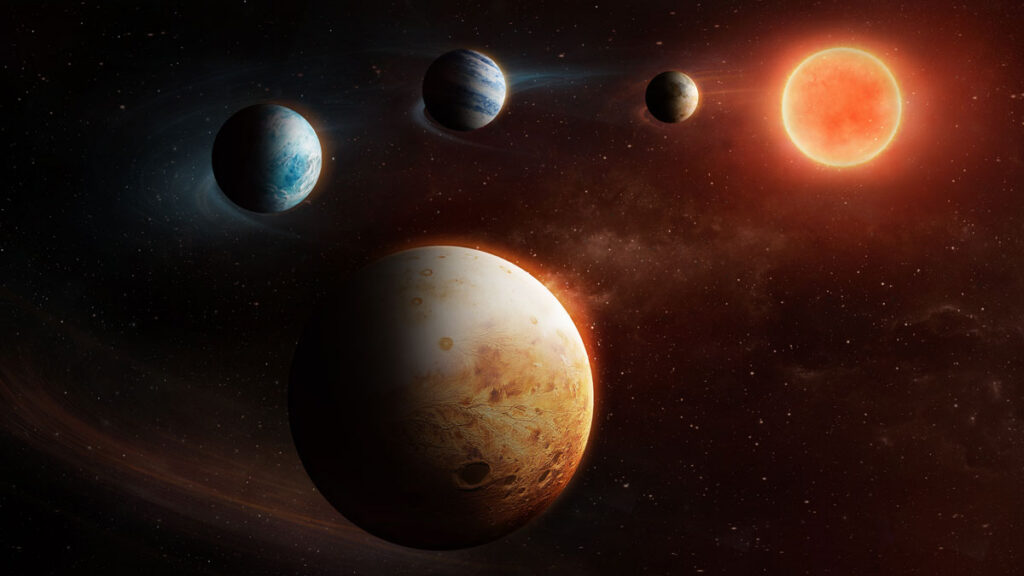
The discovery of a previously undetected fourth planet around a nearby star has turned astronomers’ expectations about what planetary systems should look like upside down.
Everything looked normal, until recent follow-up observations revealed a fourth planet occupying the outskirts of the system—a rocky world 1.7 times the size of Earth that basically shouldn’t be there.
Astronomers already knew that LHS 1903, a red dwarf 116 light-years from Earth, hosted three planets: a large, rocky world orbiting very close to the star, followed by two mini-Neptunes with extended gaseous atmospheres. Everything looked normal, until recent follow-up observations revealed a fourth planet occupying the outskirts of the system—a rocky world 1.7 times the size of Earth that basically shouldn’t be there.
This unexpected configuration is inside out: Typically, terrestrial worlds lie close to their star, while planets with larger gaseous envelopes orbit farther out. This distribution is driven by stellar radiation, which strips gas from the inner planets while allowing more distant bodies to accumulate and retain thicker atmospheres.
This process, known as thermally driven mass loss, is considered the rule for most planetary systems. “The high density of the innermost planet and lower density of the two middle planets support thermally driven mass loss, but the fourth is anomalous,” said astronomer Andrew Cameron from the University of St Andrews in Scotland, who is part of a team of international scientists who published their findings in Science. This newfound super-Earth is nearly 6 times the mass of our planet, but despite being far enough from the star to easily retain a thick atmosphere, it “has the density of an iron-silicate planet” similar to Earth or Mercury, Cameron added.
Planetary Detective Work
LHS 1903 attracted interest after NASA’s Transiting Exoplanet Survey Satellite (TESS) revealed the three inner planets. But follow-up observations with the ground-based High Accuracy Radial Velocity Planet Searcher-North (HARPS-N) spectrograph—which measures the slight wobble of a star caused by orbiting planets—revealed that the gravitational pull of the planets didn’t match what would be expected from those three worlds alone, suggesting the presence of an unseen planet.
The researchers then used the European Space Agency’s Characterising Exoplanet Satellite (CHEOPS) to observe the star in greater detail. Its superior sensitivity confirmed the presence of the fourth planet, which orbits the star roughly every 29 days. Together with the HARPS measurements, the team determined the size, mass, and density of all four planets in the system.
Late Arrival
The existence of this dense, gas-poor world—dubbed LHS 1903 e—suggests that stellar radiation isn’t the only force at play. One possible explanation, the authors think, is that this planet did not form at the same time as its siblings.
Current consensus is that planets form from disks of gas and dust around young stars called protoplanetary disks. In these disks, planetary embryos form at roughly the same time, growing into full-fledged planets of different sizes and compositions over millions of years. However, Cameron and colleagues think that in this case the planets might have formed in sequential order, starting with the innermost planet.
Although this method of forming planets has been theorized for more than a decade, this is the first time that a planetary system has offered evidence showing that it might actually work. In this scenario, the authors propose, by the time the last planet started forming, the protoplanetary disk had already run out of gas because it was either absorbed by the inner planets that formed first or dispersed by stellar radiation.
The idea seems theoretically plausible, said Francisco Pozuelos, an astrophysicist at the Instituto de Astrofísica de Andalucía in Granada, Spain, who wasn’t involved with the study. The star’s old age—it is almost twice as old as our solar system—means that it has had plenty of time to build rocky planets from the material remaining after the inner bodies formed. “While this planet probably formed in the early stages, it has also had a vast amount of time to evolve,” Pozuelos said.
“The system defies conventional explanation.”
Before reaching this conclusion, the team also explored other possibilities, such as planetary migration, or a collision between planets that could have stripped them of their atmospheres. The overall stability of the system suggests that these scenarios are unlikely—although not entirely ruled out.
“The system defies conventional explanation,” Cameron said. “It’s a very interesting challenge to theory.”
A Misplaced Planet?
Planet LHS 1903 e not only has the wrong density for a planet in the outer rim of a system that already contains gaseous planets in inner orbits; it is also the wrong size. Its radius places it within what astronomers call the “radius valley,” or an observed scarcity of planets with radii about 1.5 to 2 times the size of Earth’s. Astronomers think this valley marks a boundary between planets that are able to hold onto thick, gaseous atmospheres and those that aren’t.
“This planetary system is a great opportunity because its four planets bridge the radius valley, ranging from rocky worlds to gaseous ones,” Pozuelos said. Usually, the radius valley is studied by comparing data from thousands of different stars. “Here, the four planets formed in the same environment,” he added. “It’s a beautiful system to do these kinds of studies.”
Both its size and location make LHS 1903 e a rarity by current standards. However, detecting low-mass planets that are farther from their host star is difficult with current techniques, such as the transit method and the radial velocity method. As a result, the number of rocky planets in wider orbits is likely underestimated.
Researchers expect to find more examples as new instruments come online, however. For instance, the European Space Agency’s Planetary Transits and Oscillations of stars (Plato) mission will use 26 telescope cameras to stare at a patch of sky with more than 200,000 stars for about 2 years, hoping to reveal rocky planets as small as Earth in long-period orbits. With Plato, “we hope to see everything there is in the backyard of planetary systems that we’ve been missing during the last 20 years,” Pozuelos said.
—Javier Barbuzano (@javibar.bsky.social), Science Writer
Citation: Barbuzano, J. (2026), The planet that shouldn’t be there, Eos, 107, https://doi.org/10.1029/2026EO260085. Published on 11 March 2026.
Text © 2026. The authors. CC BY-NC-ND 3.0
Except where otherwise noted, images are subject to copyright. Any reuse without express permission from the copyright owner is prohibited.