One way scientists search for Earth-like planets is the transit method, which involves observing a slight dimming in starlight when a planet passes in front of its star. Transits cause very small decreases in flux: A planet the size of Jupiter might block 1% of the light from a Sun-sized star, and an Earth-sized planet might block only 0.01%.
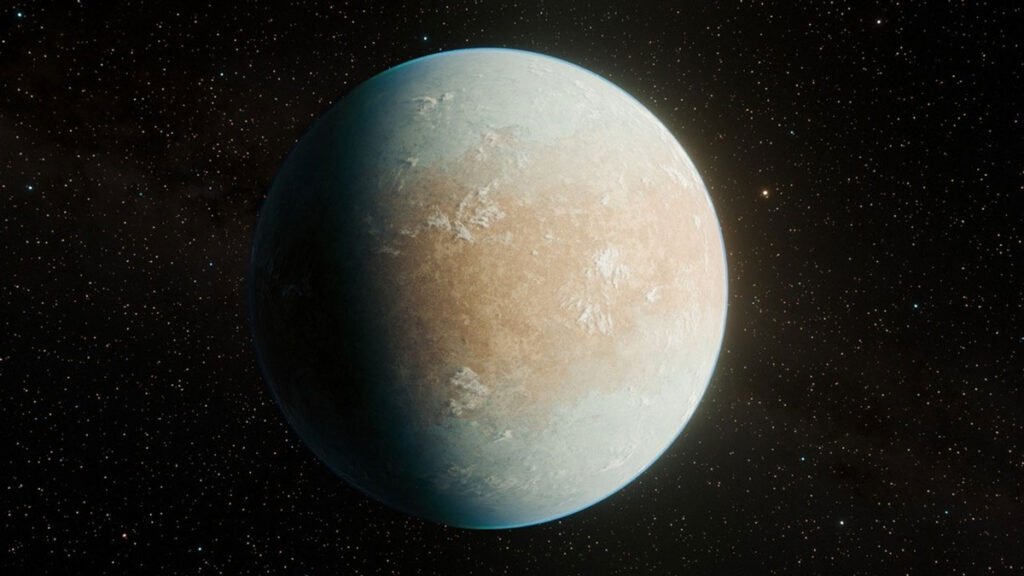
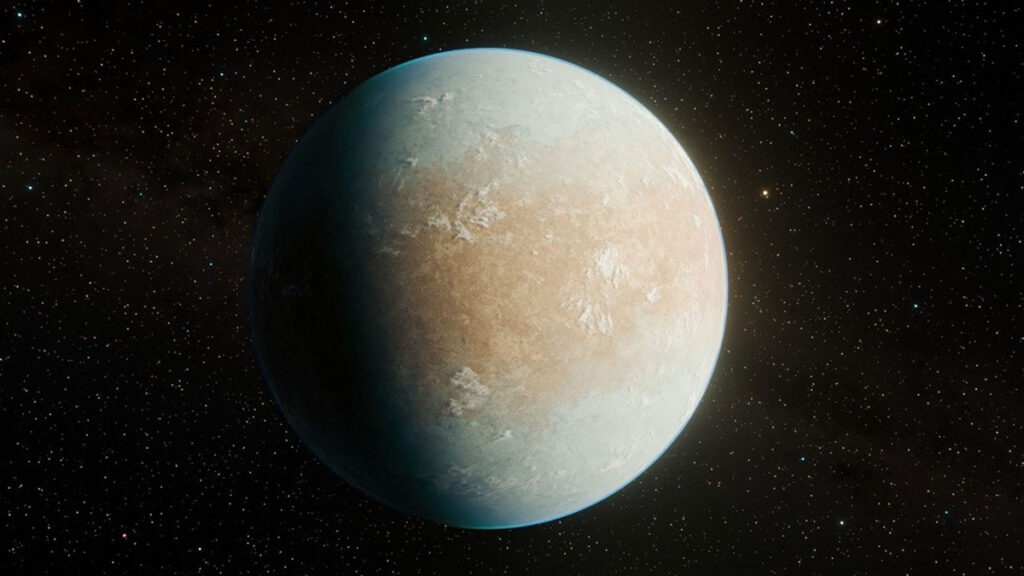
A study recently published in The Astrophysical Journal Letters suggests that an intriguing signal from the star HD 137010 comes from the transit of a planet about the size of Earth with a similar orbit. Astronomers detected the faint signal using data from NASA’s K2 mission.
HD 137010 is dimmer than the Sun, and the new planet candidate, HD 137010 b, likely lies near the outer edge of the star’s habitable zone. As a result of these factors, HD 137010 b receives far less energy from its star than the Earth receives from the Sun.
Detecting Single-Transit Events
HD 137010 b is the smallest potential planet to be detected from a single transit around a Sun-like star.
“Detecting single transit events is computationally difficult, so it’s sometimes actually easier for a human to pick out these events from the data—as was the case here,” Alexander Venner, an astrophysicist at the Max Planck Institute for Astronomy and lead author of the study, wrote in an email to Eos.
Data came from the K2 mission, which itself relied on the Kepler mission, NASA’s primary mission to find Earth-like planets orbiting Sun-like stars. After the Kepler spacecraft lost some functions, the K2 mission reused Kepler’s telescope to study brighter stars with high precision. Though each of K2’s observation campaigns lasted only about 80 days, too short to catch transiting planets with longer orbital periods, the mission still managed to discover planets from single-transit events.
“I knew there was something to it as soon as I saw it.”
The team noticed a 10-hour transit across the bright star HD 137010 in 2017. The telescope was precise enough to see the star clearly, even though its light dimmed only slightly, by 225 parts per million. Venner said some planetary scientists compare the effect to a moth passing in front of a lighthouse.
Still, Venner said the transit signal was significant enough that “I knew there was something to it as soon as I saw it.”
Even though Venner and the team were confident that the signal was significant, they still had to make sure the signal wasn’t a false alarm caused by background stars or quirks in the data.
To rule this out, the team carefully checked for any stars close to HD 137010. Radial velocity data, Hipparcos and Gaia astrometry, archival images, and high-resolution imaging showed no signs of stars falling within the K2 photometric aperture. Because only one transit was seen, astronomers can’t yet be certain it was caused by a planet, but the candidate was designated HD 137010 b.
Planetary Properties and Habitability
The new analysis suggests the radius of HD 137010 is about the same as Earth’s, and its orbital period is about 365 days. Using the planet’s orbit and the star’s brightness, the team estimated that HD 137010 b receives only about 0.3 times the amount of sunlight as Earth.
HD 137010 b is one of the coldest Earth-sized planets seen crossing a Sun-like star. Its surface may be as cold as −68°C (−90°F), even colder than Mars, which averages about −65°C (−85°F).
“Whether its surface is at all ‘Earth-like’ depends on the properties of its atmosphere, which we just can’t constrain from the current data,” Venner said. “A thick warming atmosphere might allow for a warm wet surface, but a thin atmosphere might result in a completely frozen surface colder than Mars.”
Future Prospects
This “represents a milestone in the search for worlds that might one day be considered truly Earth-like.”
“This is, indeed, an exciting result. It represents a milestone in the search for worlds that might one day be considered truly Earth-like,” Jon Jenkins, who served as the coinvestigator for data analysis on the original K2 mission but was not part of the research, wrote in an email to Eos.
“It will be extremely interesting if future observations give us information on the atmosphere or surface properties of HD 137010 b,” Venner said. “These scenarios could be distinguished if we’re able to observe the spectrum of HD 137010 b.”
—Pranjal Malewar (@PranjalMalewar), Science Writer
Citation: Malewar, P. (2026), This potential exoplanet is Earth sized but may be colder than Mars, Eos, 107, https://doi.org/10.1029/2026EO260062. Published on 19 February 2026.
Text © 2026. The authors. CC BY-NC-ND 3.0
Except where otherwise noted, images are subject to copyright. Any reuse without express permission from the copyright owner is prohibited.