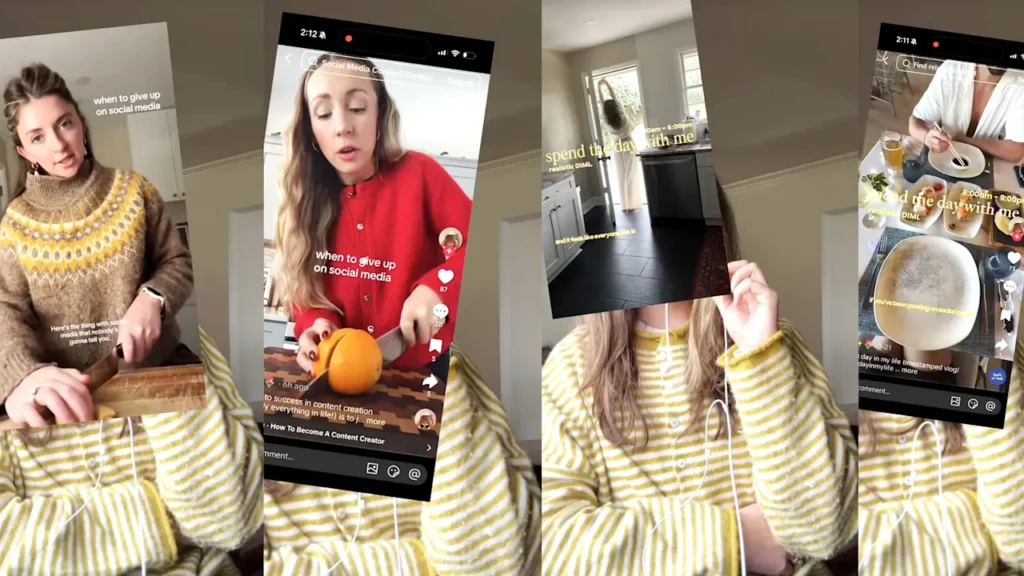
Ellie Frazier first started posting content three years ago, sharing day-in-the-life vlogs and content tips for fellow creators.
As her following grew, she began noticing other creators posting videos with uncannily similar scripts to her own. The clips felt the same. The editing style, identical.
In one example, Frazier stretched in front of a window; another creator stretched in front of a window. Frazier chopped vegetables; the other creator chopped an orange. On its own, that might not seem especially striking. But the voiceover script used by the other creator was also almost verbatim Frazier’s words.
“There’s a very stark difference between taking inspiration from everybody and giving credit, versus stealing somebody’s voiceover script word for word multiple times in a row,” says Frazier in a recent post. “Taking credit in the comments for it being their own work.”
Plagiarism—presenting another person’s ideas, words, images, or work as your own without credit—while often difficult to litigate, is a cardinal sin in most industries. And yet social media largely operates as a law unto itself.
TikTok will remove content that “violates or infringes someone else’s intellectual property rights, including copyright and trademark.” However, many posts on the platform do not clearly meet the legal threshold for copyrightable intellectual property, meaning enforcement is often left to creators themselves.
With swaths of content uploaded every day, copycat creators frequently weigh the risk of being discovered against the possibility of profiting from a viral concept with minimal effort. There is even content devoted to explaining exactly how to plagiarize others’ work.
Determining who copied whom is also largely a futile exercise. On a platform that thrives on mimicry, true originality is rare. The lifecycle of a trend is familiar: One person creates an original video. If it goes viral, thousands copy it. Some tag the original creator. But as the trend snowballs, that credit is often lost to the algorithm. Once it has been replicated enough times to be labeled a trend, the concept is widely regarded as fair game.
Frazier isn’t the first to spotlight the growing issue of digital plagiarism. In a first-of-its-kind lawsuit brought in 2024, one TikTok creator attempted to sue another for copying her “neutral, beige, and cream aesthetic” and posting content with “identical styling, tone, camera angle and/or text.”
More than a year later, the so-called “Sad Beige Lawsuit” was dismissed after the claimant chose not to move forward.
Imitation may be described as the sincerest form of flattery, but online plagiarism ultimately benefits no one. The original creator loses credit for their idea. The copycat forfeits an opportunity to develop a distinct voice. And audiences are left scrolling through an endless stream of low-quality videos, each one nearly indistinguishable from the last.