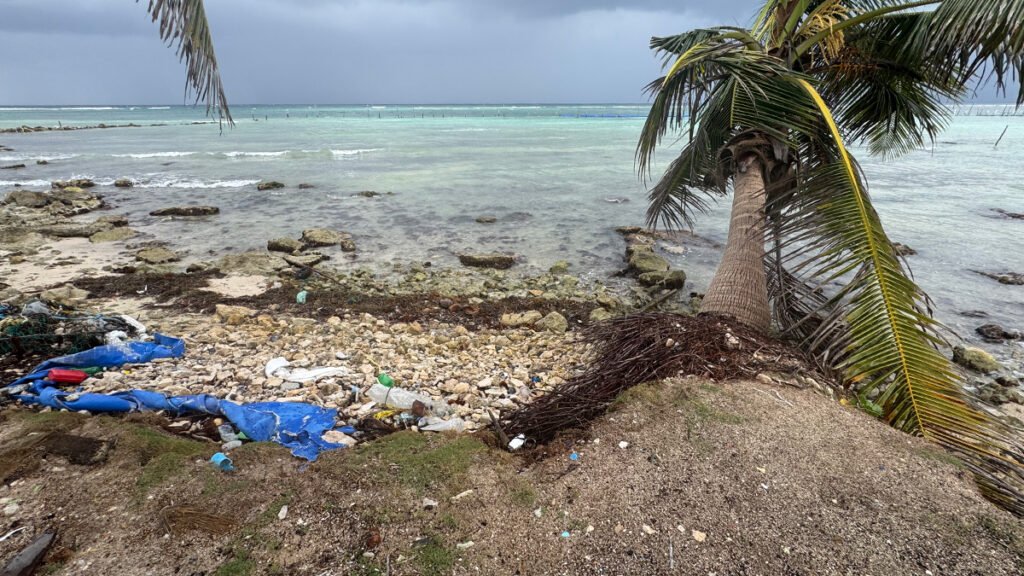
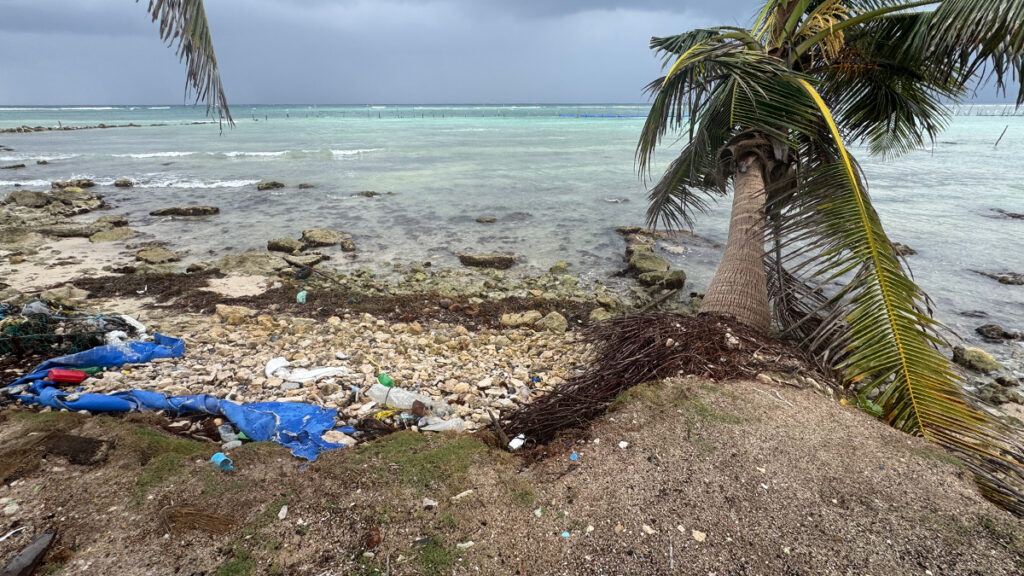
Standing on Cozumel Island’s leeward shore at sunrise, the first thing one feels is the wind. Every morning, warm air rising from the land draws in a soft sea breeze. Waves break against the barrier reef, producing countless bubbles that burst at the surface.
To most people’s eye, the crashing surf off Cozumel, which lies across a 16-kilometer channel from mainland Mexico’s Yucatán Peninsula, offers a postcard scene of the Caribbean. In those waves and bubbles, we also see a transport system, one that lofts salt and moisture into the air, as well as fragments of plastic light enough to ride the breeze.
For all the plastic entering the ocean, some marine microplastics (MPs) can make their way back into the atmosphere, yet this pathway remains poorly quantified.
Microplastics (MPs), particles smaller than 5 millimeters, are now widespread in the ocean and make up much of the growing volume of plastic pollution arriving from land and air. These materials can pose health risks for marine life and for humans, especially people who live near or depend on coastal waters.
For all the plastic entering the ocean, some marine MPs can make their way back into the atmosphere, yet this pathway remains poorly quantified. So a few years ago, we set out to understand how MPs move between the sea and the sky. Getting a handle on this exchange can reveal when the ocean acts as a source of airborne MPs, what types of plastic are most likely to be exchanged, and how local breezes and currents shape where the particles end up.
Around islands, the constant interaction between ocean currents and circulating air creates a dynamic zone for MP exchange across the air-sea boundary. Yet until recently, very few studies had examined this exchange directly [Allen et al., 2020; Masry et al., 2021]. Cozumel, which sits where the powerful, northward-flowing Yucatán Current meets the daily rhythm of sea and land breezes blowing between the mainland and the island, provided an ideal natural laboratory for our recent research [Reynoso-Cruces et al., 2026].
Catching Plastic in the Air and Sea
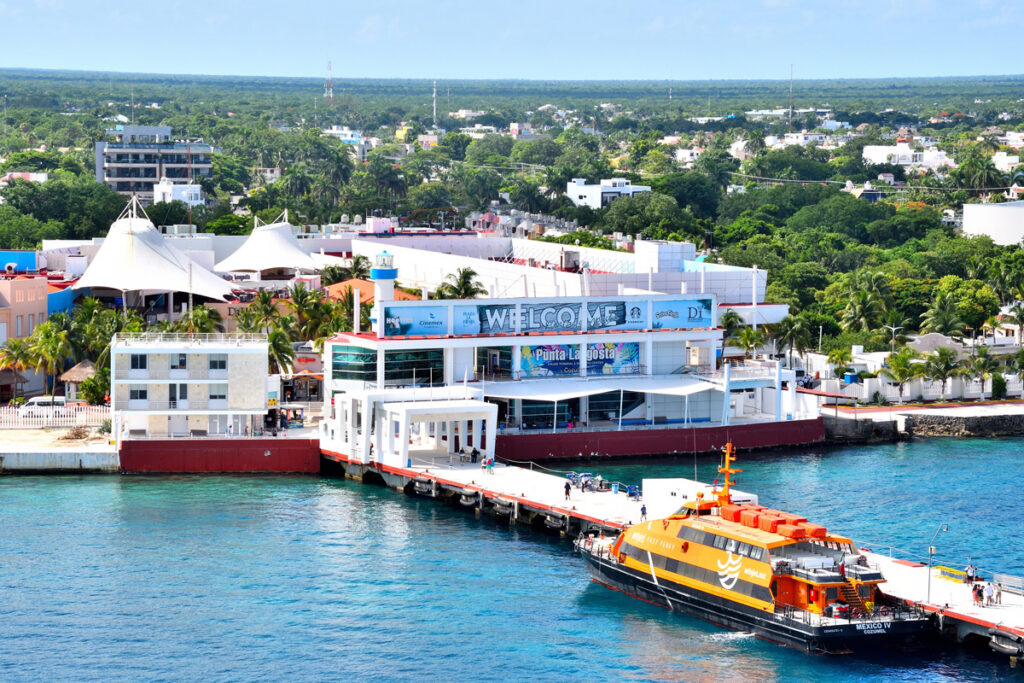
Wind, water, and human activity—from ferries and cruise ships to throngs of beachgoers—are in continuous dialogue at Cozumel. Tourism is the island’s primary economic driver, attracting millions of visitors each year and sustaining extensive coastal infrastructure [Secretaría de Turismo de Quintana Roo (SEDETUR), 2024; Magio, 2021]. All this activity turns the shoreline into a busy interface where new plastic litter is added to the ocean and existing debris is churned and broken down.
We counted thousands of particles under the microscope in both the air and the seawater samples.
In July 2023, we carried out a coordinated microplastics sampling campaign that bridged the ocean and the atmosphere at Cozumel. For a week, we turned a rooftop on the island into a temporary atmospheric observatory, setting up a high-flow air sampler adapted from a commercial water vacuum. We ran it twice a day, from 9:00 to 11:00 a.m. and from 3:00 to 5:00 p.m. local time, capturing the morning onshore and afternoon offshore winds. Particles trapped during each 2-hour sampling period were transferred into glass containers for later analysis. Beside the sampler, a compact meteorological station recorded wind, temperature, humidity, and pressure every minute, so we could pair each sample with the corresponding conditions.
At sea, our goal was to map the MP distribution across the Cozumel Channel. On the last day we sampled the air, we also used a small research vessel to stop at seven predetermined, GPS-identified locations along a transect from the island to Playa del Carmen on the mainland. We chose the locations to represent near-island waters, midchannel conditions, and the continental margin, and at each, we collected seawater at several depths (0, 1, 3, 5, 7, and 9 meters) using special horizontal bottles that can be triggered to close as desired. The depth structure matters, because microplastics don’t behave uniformly. Sampling multiple depths allowed us to see those vertical contrasts and connect them to what we observed above the waves.
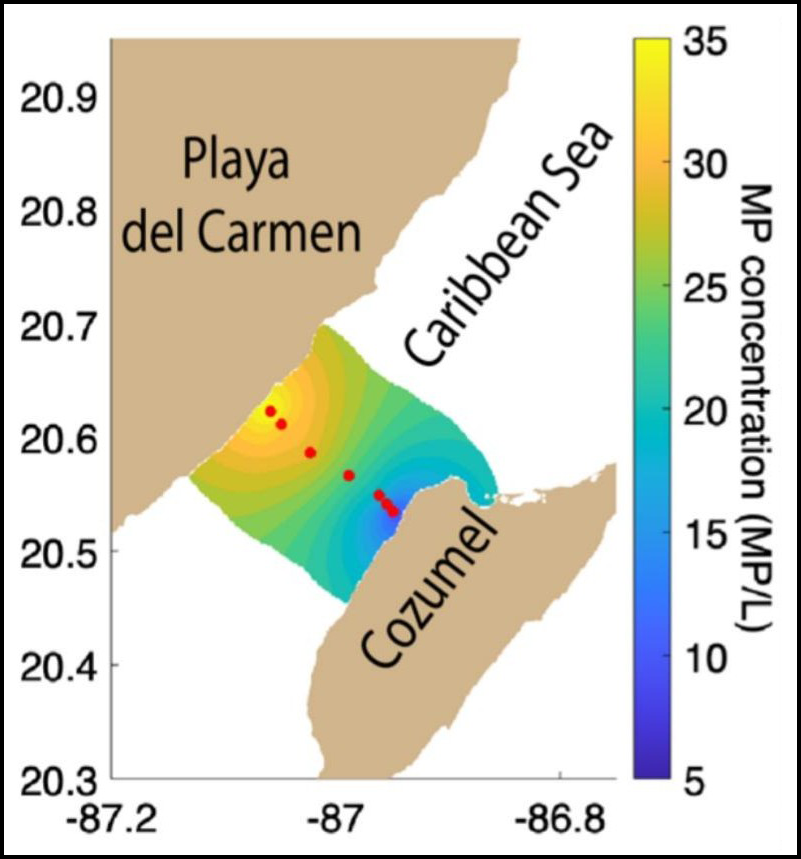
In the lab, we counted thousands of particles under the microscope in both the air and the seawater samples and used micro-FTIR (Fourier transform infrared) spectroscopy on a random subset to confirm their plastic identities. We found that concentrations in the air averaged about nine MP particles per cubic meter in the morning sea breeze and about six particles per cubic meter in the afternoon. In the water, average concentrations rose along the transect from roughly five MP particles per liter off Cozumel to about 35 particles per liter near Playa del Carmen (Figure 1).
Avoiding contamination was a particular challenge in our lab work. Stray fibers in the air or from clothing made of synthetic materials that slip into samples can look like environmental microplastics. To reduce that risk, we cleaned our equipment using contamination control procedures, wore only natural fiber lab attire, and analyzed blank samples alongside every batch of field samples. Particles detected in the blanks were flagged as background contamination, and we subtracted those counts from the sample totals [Reynoso-Cruces et al., 2025, 2026].
A Tale of Two Polymers
Overall, we found that two plastic polymers, polyethylene and polyester, predominated in our air and seawater samples, combining to account for about 63% of the airborne particles and about 76% of the seawater particles we identified. In the air samples, we also found polystyrene and acrylic (each ~15%), plus smaller fractions of polypropylene, polyvinyl chloride, and alkyd-type materials (each ~2%). In seawater, we detected polyamide (12%), acrylic (8%), alkyd-type materials (2%), and polyvinyl chloride (2%). These patterns point to a diverse set of source materials, including packaging and consumer plastics, synthetic textiles, and other manufactured polymers.
Of course, MPs do not originate in the ocean. Plastics are first released from human sources such as urban waste and wastewater and industrial and maritime activities, then transported by winds, waterways, and coastal circulation into the sky and nearshore waters. In the ocean, a subset of particles at the surface can be emitted into the atmosphere through wave action.
The density and shape of particles strongly influence whether they are more likely to sink or stay in the water or to float to the surface and perhaps take flight.
Among the identified airborne MPs, polyethylene—the lightweight material commonly used in plastic bags and food packaging—accounted for 34% of the total, making it the most prevalent polymer. In seawater, polyester—commonly associated with textile sources—was the most abundant polymer, representing 54% of the identified MPs. This contrast pointed to a simple but powerful observation: The density and shape of particles strongly influence whether they are more likely to sink or stay in the water or to float to the surface and perhaps take flight.
Polyethylene is less dense than water, allowing it to remain at the sea surface, where wave breaking and bubble bursting are more likely to eject small fragments into the air. Polyester, by contrast, is denser than water and particles are typically fibrous, characteristics that tend to keep it suspended in seawater below the surface.
On Cozumel, our rooftop sampler captured MP fragments averaging about 200 micrometers in diameter (about twice as wide as a human hair) and fibers averaging about 440 micrometers in length. We found higher airborne concentrations of MPs in the morning than in the afternoon, reflecting how onshore winds carried marine air and microplastics toward land early in the day before reversing and pushing air and particles back out to sea. This regular oscillation shows how atmospheric transport in coastal zones can operate on timescales of just a few hours.
At sea, the MPs we observed were dominated by fibers (~65%) averaging about 400 micrometers in length. Fragments were typically smaller, averaging about 100 micrometers. Measured MP concentrations increased steadily as we traveled from the island toward Playa del Carmen, where human activity is even more intense [Yang et al., 2024]. This gradient was strongest near the surface: The depth profiles we assembled showed the highest MP concentrations at the shallowest sampled depth, especially over the continental shelf near the mainland, whereas concentrations at greater depths (~5–9 meters) were lower and more uniform.
Following the Currents
Beyond our field and lab work, we combined our measurements of MP concentrations, shapes, and polymer types in the air and seawater with local meteorological records and a numerical ocean model called OpenDrift, which simulates how particles move with currents.
The idea was to connect our snapshots from the field to the area’s broader circulation patterns, using the modeling to address a couple of questions: If microplastics enter the water in and around the Cozumel Channel, do they tend to build up or are they rapidly exported by regional currents? And does the prevailing transport pattern help explain why we measured higher concentrations closer to the mainland?
Recent global modeling studies suggest that MPs follow large-scale circulation patterns in both the ocean and the atmosphere.
Using our field observations to define realistic starting conditions and particle properties in OpenDrift, we released 1,000 virtual particles from several representative nearshore locations on both coasts and tracked their movements. After 24 hours, more than 40% of the particles were still retained nearshore, especially those released near Playa del Carmen, while the rest were swept northward by the Yucatán Current. Extending the simulation over the following month, we saw that some particles remained trapped along the coast, broadly consistent with our field observations of higher concentrations in coastal waters; others were carried into the Gulf of Mexico via the Loop Current, showing how material introduced locally can be redistributed far beyond the channel [Reynoso-Cruces et al., 2026].
Indeed, recent global modeling studies suggest that MPs follow large-scale circulation patterns in both the ocean and the atmosphere [Van Sebille et al., 2015; Evangeliou et al., 2022]. Our island-scale observations provided a ground-level view of how these local processes initially shape that global transport.
Lessons for Coastal Management
Once plastics enter the environment, they no longer obey human boundaries. They follow the physics of winds and waves. By integrating observations of MP particles in the air and sea with physical transport modeling, our recent research showed how material properties and local hydrodynamics shape the pathways of plastic pollution in a dynamic, populated coastal setting.
The work also points to practical improvements for monitoring. For example, sampling should be timed to capture predictable daily wind patterns, such as the morning sea breeze when airborne MP loads are higher. Also, pairing measurements in air and surface water can better constrain air-sea plastic exchange. Furthermore, coastal monitoring programs can prioritize nearshore, near-surface pollution hot spots identified by field measurements and simple transport simulations.
Recognizing the types, amounts, and timing of plastics moving through the air and ocean changes how we think about mitigation.
Recognizing the types, amounts, and timing of plastics moving through the air and ocean changes how we think about mitigation. Policymakers and coastal managers can use these patterns to design regulations and target investments where they matter most, such as for strengthening coastal wastewater and stormwater treatment and for better handling port waste.
Industries can also voluntarily adopt practices to reduce plastic releases. For example, coastal hotels and marinas could intercept polyester textile fibers and other particles before they are emitted by retrofitting laundry and cleaning operations with finer filtration and by improving capture of particles in wastewater and stormwater runoff. Building vegetated dunes or windbreaks may reduce wind-driven resuspension and inland transport of lightweight plastic fragments by slowing near-surface winds and trapping debris and particles along the shore [Reynoso-Cruces et al., 2025].
To further sharpen the picture of MP pollution near Cozumel and elsewhere, our next steps are to expand observations across seasons and locations. Specifically, we want to quantify vertical mixing in the upper ocean and measure atmospheric deposition fluxes so we can better close the mass balance of air-sea MP exchange to assess how much moves back and forth and under what conditions.
Understanding how polymer types and distributions interact with environmental forcings will help to identify where and what interventions may be most effective in areas where human activity—related to tourism, industry, or other endeavors—converges with ocean currents and sea breezes.
References
Allen, S., et al. (2020), Examination of the ocean as a source for atmospheric microplastics, PLOS ONE, 15(5), e0232746, https://doi.org/10.1371/journal.pone.0232746.
Evangeliou, N., et al. (2022), Sources and fate of atmospheric microplastics revealed from inverse and dispersion modelling: From global emissions to deposition, J. Hazard. Mater., 432, 128585, https://doi.org/10.1016/j.jhazmat.2022.128585.
Magio, K. O. (2021), Tourism resilience in the Caribbean island of Cozumel: Best practice and high-risk areas, in Managing Crises in Tourism: Resilience Strategies from the Caribbean, edited by A. Lewis-Cameron et al., chap. 1, pp. 89–107, Palgrave Macmillan, London, https://doi.org/10.1007/978-3-030-80238-7_5.
Masry, M., et al. (2021), Experimental evidence of plastic particles transfer at the water-air interface through bubble bursting, Environ. Pollut., 280, 116949, https://doi.org/10.1016/j.envpol.2021.116949.
Reynoso-Cruces, S., et al. (2025), Microplastics at the ocean-atmosphere interface in Mexican coastal areas of two major oceans, Mar. Environ. Res., 210, 107288, https://doi.org/10.1016/j.marenvres.2025.107288.
Reynoso-Cruces, S., et al. (2026), Air-sea exchange and coastal transport dynamics of microplastics around a Caribbean island, Waste Manage., 212, 115345, https://doi.org/10.1016/j.wasman.2026.115345.
Secretaría de Turismo de Quintana Roo (SEDETUR) (2024), Indicadores Turísticos, retrieved from https://siturq.gob.mx/indicadores-turisticos.
Van Sebille, E., et al. (2015), A global inventory of small floating plastic debris, Environ. Res. Lett., 10(12), 124006, https://doi.org/10.1088/1748-9326/10/12/124006.
Yang, S., X. Lu, and X. Wang (2024), A perspective on the controversy over global emission fluxes of microplastics from ocean into the atmosphere, Environ. Sci. Technol., 58(28), 12,304–12,312, https://doi.org/10.1021/acs.est.4c03182.
Author Information
Salvador Reynoso-Cruces (reynoso@ciencias.unam.mx) and Harry Alvarez-Ospina, Universidad Nacional Autónoma de México, Mexico City
Citation: Reynoso-Cruces, S., and H. Alvarez-Ospina (2026), Tracking microplastics above and below the waves, Eos, 107, https://doi.org/10.1029/2026EO260097. Published on 25 March 2026.
Text © 2026. The authors. CC BY-NC-ND 3.0
Except where otherwise noted, images are subject to copyright. Any reuse without express permission from the copyright owner is prohibited.