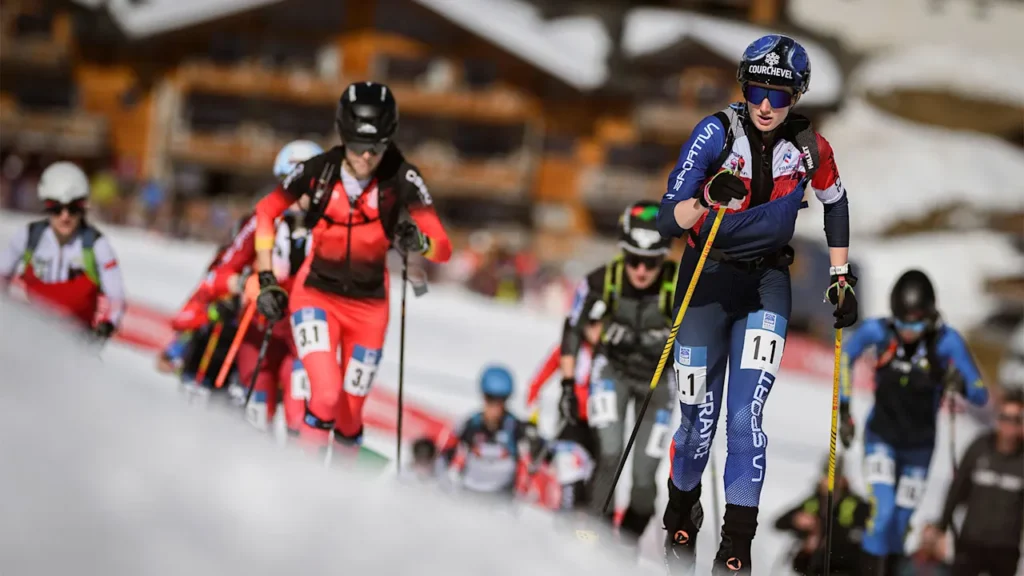
Move over, figure skating and ice hockey: There’s a new Olympic sport taking to the slopes of Italy.
Ski mountaineering, or “skimo,” is the first entirely new sport at the Winter Olympics since 2002. As its name suggests, skimo combines elements of skiing and mountaineering, requiring competitors to climb up a mountain slope before heading back down. It’s a more rugged take on the winter sport genre, and it involves rougher terrain than a cross-country or alpine ski course, calls for athletes to change their own gear mid-race, and balances both technical skill and endurance.
A total of 36 athletes will be competing in this year’s skimo events. That includes the two Americans representing Team USA, Anna Gibson and Cameron Smith, who narrowly qualified for the event back in December. Here’s everything you need to know about skimo before it becomes your next Olympic obsession.
Where does skimo come from?
According to an article on the official Team USA website, skimo traces all the way back to prehistoric times, when humans traversed Europe’s snow-covered landscapes on foot. In the modern era, the first official record of the sport comes from 1897, when the German geologist Wilhelm Paulcke crossed Switzerland’s Bernese Oberland mountain range on a pair of skis.
The sport held its first world championship in 2002, enjoying the most popularity in Europe’s wintery climes. Per the article, Italy has become “a hotbed for skimo,” with the sport’s popularity booming over the past decade: In 2010–11, there were 33,000 participants in the country, compared with more than 94,000 today. This expansion makes skimo’s debut at the Milan Cortina Games especially fitting. The races are being held in the town of Bormio.
How does it work?
Skimo can best be broken down into two component segments: the ascent and descent.
Competitors start with the ascent. During some portions of the climb, marked by green flags, they must proceed with their skis on. Special rubber membranes, called “skins,” are attached to the bottom of each ski to prevent backward sliding. One explainer video published by the International Olympic Committee (IOC) describes these skins as akin to “a sticky carpet.”
When the course’s flags turn yellow, athletes have to affix their skis to their backpacks and proceed on foot (this is called “bootpacking”). If a competitor follows these flag cues incorrectly—even because of a gear malfunction—points will be deducted.
Once the athletes reach the top of the slope, red flags mark their descent. Here, they remove the skins from their skis, fasten on a helmet, and shoot down a cross-country style course.
Unlike many other Olympic events, a large portion of success during skimo rests on athletes’ ability to quickly change their own gear. “The faster we switch gear, the quicker we can move through the race,” the IOC video explains.
What are the events?
Skimo at the Olympics will involve three different events: men’s sprint, women’s sprint, and mixed relay.
Each sprint event consists of just one ascent and descent, with races lasting less than three minutes on average. The mixed relay is a longer, more endurance-based event, comprising two ascents and two descents. Teams of one male and one female take turns navigating the course, and the first athlete to cross the finish line clinches gold for their team.