In temperate climates, the world slows down during the winter. Plants die or go dormant, animals hibernate, and snow blankets the ground. But soil below the snow is hardly frozen; it bustles with microbial life. All winter, these microscopic organisms feed on decomposing organic matter and release nutrients that will fuel plant growth in the spring.
Snowmelt is also a key component of nitrogen cycling. When snow melts each spring, microbial populations bloom and temporarily lock up available nitrogen in their biomass. This bloom is followed by a crash when the microbes die or decrease in number, releasing nitrogen back into the soil.
This microbial bloom-and-crash cycle has been observed in a variety of ecosystems, but the processes that cause it are not yet well understood. Climate change might further complicate what happens to the soil underneath snow. As warmer winters contribute to record low snowpacks, microbial activity may also change or slow. Nitrogen may be released into the atmosphere or exported into streams at different times or in different amounts—changes that would disrupt the nutrient balance that sustains plant life during the growing season.
A new study published in Nature Microbiology takes a peek at the microbial communities below the snow by tracing their chemical footprints in a high-elevation watershed in Colorado.
“What we wanted to do is to have a little bit more mechanistic understanding of the reasons why the [microbial] populations bloom, what types of nitrogen the soil microbiome uses to build biomass, and then, ultimately, what is the fate of that nitrogen after the population size crashes in spring?” said study author Patrick Sorensen, a microbial biogeochemist at the University of Rhode Island.
Digging in the Snow
The East River Watershed in Gunnison County, Colorado, is a high-altitude (9,022–13,123 feet, or 2,750–4,000 meters), mountainous area that is typically covered in multiple feet of snow between November and May. Most of its annual precipitation falls as snow, and over the past 50 years, spring snowmelt has been occurring progressively earlier.
“Historically, we thought, just like trees are losing their leaves, that the soil was also dormant in the winter. It’s cold down there. If the plants aren’t providing any carbon inputs, maybe the microbes just aren’t active,” said Stephanie Kivlin, an ecologist at the University of Tennessee, Knoxville, who was not part of the study.
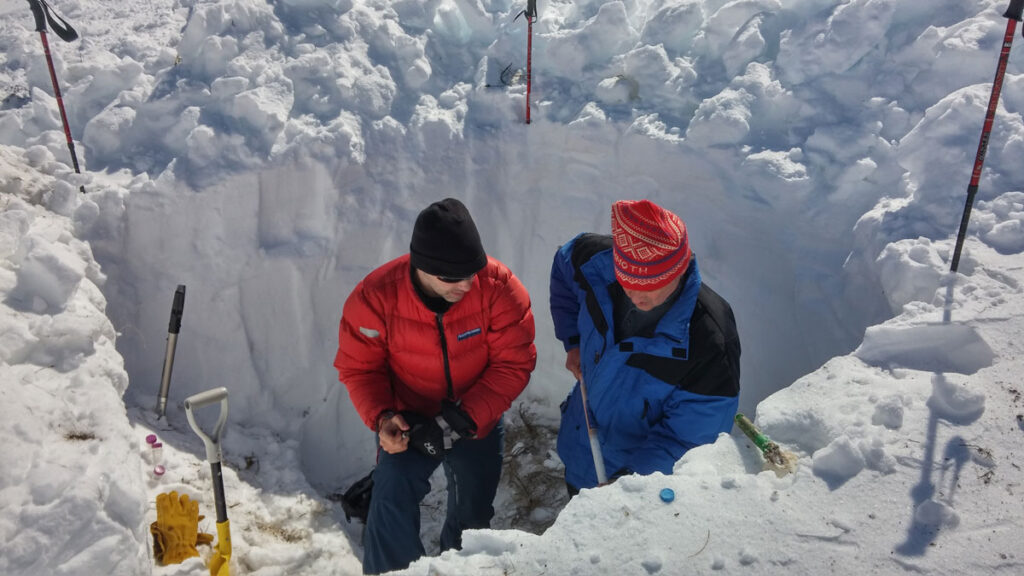
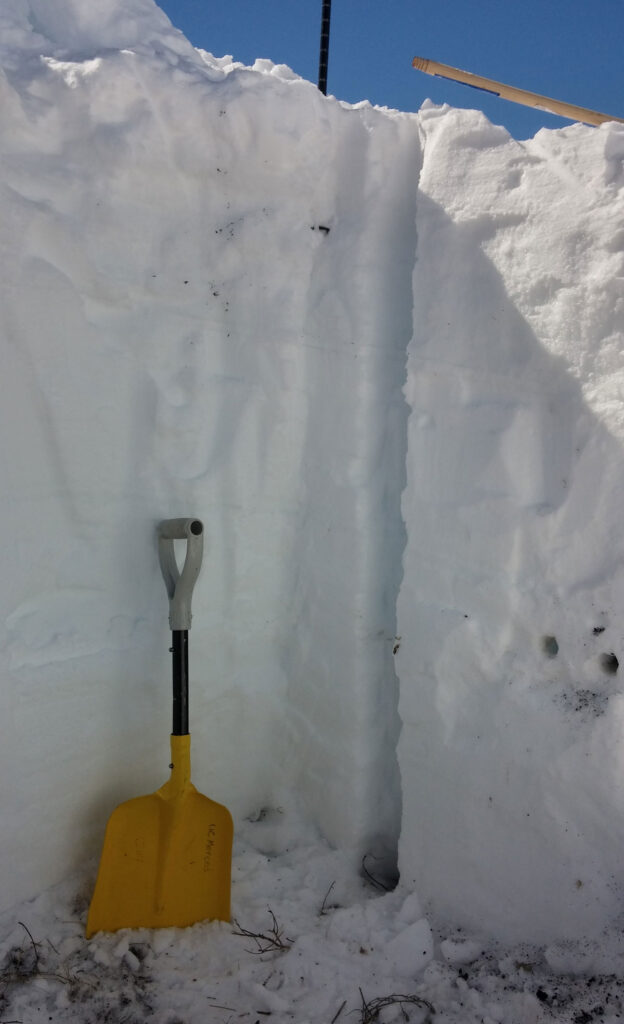
Researchers sampled the watershed six times over a period spanning the winter season, snowmelt, early growing season, and midsummer. “We snowshoed or cross-country skied out to the field site, dug snow pits, and that’s how we collected soils from beneath the snowpack,” said Sorensen. “Snow is a really good insulator, so the soils that we collect from underneath the snowpack are not frozen. At this particular field site, it’s pretty arid, so the soils were dry, even when there’s 6 feet of snow on top of them.”
Researchers split the soil samples into two groups for analysis. One set was tested for its physical and biochemical properties. The other was immediately flash frozen in dry ice to be sent to the Berkeley Lab for further genetic testing—meaning that scientists working on this project had to pack in coolers of dry ice and pack out soil samples through thick snow.
Blooming and Crashing
Research revealed that microbial populations in the soil were hardly dormant during the winter. Sorensen and colleagues divided the microbe populations into four groups:
- Fall-adapted organisms and bacteria were most active after plants had senesced.
- Winter-adapted organisms were most active when the snowpack was deepest.
- The snowmelt specialists were most active, and their numbers peaked as the snow melted.
- A final group, the spring-adapted microbes, thrived when the snow was gone and soils had warmed up.
Microbes take turns using different forms of nitrogen across the seasons, explained Sorensen. Winter-adapted microbes prefer inorganic nitrogen for their growth, while snowmelt specialists use organic nitrogen to build biomass when the soil is saturated. Once the snow is gone and soils have warmed, spring-adapted microbes take over to help convert nitrogen into a form that plants can use.
“These groups have adapted to use different types of nitrogen at different times of the year, and it’s related to the onset of snowmelt,” said Sorensen.
As snow melts and soils become saturated, the microbial population surges, rapidly incorporating nitrogen into their biomass. Their numbers then decline as conditions change.
Contrary to previous assumptions, Sorensen and colleagues realized that the bloom-and-crash cycle that microbial communities experienced during snowmelt was actually occurring much faster and in a much smaller window of time. While a typical winter lasts 120–150 days, the rapid microbial growth and decline occurs during the 60 or so days of active snowmelt, rather than gradually throughout the winter.
“It was shocking to me how much nitrogen was being cycled under the snow in the middle of the winter.”
“It was shocking to me how much nitrogen was being cycled under the snow in the middle of the winter. This is one of the first studies to really show the magnitude of that effect and who among the microbiome is doing all of that nitrogen cycling,” said Kivlin. “And, the other novel part is at snowmelt, there’s this huge flux of microbial activity, and then flux of nitrogen, probably creating available nitrogen for plants to grow once the snow has melted off of them.”
But as snowpack levels are decreasing due to warmer winters, soil microbial activity may be disrupted, Sorensen explained. Insulation from the snow keeps soils from freezing, so microbes can perform their bloom-and-crash cycle to release nitrogen as plants emerge from dormancy. More research is needed as the climate continues to warm—especially to examine how this process may affect soil microbe populations in regions beyond the mountains of Colorado.
“It’s possible that if that bloom-and-crash [cycle] starts to occur earlier and earlier in the year, but plants don’t start growing earlier, then those two processes could become decoupled. The consequences of that could be more nitrogen lost through aquatic ecosystems or through gaseous emissions. Either consequence is not great because nitrogen tends to be one of the nutrients that is most limiting for plant and microbial life on land,” said Sorensen.
—Rebecca Owen (@beccapox.bsky.social), Science Writer
Citation: Owen, R. (2026), When the snow melts, microbes bloom, Eos, 107, https://doi.org/10.1029/2026EO260073. Published on 4 March 2026.
Text © 2026. The authors. CC BY-NC-ND 3.0
Except where otherwise noted, images are subject to copyright. Any reuse without express permission from the copyright owner is prohibited.