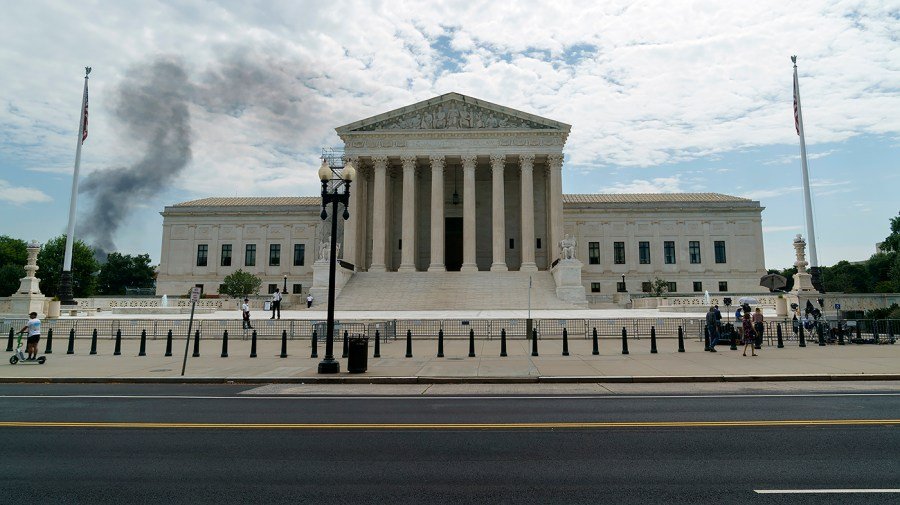
On Monday, the Supreme Court heard oral arguments in Hencely v. Fluor Corporation, a case that asks whether private military contractors can be held liable in state court for negligence and other violations of law, or whether they are immune from lawsuits brought by people they injure.
Its outcome could signal how the current majority feels about deputizing private actors with federal immunity even if they engage in blatantly illegal acts.
The word “immunity” has carried serious weight ever since the Supreme Court majority gave presidents immunity from criminal prosecution for official acts committed in their capacity as president. The ruling in Trump v. U.S. made President Trump legally untouchable and removed any meaningful incentive for him to respect the rule of law.
The Hencely case puts the related question on the table of whether federal contractors, acting at Trump’s or any future president’s behest, should enjoy immunity from civil lawsuits.
The Supreme Court hasn’t considered the issue of private contractor liability since 1988, when in Boyle v. United Technologies, it manufactured civil immunity for military equipment manufacturers. It did so even though Congress had specifically refused to protect private contractors under a statute that otherwise allows for negligence suits against the federal government.
Boyle arose when a Marine co-pilot drowned during a training exercise after his helicopter crashed off the coast of Virginia Beach. The intense water pressure made it impossible to open the door of the submerged aircraft because the escape hatch, which was designed by United Technologies Corporation, opened out instead of in. In a 5-to-4 majority opinion by Justice Antonin Scalia, the Court ruled that the procurement of military helicopters was a “uniquely federal interest” that insulated United Technologies from being sued in state court for defectively designing the helicopter.
In Hencely, Fluor Corporation — which has multiple billion-dollar contracts with the U.S. military — is asking the court to create much broader immunity from civil liability. It argues that the federal government has exclusive war-making powers under the Constitution that supplant state tort law. Fluor claims that having to defend against state tort law claims is bad for the interests of the U.S. military because it discourages risk-taking and cooperation between soldiers and contractors.
Fluor is asking the justices to block a lawsuit over a 2016 suicide bombing at the Bagram Airfield military base. Fluor, which was providing logistics for the base, had hired the bomber, Ahmed Nayeb, pursuant to an “Afghan First” program that was part of the U.S. counterinsurgency strategy aimed at helping develop the local economy. Nayeb created an explosive vest while working the night shift unsupervised, which he later detonated during a Veterans Day 5K race, killing himself and five others and wounding 17 more. The Taliban took credit for the attack.
One of the wounded, an American soldier, sued Fluor under South Carolina law for negligent supervision of the bombing and for breaching its contract with the U.S. government.
The statute addressed in Boyle, the Federal Tort Claims Act, does not allow for lawsuits against the United States for “combatant activities of the military or naval forces, or the Coast Guard, during times of war.” But that exemption from liability specifically states that it does not apply “to any contractor with the United States.”
The government’s own investigation concluded that Fluor had violated its contract by failing to properly supervise Nayeb, allowing him to roam around the base and build the explosive. The U.S. Court of Appeals for the Fourth Circuit nonetheless applied the old Boyle precedent, ruling that “uniquely federal interests” were involved so the contractor was immune from tort liability. “[W]hen it comes to warfare,” the court wrote, “the federal government occupies the field.”
The theory of immunity that Fluor is pushing in the Supreme Court — that it derives from the Constitution, not just the Federal Tort Claims Act — has even broader implications for the relationship between the federal government and the states. As Justice Clarence Thomas asked during Monday’s oral argument, what other matters are supposed to be “preempted” and cannot be touched by state laws aimed at protecting people from private companies’ bad acts?
And, I would add, does it matter that those companies work for an executive branch currently out of control when it comes to respecting the Constitution and the rule of law?
The Supremacy Clause makes clear that federal law supersedes state law when there is a conflict. However, any conflict here would not arise from an act of Congress. Boyle’s grant of civil immunity instead came from five unelected justices of the Supreme Court. Their job is to interpret the law, not make it. As Justice Ketanji Brown Jackson emphasized during oral argument, the military’s rules indicate that Fluor crossed some lines. Why should the court override the military’s own judgment?
Meanwhile, hundreds of private companies are under contract with ICE, which landed an additional $75 billion in congressional funding this summer. Under federal law, only an “officer or employee of the [Immigration and Naturalization] Service authorized under regulations prescribed by the Attorney General shall have the power” to make warrantless interrogations and arrests of suspected undocumented individuals. But numerous viral videos appear to suggest that unidentified private security contractors, bounty hunters and even ICE impersonators — in unmarked cars, without badges or uniforms — could be doing these things as well.
The line between the public and private sectors, with rare exceptions, stops at the U.S. Constitution. Its individual protections against government overreach do not extend to private parties, including government contractors, unless this Supreme Court majority says otherwise.
If a government’s ultimate goal is lack of accountability to the public and the rule of law, private contractors can provide a convenient end run around laws designed to keep the government honest. In deciding whether the Constitution immunizes private parties from the reach of state tort laws, the court should consider what a ruling that defies the judgment of Congress and state legislators would mean for individual liberty itself.
Kimberly Wehle is a professor at the University of Baltimore School of Law and author of “How to Read the Constitution — and Why,” as well as “What You Need to Know About Voting — and Why” and “How to Think Like a Lawyer – and Why.”