If you live in Southern California and you haven’t been to Avalon yet, this is your sign to go. I get it – you can practically see Catalina on a clear day from the coast, and somehow that makes it easy to put off. It’s always there, so you’ll get to it eventually, right?
Here’s the thing: Avalon is one of those places that genuinely surprises people. Most visitors expect a touristy island with overpriced fish tacos and a long line for the ferry.
What they actually find is a walkable, Art Deco-laced little beach town with golf carts weaving through narrow streets, bison roaming the interior hills, and water so clear you can see straight to the bottom from the pier. It feels nothing like the mainland.
This was my second visit to Catalina Island and Chris’s first (he’s a San Diego native who somehow never made it to the island). My first trip was camping at Two Harbors, which is a completely different experience from Avalon. I’ve also camped on Santa Cruz Island and explored Anacapa Island, but visiting Avalon had been on my list for a long time.
Whether you’re driving down from Los Angeles, up from San Diego, or flying into LAX before hopping a boat, this guide covers everything a first-timer needs to know.
How to Get to Catalina Island
By Ferry (The Most Popular Way)
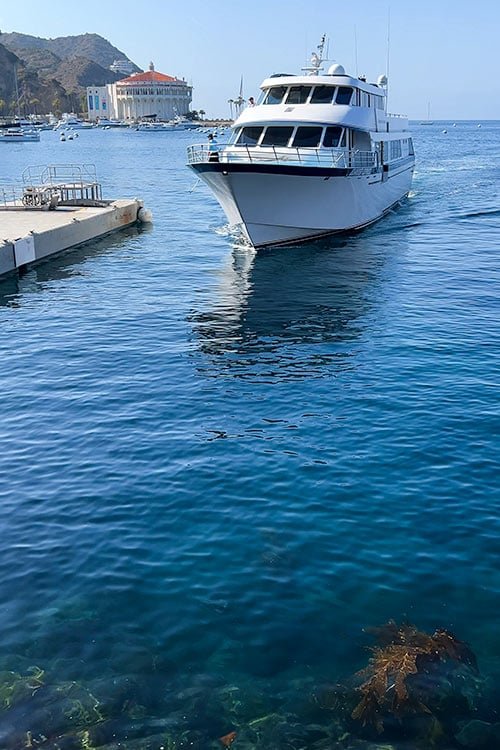
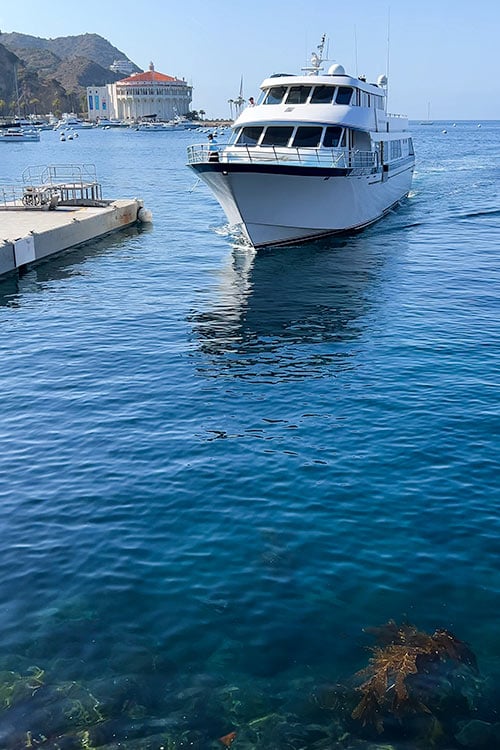
The easiest and most popular way to get to Avalon is on Catalina Express, the high-speed ferry service that has been running between the mainland and Catalina Island for decades. It’s a genuinely enjoyable part of the trip – not just transportation, but the start of the experience.
Catalina Express departs from three Southern California ports:
- Long Beach: The most departure options of any port, making it the most flexible choice if you’re coming from LA or flying into LAX. The terminal is easy to find and well-organized.
- San Pedro: A great option if you’re coming from the South Bay or want to avoid Long Beach traffic. Multiple daily departures.
- Dana Point: My personal pick coming from San Diego, and so much closer it’s not even a debate. Fewer departure times than Long Beach, so you have less scheduling flexibility, but completely worth it if you’re in south Orange County or San Diego County.
The crossing takes about an hour from Long Beach and San Pedro, and roughly 75 minutes from Dana Point. Round-trip fares run approximately $90 per adult and the best part is you’re skipping airports, TSA, and baggage carousels.
Book in advance. These boats sell out, especially on summer weekends and holidays. Two months out is not too early during peak season. Plan to arrive at the terminal 45–60 minutes before departure. There’s paid parking at all three ports (rates run about $25 per day), and you’ll want time to park and get checked in.
What to expect: Dolphin sightings are common year-round, especially in the channel. On our return trip from Dana Point we spotted a massive pod of orcas, which nobody on the boat expected, not even the captain. As you approach Avalon, the round white Casino building comes into view above the harbor, so have your camera ready.
By Helicopter
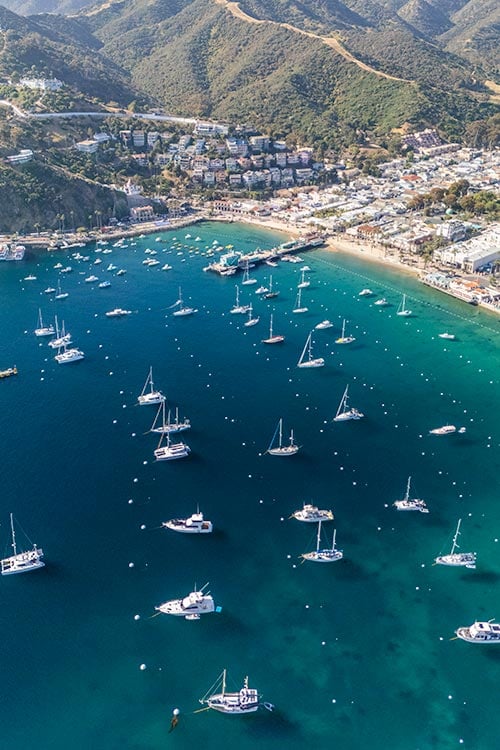
If you want to skip the hour-long crossing and make an entrance, Maverick Helicopters runs daily per-seat flights to Avalon from Long Beach (near the Queen Mary terminal) and weekend flights from San Pedro. The flight takes about 15 minutes and costs around $150 one-way. It’s a splurge, but the aerial view of the island is spectacular – and you’ll feel like a rock star walking off a helicopter into Avalon.
Read more: 25 Epic Weekend Trips from San Diego (That Locals Actually Take)
What to Expect When You Arrive in Avalon
Stepping off the ferry in Avalon is one of those travel moments that has a little magic to it – especially if it’s your first time.
You’ll disembark at the Cabrillo Mole, which is a long dock that stretches into the harbor. Give it a few minutes for the crowd to thin out. Walk up the ramp, and just like that, you’re in Avalon.
The first thing you’ll notice: there are almost no cars. The island has a very limited number of registered vehicles – locals wait years on a waitlist just to have a car here – so the streets belong to pedestrians, bicycles, and golf carts.
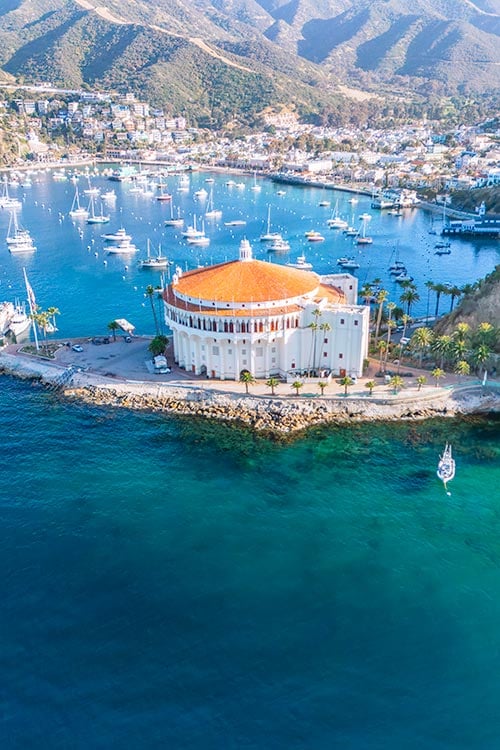
From the Mole, it’s a short, flat walk along the waterfront into the center of town. The promenade (Crescent Avenue) wraps around the harbor and is lined with restaurants, tour operators, surf shops, and ice cream stands. It’s easy, walkable, and orienting. Within ten minutes of stepping off the boat, you’ll have a solid sense of the place.
One thing to know about getting around: There is no Uber or Lyft in Avalon. Taxis (the yellow Catalina Taxi vans) meet every boat at the terminal and are the go-to for transportation if you’re staying further from the ferry landing. The newer COAST (City of Avalon Seaside Transit) electric shuttle runs on demand throughout Avalon for just $2 per rider. Just download the Ride Circuit mobile app or request a ride by calling 562.534.2820.
How to Get Around Catalina Island
The most important thing to know: there are almost no private cars in Avalon. Locals wait years on a waitlist to have one registered on the island. The streets are quiet, walkable, and genuinely peaceful compared to anywhere on the mainland.
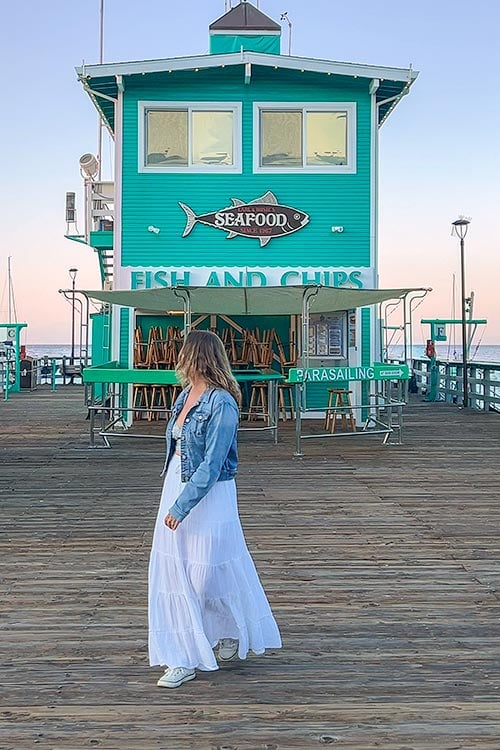
On foot: Downtown Avalon is only about one square mile, and the flat waterfront area (Crescent Avenue) is easily walkable. Most restaurants, the Green Pleasure Pier, tour operators, and the iconic serpentine tile wall are all along this stretch. If you’re not sure where to start, start here.
Golf cart: The hills above town are steep, and this is where a golf cart earns its keep. Several rental companies operate near the ferry terminal. You’ll need a valid driver’s license. Most people rent by the hour (two hours is the sweet spot). Carts sell out on summer weekends, so reserve in advance if you can.
COAST Electric Shuttle: The City of Avalon Seaside Transit runs on-demand electric vehicles throughout Avalon for just $2 per ride.
Taxi: Catalina Taxi vans meet every ferry at the terminal – look for the yellow sign at the top of the dock. Useful if you’re staying further from the waterfront or arriving with heavy bags. There is no Uber or Lyft on the island.
A few landmarks worth knowing before you set out: the Catalina Casino – the big white round building at the end of the bay – is the town’s main compass point and was never actually a gambling casino (it’s a stunning 1929 Art Deco ballroom).
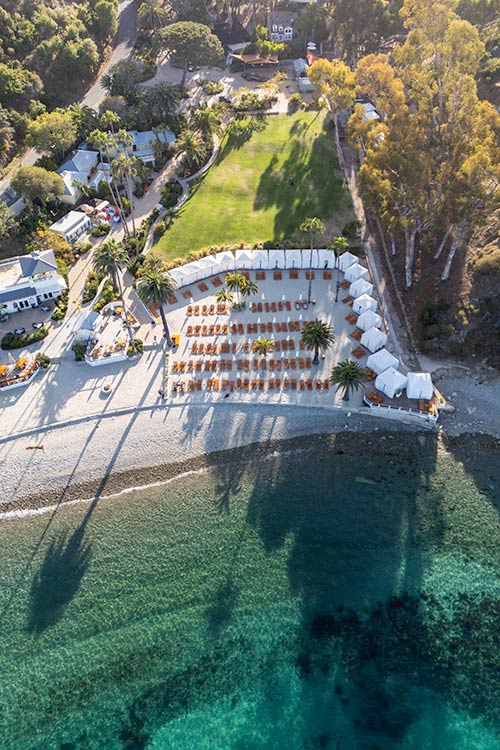
Descanso Beach Club, just past the Casino, is Avalon’s most popular beach and one of the few spots in Southern California where you can legally drink on the sand. And Lover’s Cove, a five-minute walk east of the ferry terminal, is a free marine preserve with some of the best snorkeling in the state.
Read more: 15 Best Weekend Getaways & Staycation Ideas in California
Best Things to Do on Catalina Island
Rent a Golf Cart
I’ll be honest – we didn’t rent a golf cart. We had four full days and we walked everywhere, which I loved, but our knees had some opinions about the hills by day three. If you don’t have that kind of time, rent a golf cart for at least part of your trip. An ebike is another great option that nobody talks about enough. For a shorter visit, a golf cart is definitely recommended – you’ll cover in two hours what took us several days on foot.
Rental companies operate near the ferry terminal and most rent carts by the hour, with two hours being the sweet spot for a comfortable circuit. During busy summer weekends, it’s worth calling ahead to reserve – carts go fast.
I recommend driving up past the Catalina Chimes Tower, along the ridge roads above town, and back down. From the top, you get an overhead view of the entire harbor – the Casino, the boats, the colorful hillside houses – and it’s one of the most photogenic spots on the island. Take your time up here.
Walk the Waterfront
After you’ve gotten the big-picture view from above, come back down and take your time on Crescent Avenue. Grab a coffee, poke your head into a few shops, and just absorb the atmosphere. Avalon has an unhurried energy that’s hard to find an hour from LA.
One stop I particularly love: the tile details throughout town. Catalina is famous for its hand-painted tiles, and they’re everywhere – on fountains, building facades, signage, and staircase risers. Once you start noticing them, you can’t stop.
Head to Lover’s Cove & Casino Point for Snorkeling
If you have any interest at all in snorkeling, make sure you get in the water! Lover’s Cove and Casino Point are part of nine Marine Protected Areas (MPAs), so the fish population here is extraordinary – you’ll see Garibaldi (the bright orange ones), sea bass, stingrays, and kelp forests within about ten feet of shore.
Casino Point is a designated dive park with a stunning kelp forest, and there are resident seals that hang around and will absolutely steal the show. We also snorkeled in front of Descanso Beach, which is more relaxed and great for a casual float. Casino Point is where all the scuba divers go for good reason.
Snorkel gear rentals are available at several spots around Avalon, so no need to haul your own from home. I’d also strongly recommend a wetsuit (a shortie is fine in summer) if you get cold easily. The water peaks around 67°F in August and drops into the high 50s in winter. It’s refreshing (read: cold, if you’re a Southern Californian), and you’ll stay in a lot longer with a wetsuit on.
Kayak to Frog Rock
We did a guided kayak tour with the Catalina Island Company out to Frog Rock, and it’s always great to get out on the water. The paddle is easy enough for beginners (we had a few on our tour) and the coastal views from the water are completely different from anything you see on land.
Roller Skating at the Wrigley Ballroom
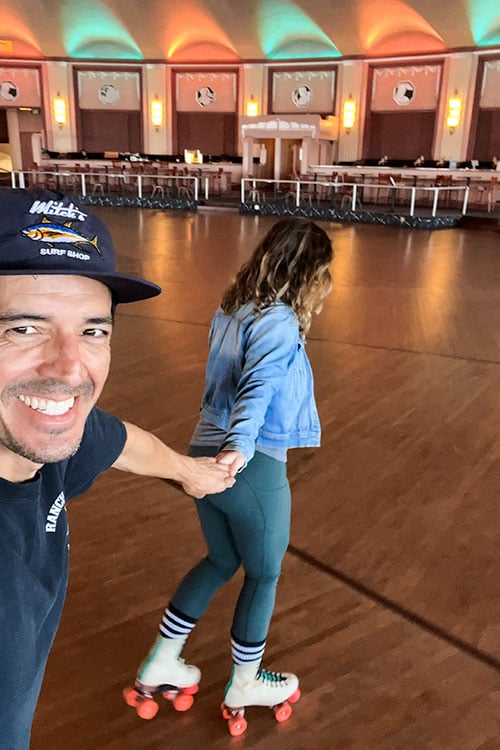
I was not expecting this to be a highlight. Neither of us had roller skated in probably 20 years, but it’s amazing how quickly things come back once you put those skates on. The Wrigley Ballroom is this gorgeous historic space and the music made the whole experience. Put it on the list even if it sounds weird, especially if you’re staying multiple nights. Reserve a spot here.
Inside Adventure Tour
I really wish we had time to add this tour to our trip! Nearly 90% of Catalina’s interior is protected conservancy land, and a guided tour (you can book here) is the only way to explore it – you can’t just wander back there on your own. A naturalist takes you out in an open-air vehicle through canyons, ridgelines, and coastline that most visitors never see, with a real chance of spotting bison, Catalina Island foxes, and bald eagles along the way. There’s genuinely nothing else like it in Southern California. Choose the 2-hour or 3-hour option depending on your schedule, and book ahead.
Nautilus Semi-Submarine
If you’re traveling with kids – or just refuse to fully grow up – this one’s for you. You board a yellow semi-submarine at the Green Pleasure Pier and spend 45 minutes cruising six feet underwater through Lover’s Cove without getting wet. Garibaldi, kelp forests, bat rays – all right outside your personal porthole. For a few extra dollars in cash you can feed the fish directly from your seat, which based on every account I’ve heard turns into a full-on feeding frenzy. Pure fun, no snorkel required. Book it here.
Cyclone Powerboat to Two Harbors
Our friends make this trip every year and they highly recommend taking a powerboat from Avalon over to Two Harbors on the other side of the island. It only runs May through early October, so we missed it on our late April visit, but it’s first on my list for next time. Two Harbors is a whole different side of Catalina worth experiencing.
Read more: The 12 Best Places to Camp in California
Best Restaurants on Catalina Island
The Lobster Trap: Everyone who’s been to Avalon more than once will mention this place. Fresh seafood, no reservations, and lines that move quickly enough. Get there early or put your name down and explore while you wait.
Nauty Fox: Order the Ahi Poke Nachos. Don’t overthink it, just trust me. Their outdoor patio also has the best view.
Katie’s Kitchen: Our go-to for cheap eats. The Korean dishes especially – this was not what I expected to find on a small California island and it completely delivered.
Catalina Coffee & Cookie Co: Best coffee on the island and the place I’d start every morning if I lived here. The breakfast sandwiches are a must-try as well.
Descanso Beach Club: Great for a long, lazy afternoon on the sand. Order the Buffalo Milk cocktail – this drink originated on the island.

Read more: The Ultimate Budget-Friendly California Road Trip Guide
Where to Stay on Catalina Island
Avalon has limited hotel rooms (remember: only about 4,000 people live here), which means prices are higher than the mainland and things book up fast. If you’re planning an overnight or weekend trip, book early.
For a budget stay: Catalina Island Seacrest Inn is a solid, well-located option in the heart of Avalon within easy walking distance of everything.
For a mid-range stay: We stayed at Snug Harbor Inn and I’d go back in a heartbeat. It’s small, quaint, and everyone is genuinely warm and helpful. Breakfast comes to your room every morning, and the afternoon happy hour snacks and drinks were something we looked forward to more than I expected. The location is perfect: right in town, across the street from the beach, restaurants all around, and Vons (the only supermarket on the island) a three-minute walk away. There’s also a little lounge downstairs that saved us on our last day when checkout was at 11 but our ferry didn’t leave until 5.
For a splurge: The Pavilion Hotel is right on Crescent Avenue, fourteen steps from the beach, and recently refreshed with a full renovation. Complimentary breakfast and an evening wine and cheese social are included, and the staff consistently gets called out in reviews as genuinely exceptional. It’s the most polished option on the main strip and worth every penny for a special trip.
Read more: 12 Best Beach Towns in California + Where to Stay
Best Time to Visit Catalina Island
The island is open year-round, but the sweet spot is May through early June and September through October. You’ll get warm, clear days, smaller crowds than peak summer, and better hotel rates.
Summer (July–August) is peak season – expect the most activity, the best water temps for swimming and snorkeling, and the highest prices. Ferries fill up weeks in advance.
Winter is quiet and affordable, with occasional stormy crossings, but also no crowds whatsoever. The island’s “second summer” in October is legitimately one of the best-kept secrets – warm, calm, and almost empty compared to July.
One thing I didn’t anticipate: the difference cruise ships make. On most days, a cruise ship is docked in the harbor and the town gets noticeably busier with day visitors. Around 5pm when they leave, Avalon goes quiet in the best way. We had one full day with no cruise ship in port at all, and the island felt completely different – where you start to feel like a local. It’s one of the best arguments for visiting in the off-season.
Catalina Island Tips for First-Timers
No cars, no Uber. You already know this, but let it sink in fully before you pack. Your options are: walk, golf cart rental or the COAST shuttle.
Cell service is spotty the further you get from downtown. Download offline maps before you go.
Bring a light jacket. Even in summer, the ferry crossing and evenings in Avalon can be cool and breezy. A layer you can throw in a bag is always worth it.
The tap water is fine to drink but doesn’t taste great and the locals don’t really drink it. A reusable filtered bottle is a smart thing to bring.
Book everything in advance for summer visits. Ferry tickets, hotel rooms, and popular tours sell out. Don’t assume you’ll figure it out when you get there.
Day trip or overnight? A day trip to Avalon is absolutely worth doing, but if you have the flexibility, an overnight lets you experience the island after the day-trippers leave on the last ferry. The town gets noticeably quieter and more local-feeling in the evenings, and you get a sunrise over the harbor that most visitors never see.
Catalina Island FAQ
Two days and one night is the sweet spot. A day trip is doable, but staying overnight means you get the island after the day-trippers leave on the last ferry – and it’s a completely different vibe. Two nights and you’ll feel like you actually went somewhere instead of just passing through.
Rent a golf cart and drive the ridge roads above Avalon – the harbor views from up there will stop you in your tracks. Snorkeling (at Lover’s Cove and Casino Point) is a close second. The Garibaldi are so orange they look fake, and it’s completely free. Do both before you decide you’re too tired.
September and October. The summer crowds are gone, the water is still warm, and hotels are more affordable. May and early June are a close second. Summer is peak season with the most energy but also the most crowds and highest prices; book everything well in advance if you’re going then.
Plan on roughly $650-$900 for two people on a one-night trip, including ferry ($160-$180 round trip for two), a mid-range hotel ($200-$350), golf cart rental (~$150), and meals. The ferry is the one fixed cost you can’t get around. Budget travelers can trim this significantly by visiting midweek in the off-season.
Completely. It’s an hour from LA by ferry and feels like a different world – limited cars, no chain restaurants, Art Deco architecture, and impossibly clear water. First-timers almost always leave wanting to come back.
No. Catalina is part of Los Angeles County, so you never leave California. A standard government-issued photo ID like a driver’s license is all you need for the ferry.
No. Avalon is very walkable, and most people get around on foot, by rented golf cart, or via COAST – the city’s on-demand electric shuttle that runs anywhere in Avalon for $2 a ride. There’s also one taxi company whose vans meet every ferry at the terminal.
Yes, with restrictions. Dogs are allowed on the Catalina Express (leashed and muzzled or in a carrier), but not on Crescent Avenue, public beaches, or the pier. A handful of hotels and some restaurant patios are pet-friendly. It’s doable, but Avalon has more restrictions than most California beach towns, so research before you book.
Some people do, especially in winter or on windy days. Take Dramamine about an hour before boarding if you’re prone to motion sickness. On the boat, sit toward the middle, focus on the horizon, and skip reading or looking at your phone during the crossing.
No, there are no car ferries and no car rentals on the island – and that’s part of the charm. Only a small number of residents and businesses are permitted to have vehicles. Pack light, wear comfortable shoes, and embrace the golf carts.
Very. Snorkeling at Lover’s Cove, the glass-bottom boat tour, mini golf at Avalon Golf Gardens, and the zip line are all great with kids. The waterfront is stroller-friendly, but the hilly streets are easier with a carrier for little ones.
A light jacket (the ferry crossing gets breezy), comfortable walking shoes, reef-safe sunscreen, and a reusable water bottle – the tap water is technically fine but locals don’t drink it. Bring some cash, and download offline maps since cell service gets spotty away from downtown.
The post The Complete Catalina Island Travel Guide: Plan Your Perfect Trip appeared first on Ordinary Traveler.