
I spent my school life studying. Not learning. Just studying. No subject was enticing enough to go beyond that. Everything came down to my grades anyway.
A decade later, I pay to learn on the weekend. In a bar, with a snack (shout out to Dorf’s truffle popcorn).
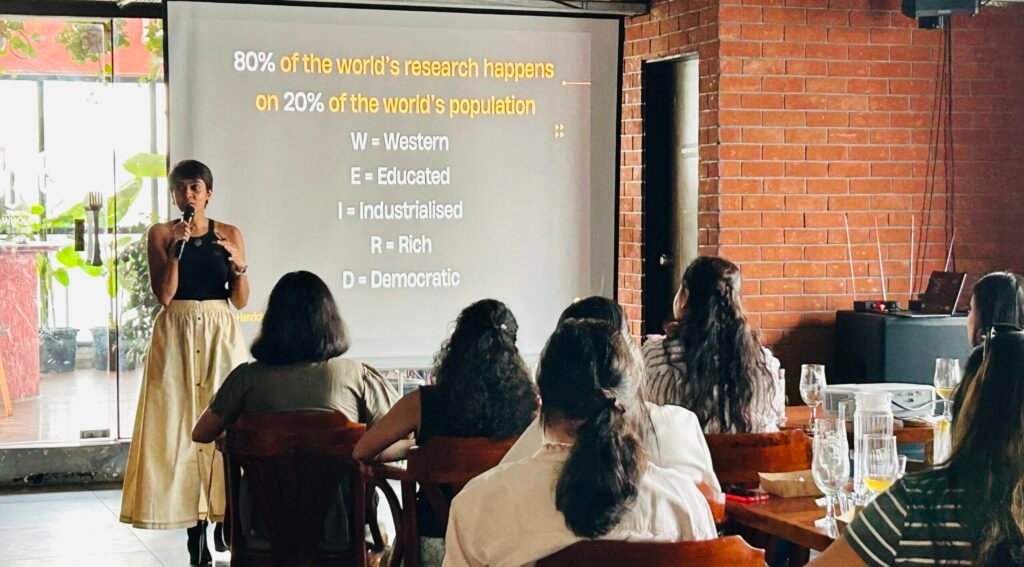
Pint of View (PoV) is the new cultural attraction in my city, Pune. Every weekend, a scientist, researcher, doctor, or professor; basically an expert in a field, teaches a topic over two hours. 50-60 of us gather and listen.
I started writing this essay five weeks ago. For three weeks, I wondered why someone from edtech would write about live lectures. Then I realized the excitement I feel toward PoV matches the excitement my Classmates (what we call each other at Class Central) had during the early days of online courses. It’s new. It’s cool. And much of what online learning has de-prioritized.
Redefining Quality Learning
PoV started in 2025, when Harsh Snehanshu, an author and an entrepreneur, and Sneha Shah, a documentary filmmaker, stopped waiting for Lectures on Tap, the US version of bar lectures, to come to India.
The first lecture in Bangalore sold out in three days in mid-2025. I get the hype.
The first lecture I attended was ‘Drugs & Other Loves’ which walked us through how vaccines are developed. It had nothing to do with my profession, writing/education, nor with my academics (psychology).
But in retrospect, the topic had hit this sweet spot. It was relatable and valuable (as anything is when it’s about your health), and it was perfectly interesting (we already had half-knowledge about the COVID-19 vaccine).

The main lecturer was an immunologist with three decades of experience. He teaches drug development at UPenn and at Indian Institutes of Technology Mumbai and Delhi. He’s also an author!
I asked Harsh how they vetted lecturers, and whether a connection with leading institutions is a deciding factor.
“Many of our speakers come from top universities, but that’s not the goal in itself. Strong institutions often correlate with rigorous research and exposure to demanding students,” he said. “We’re less interested in generic themes and more interested in what someone has spent years researching. Three things matter the most: they must be engaging, bring original research, and must be able to handle depth and questions.”
The experience showed. More than 80% of the lecture was interactive. In fact, the facilitator taught through three participants who he assigned roles to: a drug development company’s finance head, its researcher, and the CEO.
I hadn’t expected the lecture (or any lecture) to be this humorous or lively or loud.
“Our non-negotiables are: the talk should be visual, not text-heavy, it shouldn’t be read off a script, it should feel extempore and alive” – Harsh, Co-founder of Pint of View
The access to a 100% human learning experience was refreshing. At Class Central, we often come across online courses where little thought hasn’t been given to the design, the delivery, even the slide content. White-labeled courses, produced with minimal effort, for reputable organizations, are published on multiple platforms.
This has compromised the trust I have in online courses. It took me two minutes to book a live lecture which isn’t related to my career, while an online course that could offer professional skills sometimes sits in my cart for days.
Bringing Back the Joy of Learning Among Learners
I love listening to my colleagues talk about how stimulating online learning was. It was a portal to subjects school or university never taught, and there was a guarantee you’d learn from an expert or an expert-designed curriculum.
Dhawal, our founder, started with Udacity’s Introduction to Artificial Intelligence, while Pat began with Computer Science 101 (Stanford). For her, online learning was a post-retirement treat which eventually led her to work with Class Central. She’s now on her 200th-something course.
Coursera started with Stanford’s free online courses. The pitch was simple: this is how Stanford teaches, and now you can sit in. The willingness to learn outweighed everything, even the tough assignments (although not everyone completed them).

Then the spirit shifted. In 2018, Coursera announced its first professional certificate, the Google IT Support Certificate. The university-first platform moved to industry certs from Google, IBM, Meta, and others, and professional certificates have been Coursera’s primary growth engine for the last few years.
At Udemy, which calls itself “a leading AI-powered skills acceleration platform skill development”, B2B revenue makes up 65% of its business. But it’s also a marketplace where anyone can upload a course. No filtration.
Live lectures don’t have the depth or width of an online course, but they share the spirit MOOCs started with. And I’ve found that has fueled my learning. As an otherwise laid back person, I’ve found myself reading up on topics from past lectures, watching videos, going down rabbit holes I wouldn’t have entered otherwise.
“It brings back non-transactional learning. There’s no immediate payoff. You’re not learning for a job, a degree, or a credential. You’re learning because you want to.” – Harsh, Co-founder Pint of View
You can see it in the room. The second lecture I attended was on ‘neuro-aesthetics’, which dissected how and why our brain reacts to beauty, and whether it truly is subjective (fascinating stuff). Side note: The first time PoV announced this lecture, it was sold out within three days. So the next time they announced it, I booked it within a day of the announcement.
My favorite part was the Q&A: a relaxed discussion about whether our pull toward beauty is bias or a part of evolution. The questions were uninhibited, which I think, came from the trust learners had in the speaker and the crowd.

After the talk, I walked up to Dr. Kohinoor Darda, the facilitator, to ask about her work designing lesson plans for schools in Kashmir. I hadn’t planned to do this, but her research was cool enough to turn me into the bravest introvert ever.
That moment proved that non-transactional learning goes beyond a lecture, toward something intangible: the joy of community.
Creating Third Spaces
My favorite essay by David Joyner, (Executive Director of Online Education & OMSCS in Georgia Tech’s College of Computing), is on why learning needs third spaces: places where learners meet, share goals, and build the kind of intimacy online learning lacks today.
His key observation: proximity and unplanned interaction are the foundations of friendship, and school is one of the few places that historically made this happen on its own.
Now, AI is making it difficult to find humans on the other side of the course you’re taking. Almost every platform has an AI assistant. The aim is to make learning feel human while taking the humans out of it. And the more it personalizes each learner’s path, the more it’s separating them.
The Community of Inquiry Framework (Garrison, Anderson, and Archer, 2000) argues that a complete learning experience requires three things working together:
- Social presence — feeling real to each other
- Teaching presence — active facilitation and design
- Cognitive presence — actual deep thinking and meaning-making

PoV offers all three. The 50-60 of us are bound by a goal, which an experienced facilitator fulfills and pushes us to introspect.
After the session, most linger to ask more questions, network, or to have another round of beer with a new friend. Sometimes, a community table forms where the facilitators, learners, and the event organizers stay back for food, cocktails, and an informal QnA.
Catering to the Human Needs of Learning
Of course, I’m not arguing that live lectures are better than online courses.
Online learning might be shifting toward skill development because of the demand (and business opportunities). But during that shift, the excitement and liveliness disappeared. The curiosity that made my Classmates fall in love with MOOCs over a decade ago has dimmed.
Live lectures are bringing some of that light back. What it does beautifully and rather perfectly, is cater to the information gap theory: the idea that we’re most curious when we know just enough about a topic to feel the gap between what we know and what we don’t.
The lecturers don’t close the gap completely. They leave you with a narrower one to fill, not because you get graded for it, or a certification, but because you want to.
“There wasn’t really a space where you could just sit, listen, and learn something deeply, without needing to perform or participate constantly,” said Harsh. ”We wanted to recreate that feeling of going back to school, but on your own terms. A space where you could be curious again.”
The post The Joy Online Learning Forgot: What Bar Lectures Are Getting Right appeared first on The Report by Class Central.