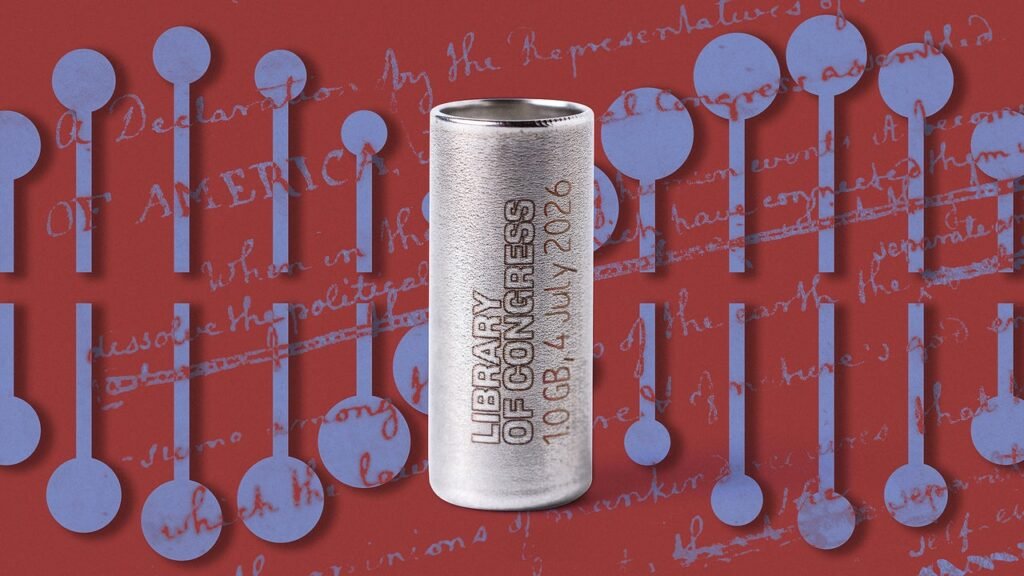
To save on space, the Library of Congress is packing what would otherwise be pages and pages worth of documents and other media from U.S. history into a single vial for the nation’s time capsule marking 250 years since the founding. The method that makes it possible is synthetic DNA.
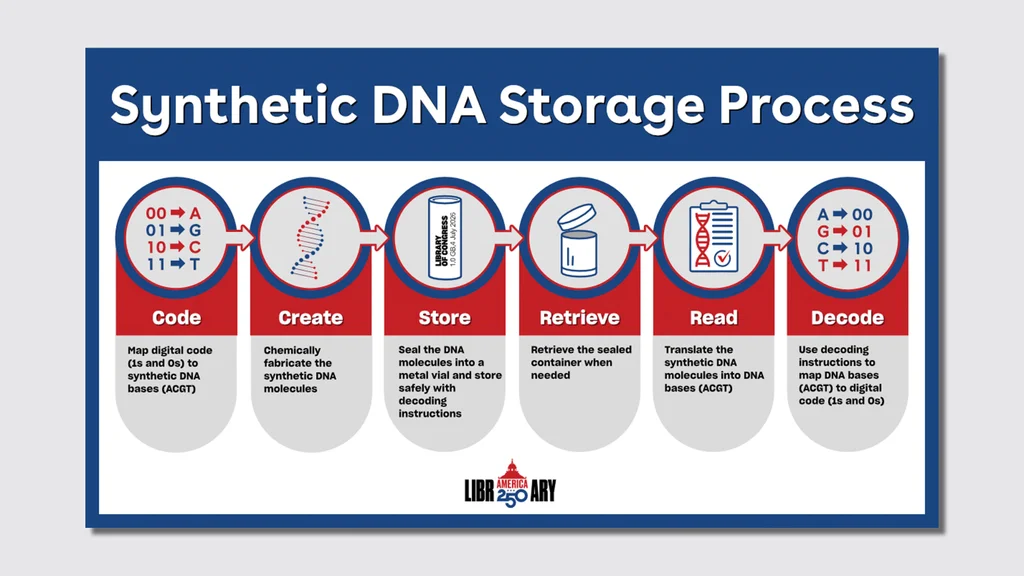
The storage technique uses artificial DNA molecules like a hard drive by converting data sequenced in 0s and 1s, the binary language of computers, into As (adenine), Cs (cytosine), Gs (guanine), and Ts (thymine), the bases that make up a DNA molecule.
It’s not biological in any way, but it does use DNA structure to pack data more densely than other storage methods, and it lasts far longer than paper would. For a time capsule that’s not supposed to be open until 2276, it’s a smart way to preserve history for the long run.
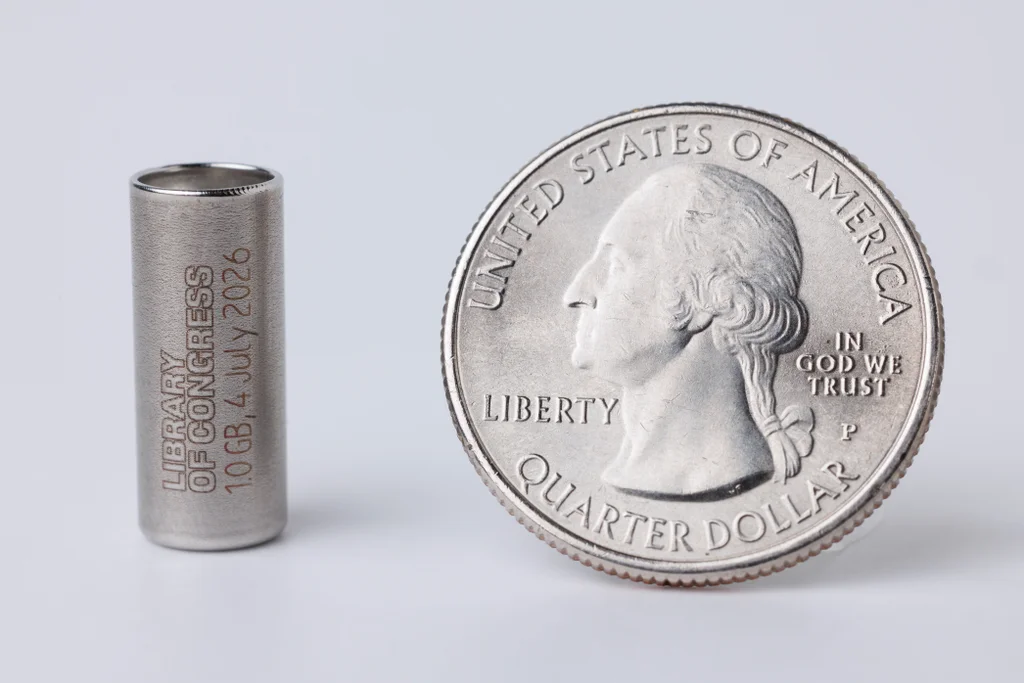
The vial from the Library of Congress includes digital copies of documents like Thomas Jefferson’s rough draft of the Declaration of Independence and Francis Scott Key’s hand-written lyrics of “The Star-Spangled Banner,” as well as the entire Annals of the Congress of the United States from 1789 to 1824, which detail congressional proceedings.
All told, it’s 1 gigabyte of data, or several social studies lessons’ worth of history, all shrunken down so it can fit into a container no taller than a quarter. The items were chosen by a a cross-library group.
“It’s really a reflection of what we find important at this time in the United States,” Natalie Buda Smith, the Library’s director of digital strategy, tells Fast Company.
There’s an 1898 audio recording of “The Star-Spangled Banner” by John Philip Sousa’s band; a 3D rendering of Abraham Lincoln’s hand; the 1791 L’Enfant plan for Washington, D.C.; and a rare, pre-1600 Mesoamerican manuscript called the Codex Quetzalecatzin.
Also included will be handwritten cataloged items from Thomas Jefferson’s library; digitized 1890 audio recordings of Native American numbers, a rhyme, days of the week, and a funeral song; the canvas drawing of the Blackwell’s Kinfolk family tree, an eight-foot tall family tree that shows more than 1,500 names from an African-American family in Virginia 1789 to the 1970s; as well as other items from the Library’s collection.
The Library of Congress worked with the University of Washington’s Molecular Information Systems Lab to translate the data into synthetic DNA strands that were sealed into the metal vial. The vial will be stored inside a small metal box with the Library of Congress logo on the front and placed inside the time capsule. Instructions for opening the vial will be buried with it so people in the future can understand what’s inside before breaking into it.
“We’re using a technology that we hope is still accessible in 250 years, but you never know,” Smith says.
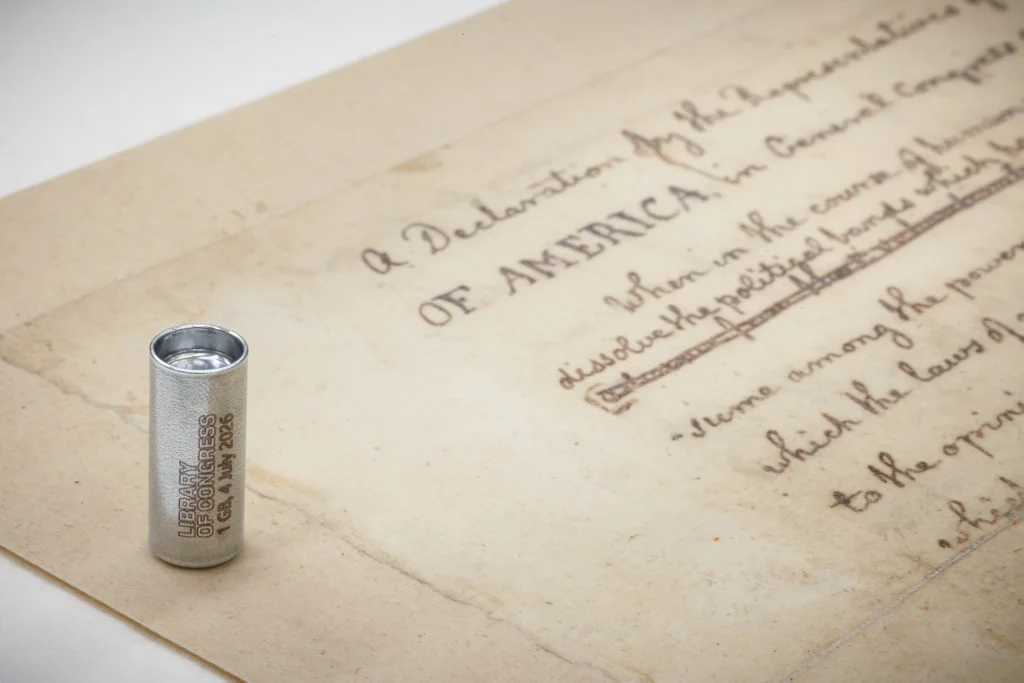
To show off the vial before it’s buried, the Library of Congress hopes to display it next to its draft of the Declaration of Independence this summer, a juxtaposition that shows just how far the U.S. has come since the days of parchment and ink to synthetic DNA.
“It does say a lot about progress,” she says.